

TL;DR:
- Most UK hospitality venues still rely on outdated methods like spreadsheets for staff rotas, which leads to inefficiencies. Modern POS systems enable demand-led scheduling by analyzing real transaction data, improving cost control and legal compliance. Implementing POS-driven workflows helps venues optimize staffing, reduce costs, and ensure regulatory adherence systematically.
Most hospitality venues in the UK run their rotas the same way they did a decade ago: a spreadsheet, a whiteboard, or a manager’s best guess based on last week’s numbers. The result is predictable. You either overstaff quiet Tuesdays and burn through payroll, or you understaff a busy Friday evening and watch your service quality collapse. Modern POS systems change this entirely. By linking staffing decisions directly to real transaction data, venue owners can build rotas that reflect actual demand, control labour costs within industry benchmarks, and stay compliant with working-time legislation, without the guesswork.
Table of Contents
- Why traditional rota planning falls short in UK hospitality
- How POS data revolutionises staff scheduling
- Linking scheduling decisions to labour cost benchmarks
- Compliance essentials: working time and edge-case risks
- Implementing a POS-powered scheduling workflow in your venue
- The uncomfortable truth: why most venues miss the mark on scheduling
- Next steps: unlock smarter staff scheduling with POS
- Frequently asked questions
Key Takeaways
| Point | Details |
|---|---|
| Demand-led scheduling | Using POS data, venues can build rotas based on actual customer flow for maximum efficiency. |
| Labour cost benchmarks | A well-managed rota keeps staff costs within the 28-35% turnover range for UK hospitality venues. |
| Compliance risks | Correct classification and monitoring of working hours are essential for avoiding legal penalties. |
| Digital workflow benefits | POS-supported tools streamline rota updates, shift swaps, and tracking of actual hours worked. |
| Continuous review | Scheduling decisions should be reviewed every four weeks to meet changing demand and compliance needs. |
Why traditional rota planning falls short in UK hospitality
Static rota planning creates a false sense of control. You write the shifts, pin them up, and assume the week will follow the pattern. It rarely does. Demand fluctuates based on weather, local events, school holidays, and dozens of other variables that a fixed template simply cannot account for. When the rota doesn’t flex, your payroll does, and not in a good way.
The most common pitfalls in traditional rota management include:
- Overstaffing during slow periods, which inflates wage costs and drains your budget before the week is out
- Understaffing during peak periods, leading to slower service, frustrated customers, and negative reviews
- Inconsistent application of break rules, which can expose your venue to legal risk
- No audit trail, leaving you unable to defend scheduling decisions if a dispute arises
- Reliance on word-of-mouth shift swaps, which creates gaps and confusion
There is also a widespread misunderstanding around the Working Time Regulations. Many managers assume that if a worker has signed an opt-out agreement for the 48-hour weekly average, that covers all bases. It does not. As working time rules make clear, opt-outs do not remove other obligations such as mandatory rest periods, night-worker limits, or accurate monitoring of hours worked. Misclassifying a worker’s status or failing to track actual time can expose your business to tribunal claims, enforcement action, and reputational damage.
“Getting rota management wrong is not just an operational problem. It is a legal liability. Evidential records are your first line of defence.”
Adopting hospitality staff management strategies that are built around data rather than habit is the first step toward a more resilient and cost-effective operation. Now that we see the limits of traditional approaches, let’s unpack how a POS-driven, demand-led model addresses these gaps.
How POS data revolutionises staff scheduling
A modern POS system records far more than just sales. Every transaction, table turn, cover count, and order placed at the bar is logged with a timestamp. Over a fortnight, those data points form a precise picture of your venue’s demand curve: when customers arrive, how long they stay, how much they spend, and which parts of the day generate the most activity.
Demand-led scheduling for UK pub operators works by mapping actual covers, transactions, and customer counts by day-part, then building rotas directly to match that demand curve, reviewed on a rolling cadence. This is a fundamentally different approach to pencilling in shifts based on what worked last month.
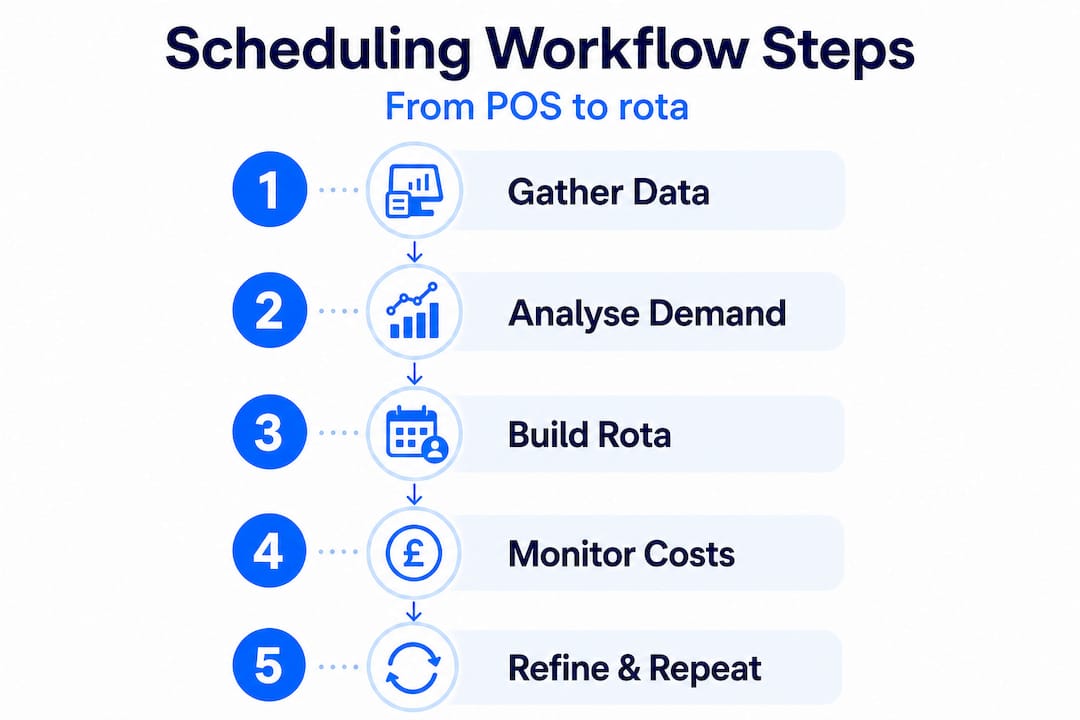
Here is a straightforward four-step process for implementing POS-driven scheduling:
- Collect two to four weeks of POS transaction and cover data, broken into meaningful day-parts (breakfast, lunch, afternoon, evening, late)
- Analyse the data to identify consistent peaks and troughs by day and day-part across the week
- Build your rota to match the demand curve, adding staff where transaction volume is highest and reducing hours where it is consistently quiet
- Review actual versus planned hours every four weeks using POS reports, adjusting future rotas based on what the data tells you
The difference between reactive and proactive scheduling is significant. Consider this comparison:
| Factor | Traditional rota | POS-driven rota |
|---|---|---|
| Basis for scheduling | Manager’s experience | Actual transaction data |
| Flexibility | Fixed, rarely adjusted | Rolling, reviewed regularly |
| Labour cost accuracy | Often over or under budget | Aligned to real demand |
| Compliance tracking | Manual or absent | Integrated with digital records |
| Response to demand shifts | Reactive, after the fact | Proactive, planned in advance |
Pro Tip: Pull your POS data by hour rather than by day when building your first demand-led rota. Hourly granularity reveals patterns that daily averages hide, such as a sharp 90-minute peak between 12:30 and 14:00 that justifies an extra member of floor staff on a rolling shift.
Understanding how to correctly optimise your hospitality operations using POS tools is the foundation of everything else. Venues that use their POS for staff management efficiency consistently outperform those that treat POS as a payment terminal and nothing more. With the tech-driven workflow introduced, let’s examine how it impacts your labour costs and bottom line.
Linking scheduling decisions to labour cost benchmarks
Labour is the single largest controllable cost in any hospitality venue. Unlike rent or rates, it moves every week based on how well you schedule your team. Getting this right has a direct impact on profitability.
UK labour cost benchmarks for pubs in 2026 sit at approximately 28 to 35 per cent of turnover, varying by venue type and scheduling efficiency. This is not a target you hit once and forget. It requires weekly attention and a clear line between what you planned to spend and what you actually spent.
The split between wet-led and food-led venues matters here:
| Venue type | Typical labour cost range | Key driver |
|---|---|---|
| Wet-led pub (bar-focused) | 28 to 31% of turnover | Bar staff scheduling, opening hours |
| Food-led pub or restaurant | 32 to 35% of turnover | Kitchen and front-of-house ratios |
| Casual dining or café | 30 to 34% of turnover | Split-shift management and covers per head |
Understanding which category your venue falls into helps you set a realistic benchmark and identify quickly when your rota is pushing you above it. The costs that accumulate when scheduling is inefficient go beyond basic wages. Unplanned overtime triggers higher employer National Insurance contributions. Excessive hours accelerate staff burnout, increasing turnover and training costs. Poor shift design can also leave you paying pension contributions on hours that generated minimal revenue.
Your POS back office gives you the tools to track actual spend against your planned labour budget in near real-time. When you connect cover counts to scheduled hours, you can calculate your labour cost per cover and compare it week on week. Venues that use their back office POS tools for this kind of analysis often discover that small adjustments, such as shifting one member of staff from a 5pm start to a 6pm start on a Monday, save hundreds of pounds across the month. If you operate a catering operation alongside your venue, catering staff management systems offer additional ways to keep labour aligned with output. Cost controls are only effective when scheduling is also compliant. Let’s clarify the legal nuances that every UK venue needs to know.
Compliance essentials: working time and edge-case risks
Working-time compliance is one of the most underestimated risks in hospitality scheduling. Most venue managers know the broad rules, but edge cases catch them out. Regularly, the same mistakes appear across independent venues and small groups alike.
The most common compliance gaps include:
- Failing to enforce 11-hour rest breaks between shifts, particularly when staff cover back-to-back closes and opens
- Misapplying the 48-hour average, which is calculated over a reference period, not on a week-by-week basis
- Incorrectly processing opt-out agreements, including not updating agreements when a worker changes role or contract
- Insufficient monitoring of night workers, who have a separate eight-hour limit per shift and the right to a free health assessment
- Lack of evidential records, making it impossible to demonstrate compliance in the event of a dispute or inspection
As emphasised in detailed guidance on working time rules, opt-outs do not remove other obligations. A worker who has signed an opt-out can still invoke their right to rest periods, and you are still required to monitor and record their hours accurately. Thinking an opt-out form is a blanket protection is a significant and costly misconception.
A POS system with integrated clock-in and clock-out functionality gives you an automatic record of actual hours worked. This is not just useful for payroll; it is your evidence base if a working-time claim is ever raised. Comparing planned hours on the rota against actual hours recorded by your POS lets you spot patterns before they become problems, such as a shift that consistently runs 45 minutes over due to poor handover planning.

Pro Tip: Run a monthly hours audit using your POS data. Compare scheduled hours against clocked hours for every team member. If the gap is consistently more than five per cent, your rota has a structural problem that needs addressing, not just firefighting week by week.
Working with a staff management system that integrates scheduling with your POS significantly reduces the administrative burden of compliance, while giving you a defensible paper trail at no extra effort. Armed with clarity on compliance and cost control, let’s dive into practical steps for applying POS-driven scheduling in your own venue.
Implementing a POS-powered scheduling workflow in your venue
Knowing that POS-driven scheduling works is one thing. Building it into your weekly routine is another. Here is a practical workflow that connects your POS data to your rota in a structured, repeatable way.
- Extract your POS sales and cover report at the end of each trading week, broken down by day and day-part
- Plot your demand curve for the upcoming equivalent week, accounting for any local events, bank holidays, or seasonal shifts
- Build your rota from the demand curve, assigning the highest number of staff to your peak day-parts and reducing hours during consistently quiet periods
- Apply your compliance filters, checking that no team member breaches rest-hour minimums, their reference-period average, or any night-shift limits
- Publish the rota digitally with enough notice for staff to arrange childcare, transport, or secondary commitments, reducing last-minute call-outs
- Track actuals against plan throughout the week using your POS clock-in data
- Conduct a rolling four-week review, adjusting your demand assumptions and rota templates as seasonal patterns shift
Demand-led methodology consistently points to the same four steps: use POS sales and covers to inform demand by day-part, convert that demand into staffing budgets, enforce compliance constraints, and use system-supported workflows for swaps and hour tracking. The venues that follow this cycle rigorously are the ones that stay within their labour cost benchmark without sacrificing service quality.
Digital shift-swap workflows are a particularly underused feature in most venues. Rather than managing swaps through group chats and informal agreements, a digital process logs every swap, confirms both parties have agreed, and flags any compliance issue before it occurs. Following a clear POS workflow guide helps you set this up correctly from day one. Venues using POS systems designed for pubs find that digitising the scheduling workflow reduces no-shows and last-minute rota chaos within the first month of implementation.
Pro Tip: Build a simple spreadsheet that maps your average covers per day-part against your staffing ratio. Even before your POS-driven rota is fully embedded, this single document will immediately highlight where you are over or under-resourced on a predictable basis.
The uncomfortable truth: why most venues miss the mark on scheduling
Here is what we see repeatedly, and it is worth being direct about it. Most venue owners collect plenty of POS data. They just never use it for scheduling. The reports sit in the back office, reviewed occasionally for sales figures, and ignored when it comes time to write the rota. The rota gets written the same way it always has, and the same problems repeat.
The failure is not technical. It is behavioural. Demand-led scheduling requires a habit change, not just a software change. Managers need to pull the data before they write the rota, not after. Owners need to build a review process that actually happens every four weeks, not just when payroll looks alarming. And teams need to be trained on digital workflows so that shift swaps and notifications become systematic rather than chaotic.
There is also a tendency to treat compliance as a box-ticking exercise rather than a genuine risk management task. Venues that take this attitude are the ones who get caught out by edge-case claims. The irony is that POS systems make compliance far easier to manage. All the data you need is already being captured. You just have to connect it to your scheduling process.
Addressing staff management pitfalls before they become costly is far simpler than fixing them after the damage is done. The venues that master scheduling treat it as a core operational skill, not an administrative chore.
Next steps: unlock smarter staff scheduling with POS
If you have recognised your own venue in any part of this guide, that clarity is the starting point. POS-driven scheduling is not a theoretical concept. It is a practical, proven approach that venues across the UK are already using to control labour costs, improve service consistency, and stay compliant with confidence.
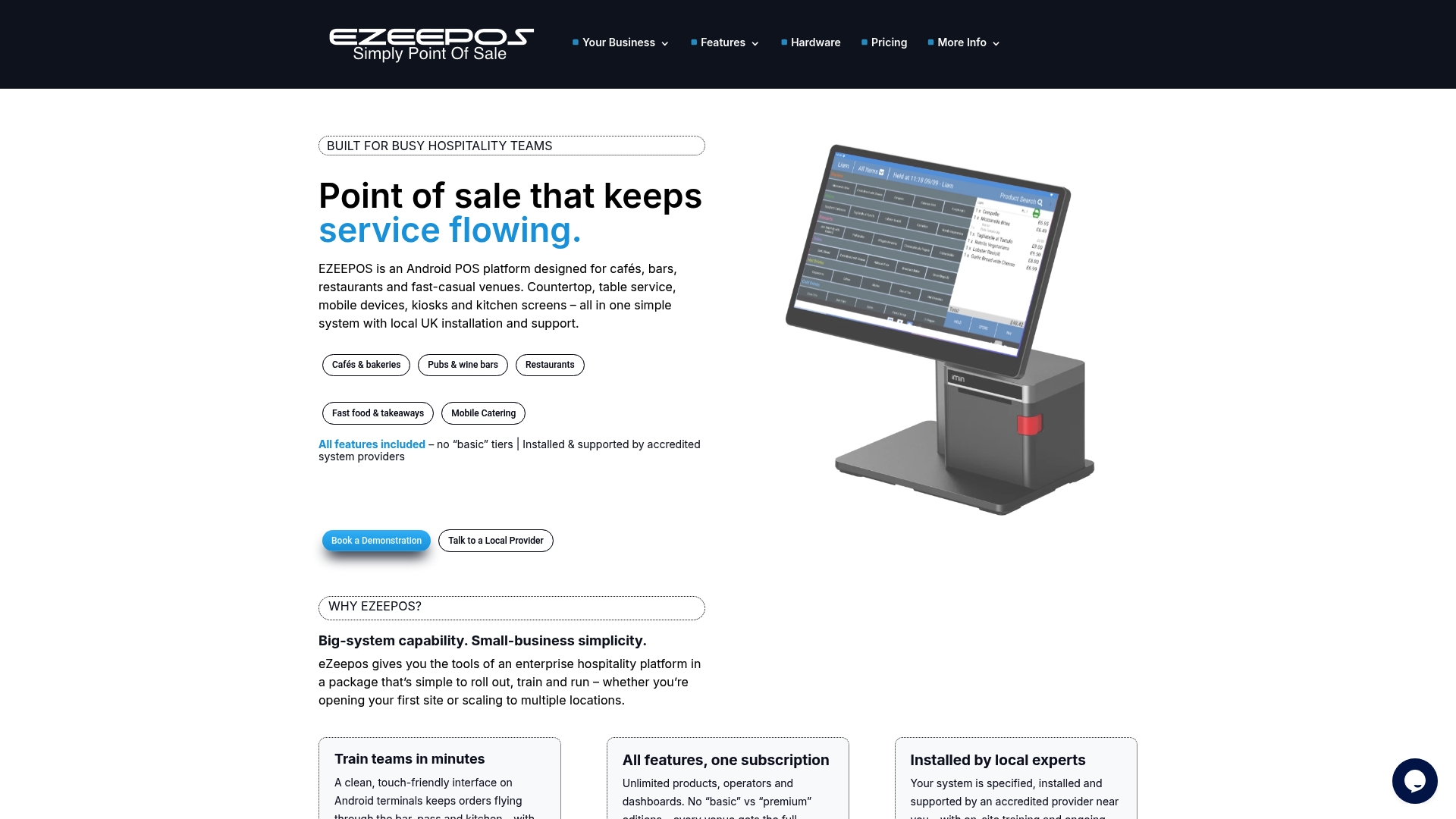
At eZeepos, our POS solutions are built specifically for hospitality venues that need more than a basic till. The platform gives you the data, reporting, and back-office tools to move from guesswork to demand-led scheduling without complexity or steep learning curves. Explore the benefits of a unified POS platform for your operation, or see how POS-driven efficiency is transforming service and profitability in fine dining environments. Speak to one of our UK-based specialists to find out how quickly your venue can make the shift.
Frequently asked questions
What is demand-led scheduling in POS for pubs?
Demand-led scheduling uses POS sales, covers, and transactions to map customer flow by day-part and build rotas that match actual demand, reducing wasted hours and keeping staffing aligned with revenue.
How does POS help with compliance in staff scheduling?
A POS system tracks actual clocked hours and enforces working-time classification, as detailed guidance confirms, helping venues maintain accurate records for rest periods, opt-out obligations, and night-worker limits.
What are typical labour cost benchmarks for UK hospitality venues?
UK hospitality benchmarks for 2026 place labour costs at approximately 28 to 35 per cent of turnover, with the exact figure depending on venue type, service model, and how efficiently rotas are built.
How can digital tools and POS workflows improve rota management?
Digital POS workflows streamline shift swaps, automate staff notifications, and compare planned against actual hours, making rota management more accurate and far less reliant on informal communication.
What is the risk of ignoring working-time edge cases in pub scheduling?
Ignoring edge-case compliance, as working time guidance makes clear, can lead to tribunal claims and enforcement penalties even where opt-out agreements are in place, because opt-outs do not override rest-period or monitoring obligations.
Recent Comments