
TL;DR:
- A modern POS system functions as an operational hub, managing stock, staff, and sales data.
- Choosing the right POS type involves considering offline resilience, support, and total cost of ownership.
- A reliable, well-integrated POS enhances service speed, reduces downtime, and improves profit margins.
Most pub owners think of their POS as a glorified till. It takes payments, prints receipts, and sits on the bar looking purposeful. But that framing costs money every single week. A modern point of sale system is closer to the operational brain of your entire venue, managing stock, staff, sales data, and customer flow simultaneously. Get it right, and you can cut waste, accelerate service, and push gross profit margins into the 25 to 35% range that separates thriving pubs from struggling ones. This guide breaks down exactly how the right POS transforms UK pub operations, from choosing the correct system type to squeezing every penny of value from it.
Table of Contents
- From till to toolkit: how POS systems shape pub operations
- Comparing cloud, hybrid, and traditional POS: choosing what works for your pub
- Improving service speed, reliability, and uptime: why POS resilience matters
- Driving profit and control: POS as the engine behind smart inventory and sales management
- Why most pub POS decisions miss the mark (and what really works)
- Level up your pub with a purpose-built POS solution
- Frequently asked questions
Key Takeaways
| Point | Details |
|---|---|
| POS systems cut downtime | Choosing the right POS can reduce outages by over 60 percent and keep service flowing during busy periods. |
| Hybrid and offline matter | A hybrid POS protects your pub’s turnover when internet connections are unreliable or peak demand spikes happen. |
| Profit and control boost | Modern POS provides live inventory, smarter reporting, and helps you hit profit margins of 25 to 35 percent. |
| Don’t overlook support | Local POS support and real-world speed testing before buying ensures your system stands up to pub challenges. |
From till to toolkit: how POS systems shape pub operations
The pub till has come a long way. Twenty years ago, a cash register recorded a sale and that was the end of its job. Today, a POS system does far more than process transactions. It maps your tables, tracks every ingredient, generates end-of-day reports, manages staff clock-ins, and lets you check last Saturday’s sales from your phone on a Sunday morning.
This shift matters because pubs are operationally complex. You are running a kitchen, a bar, possibly a restaurant area, and a takeaway service, all at once. Without a system that ties all of that together, you are relying on memory, paper, and guesswork. That is a recipe for over-ordering, under-pricing, and slow service.
Modern POS systems typically include:
- Table mapping and order routing to kitchen screens
- Real-time stock control with low-stock alerts
- Sales reporting broken down by item, period, and staff member
- Staff management including permissions and clock-in tracking
- Remote access via cloud back-office dashboards
- Offline capability so you keep trading during internet outages
The cloud element is particularly significant. Cloud POS cuts downtime by 80% compared to legacy systems, and local support reduces outages by a further 60%. That reliability is not a luxury. On a busy Friday night, every minute of downtime is a queue growing at the bar.
“Think of your POS not as a payment tool but as the operational hub that connects your team, your stock, and your sales data into one coherent picture.”
Unified POS platforms bring all of these functions together without requiring separate software subscriptions for each feature. For pub operators, that means less time toggling between systems and more time running the venue.
Comparing cloud, hybrid, and traditional POS: choosing what works for your pub
Not all POS systems are built the same, and choosing the wrong type can leave you exposed at the worst possible moment. The three main categories each have genuine strengths, but they also carry real trade-offs.
| POS type | Strengths | Weaknesses |
|---|---|---|
| Cloud-only | Remote access, automatic updates, scalable | Relies on internet; outages stop trading |
| Hybrid (offline-first) | Works offline, syncs when online, resilient | Slightly higher setup complexity |
| Traditional/local | Fully offline, no internet dependency | Limited reporting, poor integration |
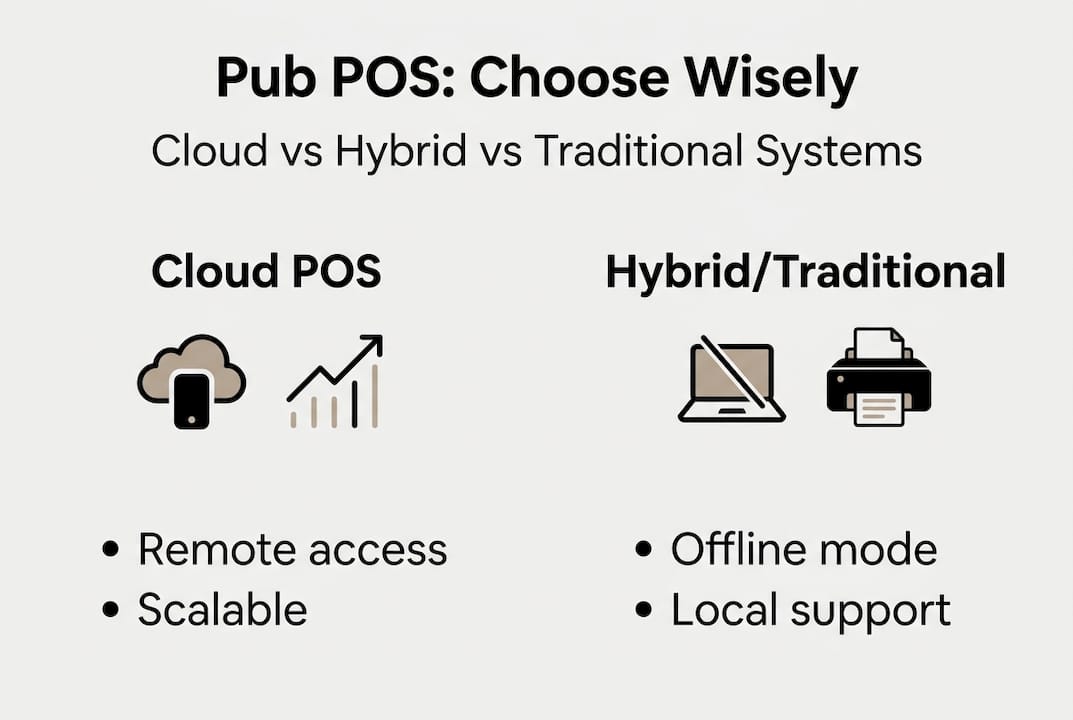
Cloud POS offers remote access and scalability but carries a real risk of downtime if your broadband drops. Traditional tills are reliable offline but lack the reporting and integration that modern pub management demands. The hybrid model sits in the middle and, for most UK pubs, represents the strongest balance.
When evaluating types of pub POS systems, ask three questions before anything else. First, what happens to my system if the internet goes down? Second, how quickly can I get local support if hardware fails? Third, can I access sales data remotely without being physically in the pub?
Pro Tip: Before signing any contract, request a live demonstration of the offline mode. Ask the sales rep to disconnect the internet during the demo and watch what happens. If the system freezes or loses data, walk away.
The cost picture is also worth examining carefully. Cloud subscriptions can appear cheaper upfront but accumulate over time. Traditional systems often require expensive hardware replacements. Hybrid systems with a local support partner tend to offer the most predictable total cost of ownership over a three to five year period. Looking at top pub POS options side by side will help you benchmark what you should expect to pay and what you should refuse to compromise on.
Improving service speed, reliability, and uptime: why POS resilience matters
Speed matters in a pub. A customer waiting three minutes to be served at a busy bar is a customer considering leaving. A POS that processes transactions slowly, crashes mid-shift, or loses orders during peak hours does not just frustrate staff. It directly cuts your takings.
Consider the numbers. An internet outage can cost a busy pub up to £8,000 per day in lost sales. A hybrid or offline-first POS caches data locally, meaning orders keep flowing even when connectivity drops. These systems can handle over 80 orders per hour during an outage, with full synchronisation once the connection is restored.
| Performance metric | Standard POS | Hybrid/offline POS |
|---|---|---|
| Orders per hour during outage | 0 | 80+ |
| Service speed improvement | Baseline | Up to 22% faster |
| Outage frequency reduction | Baseline | Up to 60% fewer |
The service speed increase of 22% that comes with a well-configured hybrid system is not trivial. Over a Saturday night session, that translates to more rounds served, shorter queues, and happier customers who are more likely to stay for another drink.
Before committing to any system, run through this checklist:
- Test transaction speed in a live environment. Anything over two seconds per transaction is too slow for a busy bar.
- Simulate an internet outage and confirm the system continues processing orders without data loss.
- Verify local support availability. A remote helpdesk in a different time zone is no use at 9pm on a Saturday.
The benefits of local POS support cannot be overstated here. A local engineer who can be on-site within hours is worth far more than a cheaper system with no regional backup. And cloud POS efficiency only delivers its full value when paired with that resilience layer.
Driving profit and control: POS as the engine behind smart inventory and sales management
Service speed and uptime keep customers happy. But the real long-term value of a strong POS sits in what it does for your margins. Pubs that use their POS purely for transactions are leaving significant money on the table.
A well-configured system automates stock tracking from the moment a sale is made. Every pint poured, every burger ordered, every portion of chips sent to the kitchen reduces your stock count automatically. When levels drop below a threshold you set, the system flags it. No more emergency orders at premium prices because someone forgot to check the cellar.
The gross profit margin target of 25 to 35% that characterises well-run UK pubs is significantly easier to hit when your POS is doing the heavy lifting on inventory. You can see exactly which products are your top sellers, which are sitting on the shelf, and where wastage is creeping in.
Key POS-driven profit boosters include:
- Automated reorder alerts to prevent stockouts and over-ordering
- Wastage tracking to identify where product is being lost
- Sales mix reports showing which menu items drive the most margin
- Pricing optimisation based on real sales data rather than gut feel
- Promotion management to run happy hour deals without manual overrides
Pro Tip: Integrate your POS with your accounting software and card payment provider from day one. This eliminates duplicate data entry, reduces human error, and gives you a single accurate picture of your finances without the end-of-week reconciliation headache.
The POS integration advantages here are substantial. When your till, your stock system, and your accounts all talk to each other, you stop managing data and start managing your business. Pair that with strong back office POS tools and you have a genuine management platform, not just a payment terminal.
Why most pub POS decisions miss the mark (and what really works)
Here is an uncomfortable truth: most pub operators choose their POS system based on price and a feature list. They compare monthly subscription costs, count the number of integrations on offer, and pick whichever demo looked the most polished. Then, six months later, they are on hold with a remote support line at 8pm on a Friday while the queue at the bar grows.
The features that actually determine whether a POS works in a pub environment are rarely the ones highlighted in a sales brochure. Transaction speed under two seconds, genuine offline resilience, and local support availability are the factors that separate a system that performs under pressure from one that collapses exactly when you need it most.
What 2026 pub operators consistently report wishing they had checked before purchase is not feature depth. It is support response time and offline behaviour. A system with fewer bells and whistles but a local engineer and a sub-two-second transaction speed will outperform a feature-rich cloud platform with a 48-hour support ticket queue every single time.
When you review best pub POS systems, reframe your evaluation criteria. Ask for references from similar-sized pubs. Ask what happens during an outage. Ask how long a support call takes to resolve. The answers will tell you far more than any feature comparison table.
Level up your pub with a purpose-built POS solution
If this guide has shifted how you think about your POS, the next step is finding a system built specifically for the realities of UK pub and hospitality environments.
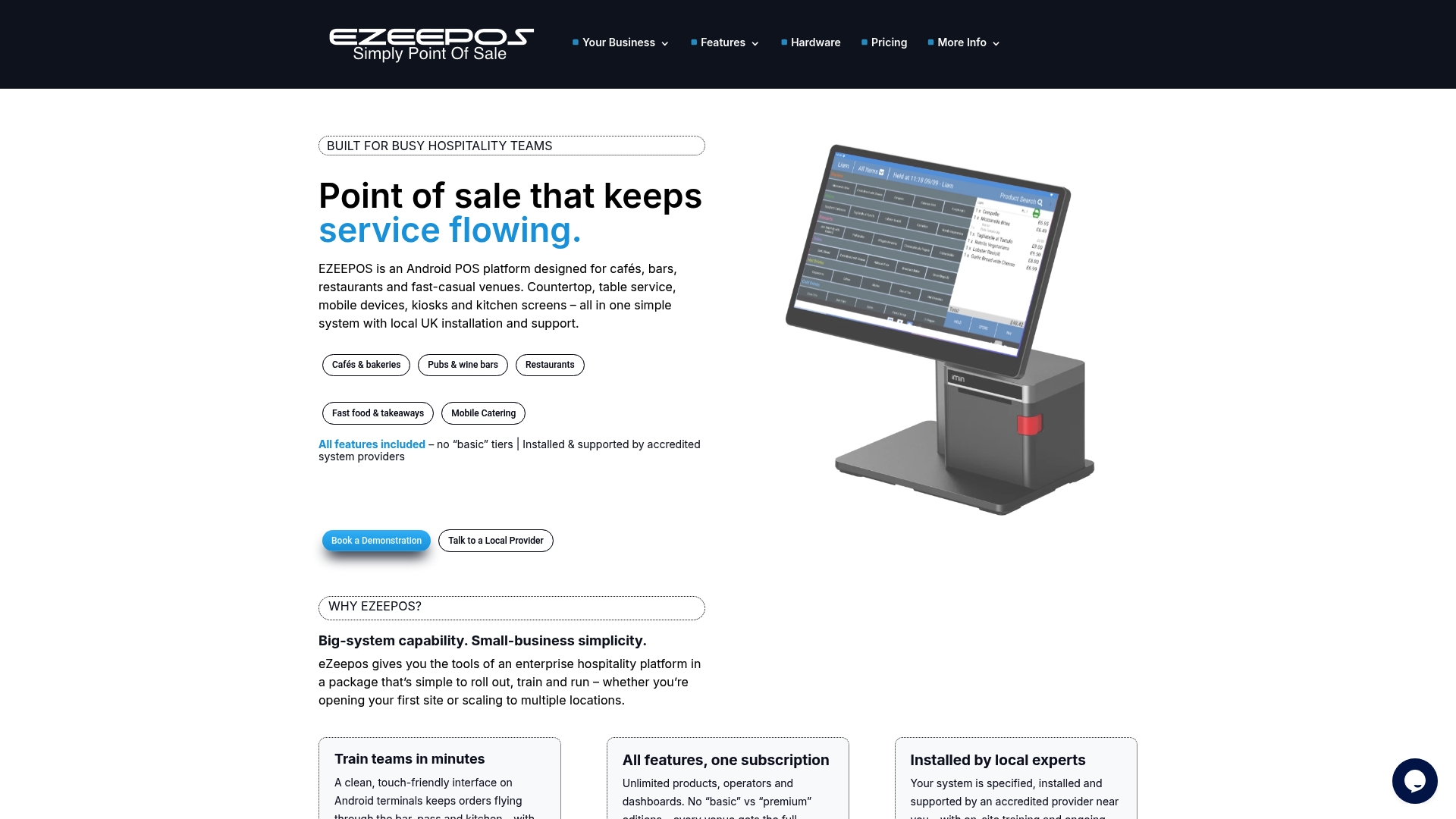
At eZeepos, we build hospitality POS solutions designed around the pressures your venue actually faces: peak-hour rushes, connectivity drops, fast staff turnover, and the need for real-time margin visibility. From countertop terminals to kitchen order display systems, every element is designed to work together without complexity. Our accredited UK installation partners provide local support, not a remote ticket queue. Explore what eZeepos can do for your pub and book a tailored demo to see it in action.
Frequently asked questions
How does a pub POS system improve profit margins?
A modern POS tracks every sale and automates stock management, reducing wastage and giving you the data to hit gross profit margins of 25 to 35% more consistently.
What is the biggest risk of relying only on cloud-based POS in a pub?
Cloud-only systems stop functioning during internet outages, and with outages costing up to £8,000 per day, that is a risk most pubs cannot afford to take.
How do I test if a POS system is right for my pub?
Request a live demo that includes disconnecting the internet, then check transaction speed under two seconds and confirm local support is available before you commit.
Can modern POS solutions automate pub inventory ordering?
Yes. Most current systems automate stock tracking and reorder alerts based on real-time sales data, significantly reducing manual stock management effort.
Recent Comments