
TL;DR:
- UK hospitality profits are very slim due to operational inefficiencies rather than demand.
- Conducting an honest operational audit and setting SMART goals are crucial before POS implementation.
- Continuous staff engagement, data analysis, and process controls are key to sustained operational improvement.
UK hospitality runs on razor-thin margins. Restaurant profit margins typically sit between 3% and 10%, and even well-run venues lose money daily through slow service, inaccurate orders, and manual processes that should have been automated years ago. If you manage a café, bar, or restaurant, the pressure is relentless: rising food costs, staff churn, and increasingly demanding customers all pulling in opposite directions. The good news is that a correctly optimised point of sale (POS) system is one of the most direct levers you can pull to close the gap between operational chaos and consistent profitability. This guide walks you through exactly how to do it.
Table of Contents
- Understanding core operational challenges in UK hospitality
- Preparing for optimisation: auditing operations and setting goals
- Implementing POS technology for streamlined service
- Verifying impact: measuring results and continuous improvement
- What most guides miss about hospitality optimisation
- Optimise your operations with proven POS solutions
- Frequently asked questions
Key Takeaways
| Point | Details |
|---|---|
| Benchmark before optimising | Always establish your operational baseline with hard KPIs before starting optimisation. |
| Combine tech with training | Pair new POS analytics with clear SOPs and staff training for actual results. |
| Low-capex POS is accessible | Unified cloud POS systems are now affordable and practical, even for small venues. |
| Measure what matters | Focus monitoring on GOPPAR, RevPAR, CPOR, and guest experience metrics for real improvement. |
| Continuous feedback is key | Ongoing routine checks and feedback ensure sustainable operational gains. |
Understanding core operational challenges in UK hospitality
Having highlighted optimisation’s importance, let’s examine some hard figures and core UK industry challenges.
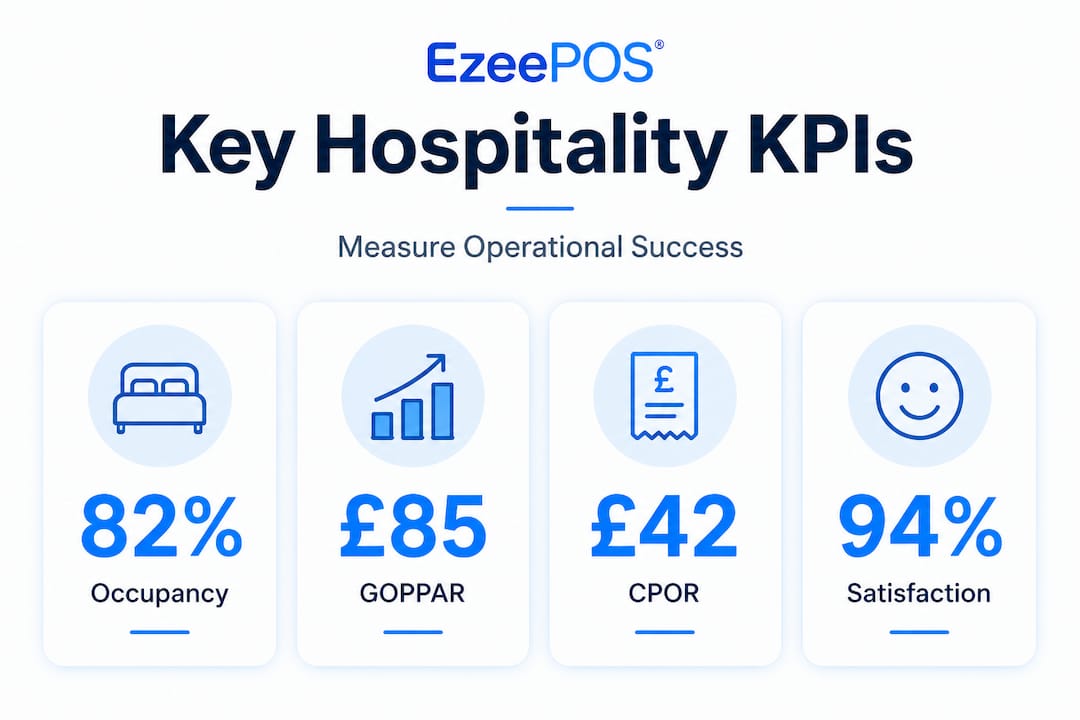
UK hospitality is not struggling for lack of demand. London upscale hotels reported 82% occupancy rates, and Gross Operating Profit Per Available Room (GOPPAR) benchmarks hover around 30% for well-managed properties. Yet profits remain stubbornly low across the sector. The reason is almost always operational, not commercial.
| Metric | UK benchmark | What it reveals |
|---|---|---|
| Restaurant profit margin | 3% to 10% | Very little room for operational waste |
| London upscale occupancy | 82% | High demand, but margin pressure persists |
| GOPPAR | ~30% | Strong revenue can still produce poor net return |
| Average staff turnover | 30% or above | Constant retraining costs erode profitability |
The daily reality for most venue managers looks like this:
- Orders miskeyed at the till, leading to kitchen errors and comped meals
- Staff spending 20 minutes at end of shift reconciling cash instead of cleaning down
- Promotions applied inconsistently because there is no automated rule set
- Managers pulling sales reports manually rather than reading live dashboards
- Inventory counted by hand with no real-time visibility into shrinkage
These bottlenecks are not caused by lazy staff. They are caused by systems that were never designed to handle the pace and complexity of modern hospitality service. Understanding why POS matters for UK venues starts here: not with features and specs, but with the real operational pain they are designed to solve.
“Employee turnover drains profits directly through recruitment, induction, and lost productivity costs. Monitoring your Cost per Occupied Room (CPOR) is critical for spotting where rising costs are eroding your margins before they become a crisis.”
Manual processes also create compliance blind spots. When allergen information is managed via handwritten notes or staff memory, the risk of a serious incident is never far away. Hospitality compliance automation is increasingly essential in a regulatory environment where errors carry both financial and reputational consequences.
Preparing for optimisation: auditing operations and setting goals
To tackle inefficiency, it is essential to know where you stand before you spend a penny on new technology.
Many venue managers make the mistake of purchasing new POS hardware and hoping the improvement will follow automatically. It rarely does. The venues that achieve lasting operational gains begin with an honest audit of their current processes, identifying precisely where time, money, and quality are being lost.
A practical operational audit covers the following areas in sequence:
- Map your current service flow from customer arrival to payment, noting every handoff point where errors or delays occur
- Review your end-of-day reconciliation to understand how long it takes and how often figures do not match
- Analyse your most common order errors by speaking directly to kitchen staff about what comes back or gets queried
- Assess your current reporting capability by listing every question you cannot currently answer without manually pulling data
- Interview your front-of-house team about which parts of their workflow feel unnecessarily complicated or slow
Once you have mapped the current state, set goals using the SMART framework. Specific, Measurable, Achievable, Relevant, and Time-bound goals give your optimisation project a clear finish line. For example: “Reduce average order-to-kitchen time from 4 minutes to 90 seconds within 60 days of POS deployment” is a SMART goal. “Improve service” is not.
| Vague goal | SMART equivalent |
|---|---|
| Reduce waste | Cut food waste cost by 15% within 90 days using live inventory data |
| Speed up service | Reduce table-to-order time to under 2 minutes by end of Q3 |
| Improve reporting | Produce daily revenue summaries automatically by 9am each morning |
| Better staff management | Reduce overtime costs by 10% through shift scheduling integration |
The most important insight from this preparation phase comes from mastering operational optimisation: data alone is noise without accompanying controls and insight. Pairing your POS analytics with written Standard Operating Procedures (SOPs), regular management audits, and structured staff training is what separates venues that improve from those that simply collect more data.
Understanding what defines a hospitality POS and how it fits your service style is a useful grounding exercise before you start evaluating specific systems.
Pro Tip: Resist the urge to fix everything at once. Choose one or two areas with the highest operational impact, such as order accuracy and stock visibility, and focus your first 60 days entirely on those. You will build confidence, see measurable results, and create momentum for broader change.
Implementing POS technology for streamlined service
Once goals are set and pain points mapped, it is time to implement practical solutions.
Choosing and deploying the right POS system is where preparation pays off. Venues that have completed an honest audit know exactly what they need their technology to do. Those that skip straight to purchasing often find themselves with capable hardware that is configured for the wrong workflows.
Here is a practical step-by-step approach to implementation:
- Define your non-negotiables based on your audit findings. If live inventory tracking is essential, it must be a core feature, not a paid add-on
- Evaluate cloud-based systems specifically, since low-capex unified cloud POS solutions have dramatically lowered the capital barrier for smaller and medium-sized venues
- Pilot the system in one area of your venue before full rollout. A single till point or one section of the dining room is enough to identify configuration issues before they affect your whole operation
- Configure promotions, allergen flags, and modifier rules before go-live, not after. Post-launch configuration creates confusion during busy service
- Deliver structured staff training before the system goes live, not on the day. Aim for at least two practice sessions per team member
- Set a hard go-live date and communicate it to the whole team. Ambiguity around launch timing undermines staff confidence in the new system
- Assign a system champion from within your existing team. This person owns the day-to-day troubleshooting and becomes the internal expert others turn to
The real benefits of a POS system for a busy UK venue include real-time sales data, automated stock deductions, integrated kitchen display routing, and the ability to manage multiple service modes from a single back office. These are not luxury features. For a venue turning 200 covers a day, they are operational necessities.
One critical edge case that catches many managers off-guard is seasonality. Adaptive POS forecasting for seasonal demand is not optional if your venue sees significant swings in covers between summer and winter. Configuring your system to handle variable staffing levels, promotional pricing, and adjusted stock reorder points for different trading periods is a step that most generic implementation guides overlook entirely.
Pro Tip: Never allow a vendor to go live on a Saturday evening. Schedule your system launch for a quieter mid-week service so your team can find their feet without the pressure of a full house. One quiet shift is worth three days of fire-fighting during peak hours.
Understanding what works in practice, rather than just in vendor presentations, is explored in detail through real examples of POS for restaurant success. The difference between a system that improves your venue and one that adds complexity often comes down to configuration quality and the depth of training provided at launch.
For venues using property management SaaS alongside their POS, integration between systems is a priority. Disconnected platforms that require manual data transfer between them quickly become a source of errors and frustration.
Verifying impact: measuring results and continuous improvement
After implementing new systems, the next step is ensuring they are really delivering the benefits you expect.
Deploying a POS system is not the end of the project. It is the point at which the real work of measuring, adjusting, and improving begins. Many venues declare success after go-live and never look at performance data again until something goes wrong. That approach wastes the majority of the value the system can deliver.
The metrics that matter most for UK hospitality operations are:
| KPI | What it measures | Review frequency |
|---|---|---|
| GOPPAR | Gross profit per available unit | Monthly |
| RevPAR | Revenue per available room or cover | Weekly |
| CPOR | Cost per occupied room or service | Monthly |
| Order accuracy rate | Percentage of orders fulfilled without error | Weekly |
| Customer satisfaction score | Direct feedback from guests | After every service period |
| Average transaction value | Revenue per customer interaction | Daily |
Build simple routines into your management schedule rather than waiting for problems to surface:
- Daily: Review the previous day’s transaction summary, flag any voids or discounts that were applied manually
- Weekly: Compare revenue per cover against the same week in the prior month, check stock variance against POS deductions
- Monthly: Review RevPAR and CPOR trends side by side to understand whether improvements in revenue are actually flowing through to profit
Customer feedback is often the earliest warning signal that something has gone wrong operationally. A dip in satisfaction scores often precedes a drop in covers by two to three weeks. Catching it early gives you time to investigate and correct before it affects revenue.
For venues offering catering and mobile services, tracking performance across multiple locations or service points adds complexity but also reveals where your strongest and weakest performing operations sit. That comparison is enormously useful for directing management attention.
Pro Tip: Set a monthly benchmarking review in your calendar on the same date every month, even if it is only 45 minutes. Month-on-month comparison is far more revealing than looking at totals in isolation, and it gives you early detection of ROI erosion before it becomes a serious problem.
What most guides miss about hospitality optimisation
Here is the uncomfortable truth that most technology vendors will not tell you: a POS system will not fix a broken operation on its own. It will simply give you faster, more detailed visibility of the problems you already have.
The venues that consistently achieve strong operational results are not necessarily the ones with the most sophisticated technology. They are the ones where management takes the data seriously, builds processes around it, and invests continuously in staff capability. POS analytics alone are noise without active controls, regular audits, and structured ongoing training for every team member.
Staff engagement is the variable that most guides undervalue. A well-configured POS system operated by a disengaged team will underperform a simpler system used by a team that understands why it matters. Investing in regular briefings, performance feedback, and genuine recognition of improvement makes your technology investment compound over time.
There is also a cultural dimension that is rarely discussed. Venues where managers treat operational data as a tool for learning rather than a mechanism for blame create teams that surface problems early. When staff know that a flagged error leads to a process review rather than a reprimand, they stop hiding problems and start reporting them. That cultural shift is worth more than any feature on a product spec sheet.
Thinking about upgrading your POS system as a one-time project rather than an ongoing capability is the single most common mistake we see. The venues that win long-term treat their POS as a living system: regularly reviewed, regularly refined, and continuously aligned with how the business is evolving.
Optimise your operations with proven POS solutions
If this guide has clarified where your operation has room to improve, the next step is finding a POS solution that is built for the specific realities of UK hospitality rather than adapted from a generic retail platform.
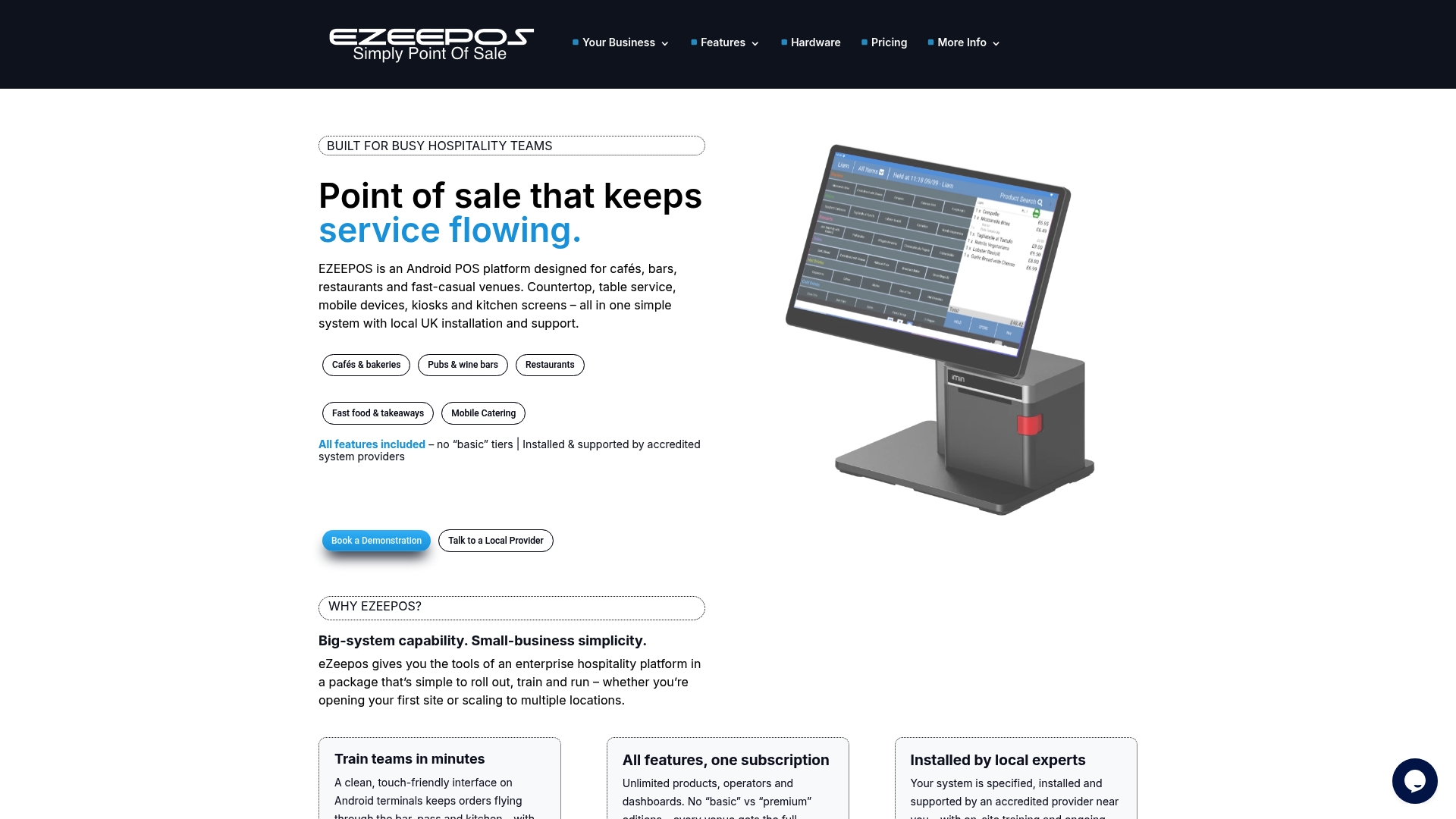
At Ezeepos, we work with cafés, restaurants, bars, and mobile catering operations across the UK, providing Android-based POS systems that cover everything from table ordering to self-service kiosks and kitchen display screens. Our systems are installed locally by accredited providers, trained into your team properly from day one, and supported by real people rather than automated helpdesks. Explore our hospitality POS essentials to understand the foundation, see how our platform drives restaurant POS systems in practice, or discover our tailored solutions for POS for cafés and fast-casual venues. Full features, no tiered pricing, genuine local support.
Frequently asked questions
What are the key KPIs for measuring hospitality operation success?
Core KPIs include GOPPAR, RevPAR, CPOR, and customer satisfaction scores. GOPPAR, RevPAR, and CPOR together give you a balanced view of both revenue performance and cost efficiency across your venue.
How do I ensure staff adopt a new POS system smoothly?
Invest in structured training before go-live and assign an internal system champion to own ongoing support. Over-reliance on tech without training is one of the most common causes of failed POS deployments in UK hospitality venues.
What’s the biggest mistake UK venues make when optimising operations?
Relying solely on POS data without supporting process controls or staff engagement often leads to missed improvements. Data without SOPs and audits is simply expensive noise that does not translate into meaningful operational change.
Can small venues afford to upgrade to cloud POS solutions?
Yes. Low-capex cloud POS platforms have made enterprise-level functionality accessible to smaller venues with flexible scaling options that grow alongside your business.
Are there seasonal considerations for hospitality operation optimisation?
Absolutely. Adaptive POS forecasting for fluctuating seasonal demand is essential for managing variable staffing levels, stock reorder points, and promotional pricing across different trading periods.
Recommended
- Why Upgrade Your POS System: Transforming UK Hospitality
- How the back office boosts POS efficiency in UK hospitality
- Role of POS in Catering: Streamlining UK Hospitality
- Counter Service POS – Improving UK Hospitality Speed
- Qué es una carta digital de restaurante y sus ventajas 2026 – Urban Burger & Bar
Recent Comments