
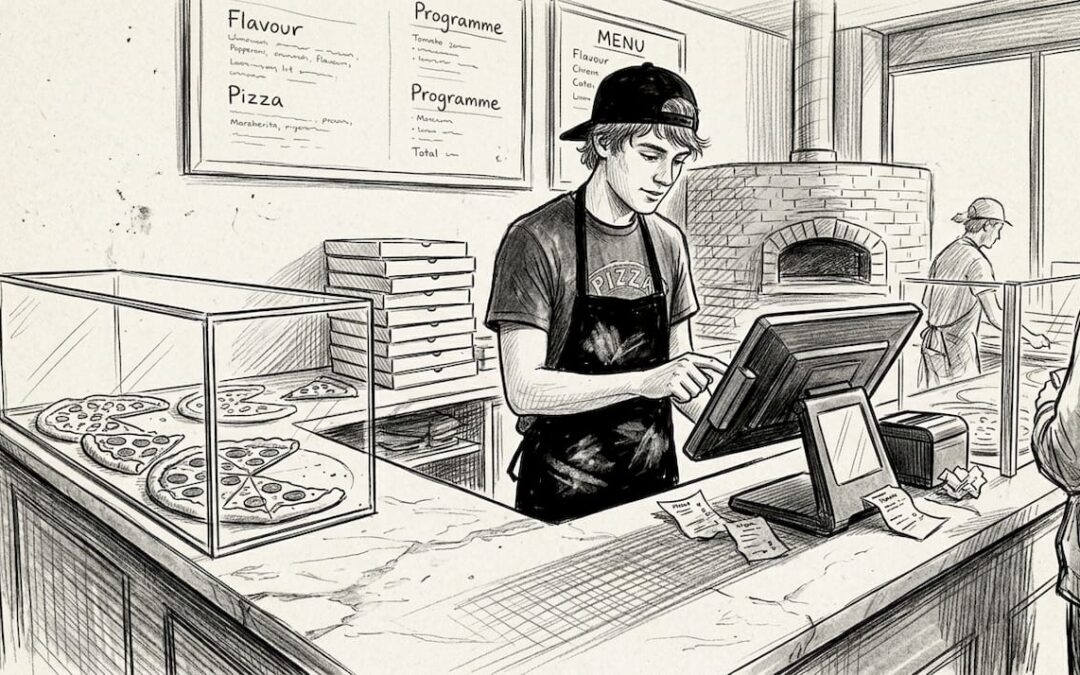
Many pizza shop owners still view POS systems as glorified cash registers, tools that simply process payments and print receipts. This misconception overlooks the transformative role modern POS technology plays in managing complex orders, coordinating kitchen operations, controlling inventory, and elevating customer service. For pizza shops juggling customisations, delivery channels, and high-volume service periods, a robust POS system isn’t just helpful, it’s essential. This guide clarifies how POS solutions specifically enhance pizza shop efficiency, reduce errors, and drive profitability in the competitive UK hospitality market.
Table of Contents
- Why Pos Systems Matter To Pizza Shops
- Core Functions Of Pos In Pizza Shops
- Comparing Types Of Pos Systems For Pizza Shops
- Maximising Your Pizza Shop Success With Pos Technology
- Explore Ezeepos Point Of Sale Solutions For Pizza Shops
- Frequently Asked Questions
Key takeaways
| Point | Details |
|---|---|
| Order accuracy | POS systems capture complex pizza customisations precisely, reducing kitchen errors and customer complaints |
| Speed and efficiency | Integrated kitchen screens and order routing accelerate service during peak periods, improving table turnover |
| Inventory control | Real-time stock tracking prevents ingredient shortages and reduces wastage through automated alerts |
| Customer experience | Seamless integration with delivery platforms and loyalty programmes enhances satisfaction and repeat business |
| Data-driven decisions | Sales analytics reveal bestselling items and underperformers, enabling smarter menu optimisation |
Why POS systems matter to pizza shops
Pizza shops face unique operational challenges that standard retail systems simply can’t handle. Every order involves multiple variables: crust type, sauce selection, cheese quantity, toppings, cooking preferences, and special dietary requirements. When you’re managing simultaneous in-store customers, phone orders, and online delivery requests during Friday evening rush, manual processes crumble under pressure. Errors multiply, tickets get lost, and kitchen staff struggle to prioritise orders correctly.
POS systems enhance order accuracy and speed, critical for pizza shops with complex customisations. Modern solutions capture every detail digitally, routing orders directly to kitchen display screens with colour-coded priority indicators. Staff input customisations through intuitive touchscreen interfaces, eliminating handwriting interpretation issues. The system automatically calculates pricing adjustments for extra toppings or size upgrades, ensuring billing accuracy whilst freeing counter staff to focus on customer interaction rather than mental arithmetic.
Beyond order entry, POS technology orchestrates your entire service ecosystem. It synchronises table service, counter pickup, and delivery operations through a unified platform. When online orders flow through integrated delivery portals, they appear alongside in-house orders on kitchen screens, maintaining a single queue that staff can manage efficiently. This integration prevents the chaos of juggling separate tablets, paper tickets, and phone scribbles.
Pro Tip: Evaluate your POS system’s ability to connect online delivery portals to pos seamlessly. Direct integration eliminates manual order re-entry, cutting errors and saving precious minutes during peak service.
The operational impact extends to staff training and consistency. New team members learn standardised processes through the POS interface, reducing training time from weeks to days. Experienced staff work faster because the system guides them through order workflows, prompting for required selections and flagging potential mistakes before orders reach the kitchen.
“A well-implemented POS system transforms chaotic service periods into orchestrated operations, where every order flows smoothly from customer to kitchen to delivery.”
Consider these immediate benefits:
- Reduced order errors by up to 70% through digital capture and kitchen screen routing
- Faster service times during peak periods, improving customer satisfaction scores
- Simplified staff training with intuitive interfaces and built-in prompts
- Unified order management across dine-in, takeaway, and delivery channels
Core functions of POS in pizza shops
Understanding what your POS system actually does helps you leverage its full potential. At its foundation, the system manages order taking with specialised features for pizza customisation. Staff navigate visual menu layouts, tapping through crust options, sauce varieties, and topping selections. The interface displays real-time pricing updates as customers build their perfect pizza, eliminating surprise charges at checkout. Modifier buttons handle special requests like extra cheese, light sauce, or well-done cooking, ensuring kitchen staff receive precise instructions.
Kitchen coordination represents perhaps the most valuable POS function. Orders transmit instantly to kitchen order screens uk positioned at prep stations and ovens. Each screen displays colour-coded tickets based on order type and urgency. Delivery orders appear in red, dine-in orders in blue, and pickup orders in green. Estimated preparation times countdown on screen, helping kitchen staff prioritise workflow during busy periods. When a pizza enters the oven, staff tap the screen to update order status, automatically notifying front-of-house team members that customer pickup approaches.
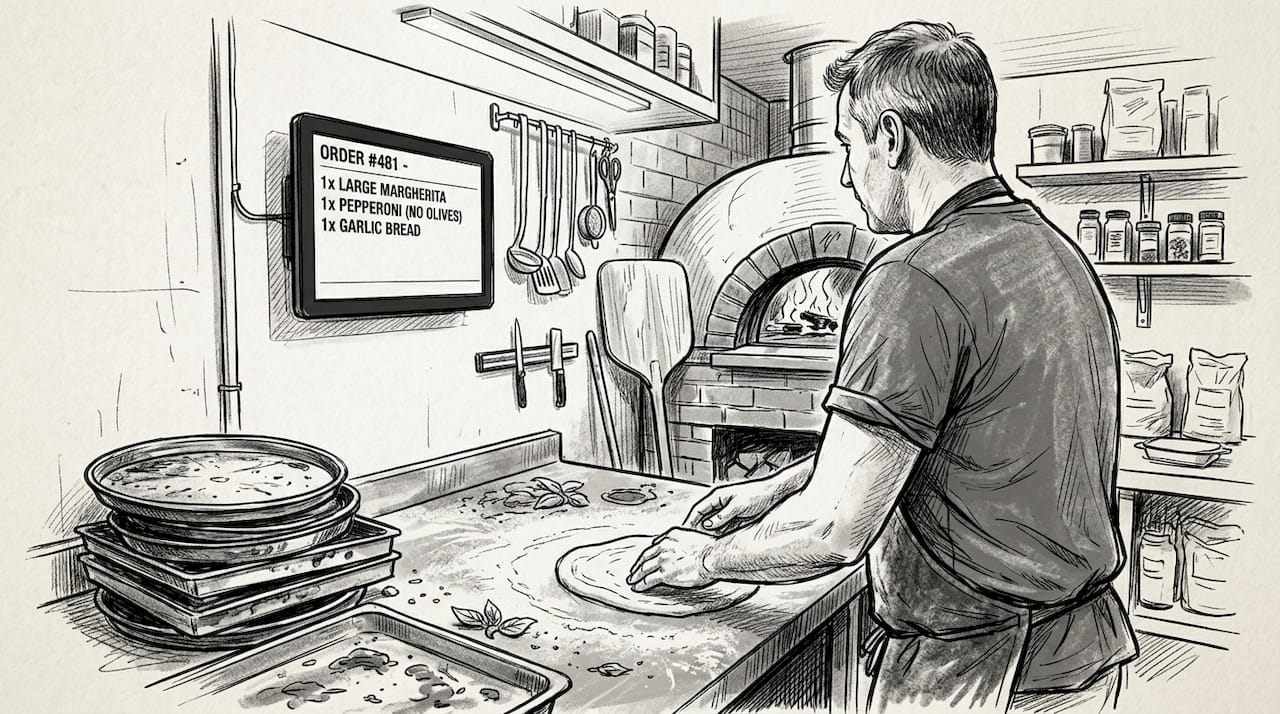
Inventory and stock management operate behind the scenes but deliver substantial cost savings. Modern POS solutions offer comprehensive back-office cloud technology for stock and sales management. Every ingredient used in pizza preparation links to inventory records. When staff process a large pepperoni order, the system automatically deducts appropriate quantities from stock levels. Low inventory triggers generate alerts before you run out during service, prompting timely reordering. This real-time tracking prevents both stockouts that disappoint customers and overstocking that leads to spoilage.
Pro Tip: Leverage cloud pos benefits uk hospitality to monitor inventory levels remotely. Check stock status from your phone whilst meeting suppliers, making purchasing decisions based on actual usage data rather than guesswork.
Sales reporting and analytics transform raw transaction data into actionable insights. Your POS generates detailed reports showing:
- Bestselling pizzas by day, week, or month, revealing customer preferences
- Peak service periods with transaction volume breakdowns, informing staffing decisions
- Average order values and upsell success rates, measuring promotional effectiveness
- Ingredient usage patterns, identifying waste reduction opportunities
- Staff performance metrics including average service times and sales per shift
These analytics enable menu optimisation. If Hawaiian pizza consistently underperforms whilst BBQ chicken dominates sales, you can adjust menu positioning, pricing, or promotional focus accordingly. Seasonal trends become visible, helping you plan special offers around customer demand patterns rather than hunches.
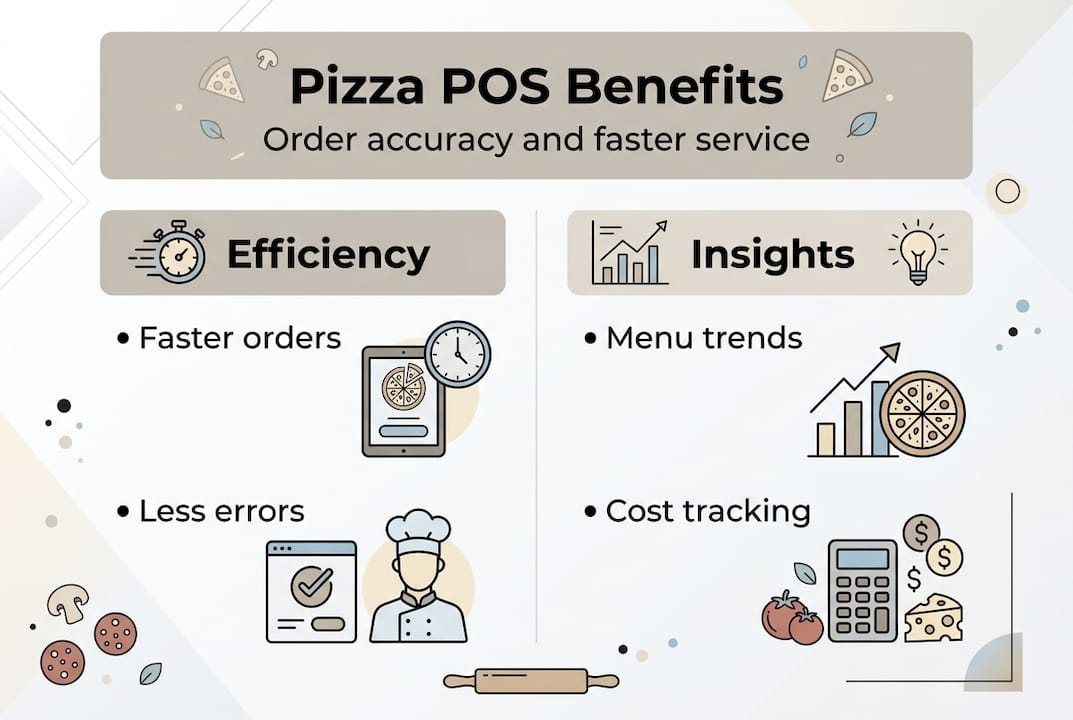
| Function | Benefit | Impact |
|---|---|---|
| Order customisation | Precise capture of complex modifications | 70% fewer kitchen errors |
| Kitchen integration | Real-time order routing and status updates | 30% faster service times |
| Inventory tracking | Automated stock deductions and alerts | 25% reduction in wastage |
| Sales analytics | Data-driven menu and staffing decisions | 15% increase in profitability |
Comparing types of POS systems for pizza shops
Selecting the right POS system requires understanding the fundamental differences between available options. Traditional terminal-based systems use dedicated hardware installed at fixed locations. These robust countertop units handle high transaction volumes reliably but lack flexibility. If you need to take orders tableside or at outdoor events, traditional terminals can’t accommodate mobile service. Updates require technician visits, and system failures mean complete service disruption until repairs complete.
Cloud-based POS systems operate through internet connectivity, storing data on remote servers rather than local hardware. This architecture delivers significant advantages for multi-location operators or shops requiring remote management. You access sales reports, update menu pricing, and monitor inventory from any device with internet access. Software updates deploy automatically overnight, ensuring you always run current versions without scheduling downtime. Different types of POS systems vary in hardware reliance, mobility, and cloud capabilities.
Mobile POS solutions use tablets or smartphones as order-taking devices, offering maximum flexibility. Staff carry tablets to tables, processing orders and payments without returning to fixed terminals. For pizza shops with outdoor seating or catering operations, mobile POS enables service anywhere. However, these systems depend entirely on wireless connectivity. Network interruptions halt operations, and smaller screens can slow order entry compared to full-size terminals.
Traditional terminal-based systems:
- Robust hardware designed for high-volume environments
- No dependency on internet connectivity for basic operations
- Higher upfront costs for specialised equipment
- Limited flexibility for mobile or remote management
- Manual update processes requiring technician visits
Cloud-based POS systems:
- Remote access to reports and management functions
- Automatic software updates and feature additions
- Scalable across multiple locations with centralised control
- Requires reliable internet connectivity for operation
- Lower upfront costs with subscription pricing models
Mobile POS solutions:
- Maximum flexibility for tableside and event service
- Lower hardware costs using consumer tablets
- Seamless integration with payment processing
- Screen size limitations for complex order entry
- Complete dependency on wireless network reliability
| System Type | Best For | Typical Cost | Key Limitation |
|---|---|---|---|
| Traditional terminal | High-volume counter service | £2,000-£5,000 upfront | Fixed location only |
| Cloud-based | Multi-location operations | £50-£150 monthly | Internet dependency |
| Mobile tablet | Tableside and catering | £500-£1,500 upfront | Network reliability |
Your choice depends on operational priorities. High-volume pizza shops with primarily counter service benefit from traditional terminals’ speed and reliability. Growing businesses planning multiple locations need cloud-based systems’ centralised management. Restaurants emphasising table service or catering require mobile solutions’ flexibility. Many successful operators combine approaches, using terminals for counter service and tablets for table orders, creating hybrid systems that leverage each technology’s strengths.
Scalability considerations extend beyond current needs. Evaluate whether your chosen system accommodates future growth. Can you add locations without replacing core infrastructure? Does the vendor support integration with emerging delivery platforms? Will the system handle increased transaction volumes as your business expands? Answering these questions prevents costly system replacements down the road.
Maximising your pizza shop success with POS technology
Owning sophisticated POS technology means nothing if your team can’t use it effectively. Staff training represents your first success factor. Dedicate proper time to comprehensive onboarding, ensuring every team member understands not just button-pushing but the reasoning behind workflows. Explain how accurate order entry prevents kitchen errors, how modifier selections affect pricing, and why timely order status updates keep service flowing smoothly. When staff comprehend the system’s role in operational success, they engage more thoughtfully with the technology.
Create training materials that staff can reference during quiet periods. Screen-capture videos showing common order scenarios, printed quick-reference guides for modifier combinations, and troubleshooting flowcharts for typical issues all reinforce initial training. Schedule refresher sessions quarterly, introducing new features and addressing recurring mistakes. The investment in thorough training pays dividends through faster service, fewer errors, and reduced staff frustration.
Loyalty programmes and promotional features built into modern POS systems drive repeat business when used strategically. Configure your system to track customer purchase history, automatically applying rewards after specified visit counts or spending thresholds. Launch targeted promotions during slow periods, using POS data to identify times needing traffic boosts. Tuesday lunch struggling? Create a “Two for Tuesday” deal that the POS automatically applies, tracking redemption rates to measure effectiveness.
Pro Tip: Regularly review POS reports to identify menu bestsellers and underperformers. Use this data to adjust ingredient ordering, menu positioning, and promotional focus, ensuring you invest resources where they generate maximum return.
Integration with delivery and online ordering platforms transforms your POS from an internal tool into a customer-facing service hub. Upgrading POS systems significantly boosts operational efficiency and customer satisfaction in UK hospitality venues. When online orders flow directly into your POS, appearing on kitchen screens alongside in-house orders, you eliminate the chaos of managing separate systems. Customers receive accurate estimated times based on actual kitchen capacity rather than arbitrary promises. Delivery drivers access real-time order status, arriving precisely when food reaches optimal freshness.
Consider these practical implementation strategies:
- Schedule weekly report reviews with management team, discussing trends and opportunities
- Set up automated inventory alerts at 20% remaining stock, preventing last-minute shortages
- Configure kitchen screen layouts to match your prep workflow, grouping related orders
- Enable customer-facing displays showing order totals in real-time, building trust
- Integrate payment processing for seamless transactions without separate terminals
The most successful pizza shops treat their POS as a strategic asset rather than a necessary expense. They leverage reporting to make data-driven decisions about menu changes, staffing levels, and promotional timing. They train staff thoroughly and update training as the system evolves. They integrate every possible service channel through the POS, creating unified operations that scale efficiently.
“Your POS system should work as hard as your team does. When properly configured and utilised, it becomes your most valuable operational partner, coordinating complex service seamlessly.”
Measure your POS investment’s return by tracking key performance indicators before and after implementation. Monitor order accuracy rates, average service times, inventory wastage percentages, and customer satisfaction scores. Document improvements, using this data to justify ongoing investment in system upgrades and staff training. When you can demonstrate that your POS reduced errors by 60% and cut service times by 25%, the business case for continued optimisation becomes undeniable.
Explore eZeepos point of sale solutions for pizza shops
Now that you understand how POS technology transforms pizza shop operations, it’s time to explore solutions specifically designed for your needs. eZeepos simply point of sale software delivers a comprehensive Android-based platform tailored for hospitality venues like yours. The system handles everything from complex order customisation to kitchen coordination, inventory management, and sales analytics through an intuitive interface your team will master quickly.
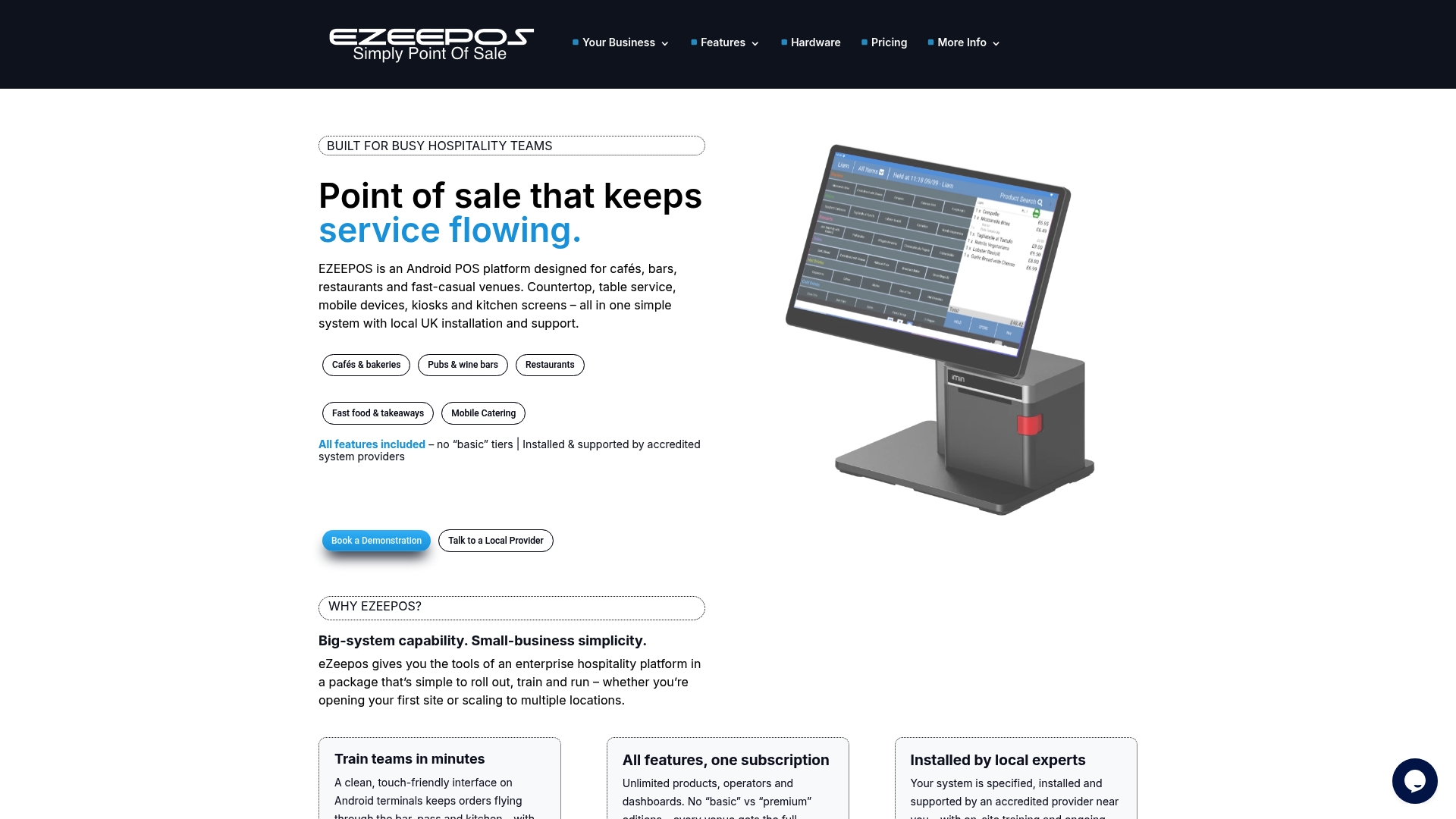
What sets eZeepos apart is the unified pos platforms benefits uk hospitality approach that integrates countertop terminals, tablets, kitchen screens, and back-office management into one cohesive system. You get enterprise-level functionality without tiered pricing restrictions, full feature access from day one, and ongoing support from local UK providers who understand your operational challenges. Whether you’re running a single location or planning expansion, eZeepos scales with your business whilst maintaining the simplicity that keeps service flowing smoothly during your busiest periods. Discover why hospitality pos matters uk and how the right system elevates every aspect of your pizza shop operations.
Frequently asked questions
What is the role of a POS system in a pizza shop?
A POS system manages the complete order lifecycle from customer entry through kitchen preparation to payment processing and reporting. It captures complex customisations accurately, routes orders to kitchen screens, tracks inventory usage, processes payments, and generates analytics that inform business decisions. Beyond simple transaction processing, it coordinates multiple service channels including dine-in, takeaway, and delivery through a unified platform that prevents errors and accelerates service.
How does a cloud-based POS differ from a traditional system?
Cloud-based POS systems store data on remote servers accessed via internet connection, enabling management from any location and automatic software updates. Traditional systems use local hardware and software, operating independently of internet connectivity but requiring manual updates and on-site management. Cloud solutions offer greater flexibility and remote capabilities whilst traditional systems provide reliability during network outages, making each suitable for different operational priorities.
Why is POS integration with delivery platforms important?
Integration eliminates manual re-entry of online orders, reducing errors and saving time during peak periods. Orders from delivery platforms appear directly on your kitchen screens alongside in-house orders, creating a single prioritised queue. This unified workflow prevents missed orders, ensures accurate preparation, and provides customers with realistic estimated times based on actual kitchen capacity rather than arbitrary promises from external platforms.
What return on investment can pizza shops expect from upgrading POS systems?
Most pizza shops report 15-25% profitability increases within the first year through combined benefits of reduced errors, faster service, decreased wastage, and data-driven menu optimisation. Order accuracy improvements of 60-70% directly reduce costly remakes and customer complaints. Inventory tracking typically cuts wastage by 20-30%, whilst analytics enable menu adjustments that boost average order values. The specific return depends on current operational efficiency and how thoroughly you leverage available features.
How long does staff training take for a new POS system?
Basic operational competency typically requires 2-3 days of hands-on training for counter staff, with full proficiency developing over 1-2 weeks of regular use. Kitchen staff need 1-2 days to master screen navigation and order status updates. Management training for reporting and configuration functions extends to 3-5 days. Modern intuitive interfaces significantly reduce learning curves compared to older systems, and ongoing support from providers helps resolve questions as they arise during initial implementation periods.
Recent Comments