
Hybrid POS architecture explained for hospitality
TL;DR:
- Hybrid POS architecture combines local transaction processing with cloud management, eliminating offline versus online trade-offs. It ensures seamless operation during outages, improves data integrity, and enables centralized reporting and multi-site management. Implementing it requires careful IT planning, conflict resolution, and strategic alignment, making it ideal for venues with unreliable connectivity or multiple locations.
Most hospitality businesses face the same impossible choice when selecting a POS system: accept the full reliability of an on-premise setup and sacrifice cloud flexibility, or go cloud-only and cross your fingers that your internet never drops during a Friday night rush. Understanding what is hybrid POS architecture matters precisely because it dissolves that choice entirely. A hybrid point of sale combines local transaction processing with cloud-based management, giving you the operational resilience of on-premise systems alongside the reporting power and multi-site visibility that modern venues demand. This article walks you through how it works, where it excels, and what to watch out for before you commit.
Table of Contents
- Key takeaways
- What is hybrid POS architecture and how it works
- Benefits of hybrid POS systems for hospitality
- Challenges of implementing hybrid POS
- Practical applications in hospitality venues
- My honest take on hybrid POS in 2026
- Why Ezeepos delivers on hybrid POS
- FAQ
Key takeaways
| Point | Details |
|---|---|
| Hybrid POS defined | A hybrid POS system combines local on-site processing with cloud sync, eliminating the offline versus cloud trade-off. |
| Operational continuity | Transactions continue uninterrupted during internet outages because the local database acts as the primary source of truth. |
| Reduced order errors | Integrated hybrid architectures cut order errors by up to 65% compared to fragmented, non-integrated systems. |
| Implementation complexity | Hybrid POS demands careful IT planning, including data identity management and conflict resolution strategies. |
| Strategic alignment required | Hybrid systems deliver full value only when aligned with broader business goals, not adopted purely for technology’s sake. |
What is hybrid POS architecture and how it works
At its core, hybrid POS architecture is a system design where every terminal runs a fully functional local database on-site, capable of processing transactions without any internet connection, while simultaneously maintaining a synchronised relationship with a cloud back office. Think of it as two systems working in tandem rather than one depending entirely on the other.
When you place an order at a hybrid-enabled venue, the terminal writes that transaction to the local database first. The local database acts as the source of truth, giving staff an instant response with no waiting for a server request to complete. Background workers then handle the cloud sync asynchronously, meaning network hiccups are invisible to the person at the counter.
When connectivity is restored after an outage, data flows back to the cloud. This is where data integrity becomes genuinely complex. Offline-to-cloud sync requires that each record carries a universally unique identifier (UUID) generated client-side rather than a simple sequential ID. Without this, two terminals creating records offline simultaneously would produce conflicting IDs when they eventually sync, corrupting your sales data.
Here is how hybrid POS compares to the alternatives:
| Criteria | Cloud-only POS | On-premise POS | Hybrid POS |
|---|---|---|---|
| Offline capability | None | Full | Full |
| Central reporting | Yes | Limited | Yes |
| Multi-location management | Yes | No | Yes |
| IT overhead | Low | High | Medium |
| Data control | Provider-held | Full owner control | Shared control |
| Scalability | High | Low | High |
As the table shows, hybrid POS software sits squarely in the middle column of every metric that matters to hospitality operators. You do not sacrifice cloud benefits to get offline resilience, and you do not lose local control to gain central visibility.
Pro Tip: When evaluating hybrid POS vendors, ask specifically whether the system uses a local-first database architecture or simply caches the last known cloud state. Only the former guarantees true offline operation.
Benefits of hybrid POS systems for hospitality
The benefits of hybrid POS go well beyond surviving a broadband outage. They reshape how you manage your business day to day.
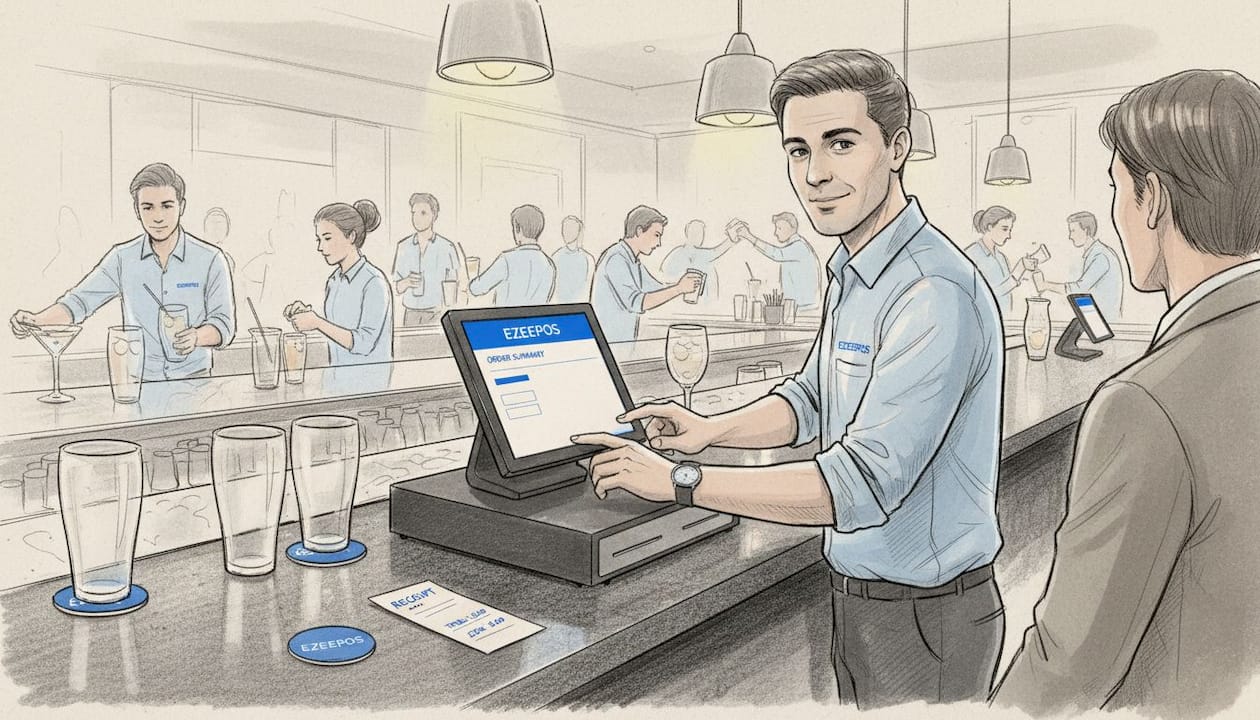
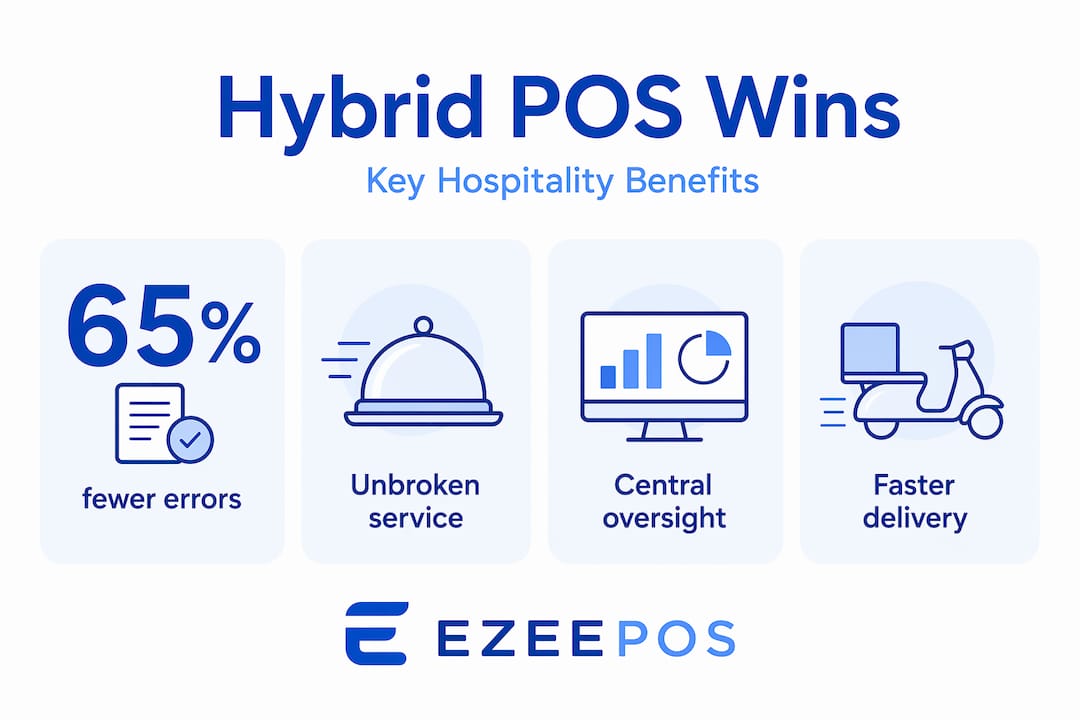
Unbroken service during outages. Hybrid systems eliminate compromises by processing transactions locally and syncing to cloud afterwards. For a bar on a Saturday night, a ten-minute broadband failure on a cloud-only system means no card payments and a queue out the door. With a hybrid setup, your staff notices nothing.
Real-time central visibility. Once connectivity is stable, every sale, menu change, and stock movement is reflected in your cloud back office. Multi-site operators can monitor performance across all venues from a single dashboard, compare cover counts, and respond to trends before they become problems.
Dramatically fewer order errors. Integrated POS architectures reduce order errors by up to 65% and increase delivery throughput by 30% compared to fragmented systems. When your POS, kitchen screens, and delivery aggregators all talk to a single source of truth, the risk of a printed ticket contradicting a digital order disappears.
Multi-location flexibility. A hybrid point of sale lets your head office push menu updates, pricing changes, and promotional configurations to every site simultaneously through the cloud layer. Individual terminals receive those changes as soon as they reconnect, without requiring manual intervention at each site.
Additional operational advantages you will notice:
- Staff spend less time troubleshooting connectivity issues and more time serving customers
- Inventory levels update from every terminal in real time once synced, reducing over-ordering and stock discrepancies
- Customer-facing screens and kitchen order systems stay in sync, so kitchen staff always work from current, accurate tickets
- Hospitality operations benefit from the ability to run reports spanning multiple service periods without waiting for overnight batch uploads
For venues with genuinely unreliable connectivity, such as festival sites, pop-ups, or rural locations, hybrid offline capability is not a nice-to-have. It is the only viable architecture.
Challenges of implementing hybrid POS
Understanding the advantages of hybrid POS architecture is the easy part. Implementing it well is where many businesses underestimate the effort involved.
-
Data identity management. Every offline terminal must generate its own globally unique record IDs. Client-side UUIDs prevent catastrophic data collisions when multiple devices sync simultaneously after an outage. Most modern hybrid POS vendors handle this internally, but you should verify this during any technical evaluation.
-
Conflict resolution strategy. When two terminals modify the same record offline, the system must have a clear rule for which version wins. Ask your vendor how their conflict resolution works and what happens to the losing record. Poor conflict resolution silently corrupts your sales history.
-
Integration with existing infrastructure. Connecting a hybrid POS to legacy accounting, stock management, or property management systems requires middleware or API work. If you are upgrading a legacy POS, budget time and resource for integration testing before going live.
-
IT management overhead. Hybrid solutions require sophisticated IT for effective operation. Unlike a pure cloud system where the vendor manages infrastructure entirely, a hybrid setup means your team or your support provider is responsible for the local hardware, operating system updates, and local database health.
-
Strategic alignment. Hybrid POS solutions should be aligned with customer, employee, and revenue goals rather than implemented purely because the technology exists. If your single-site café has rock-solid broadband and no plans to expand, a cloud-only system may serve you better and cost less to maintain.
Pro Tip: Before signing a hybrid POS contract, ask the vendor to walk you through their sync failure scenario. What happens to a transaction taken offline that fails to sync? Can you manually trigger a resync? The quality of their answer reveals how mature their architecture actually is.
When hybrid POS might not be the right fit: businesses with a single location, consistently reliable internet, and no plans for multi-site growth often gain little from the added complexity. The reasons to upgrade should be driven by operational need, not technology trends.
Practical applications in hospitality venues
Hybrid POS architecture shows its value most clearly in specific hospitality contexts. Here is where it makes a measurable difference.
Quick service and high-volume counter environments. Speed is everything at the counter. A hybrid system ensures that even during peak periods, when network congestion can slow cloud requests, every transaction is processed instantly from the local database. Staff do not wait for confirmation from a remote server before moving to the next customer.
Multi-site restaurant and bar groups. For groups managing five or twenty sites, centralised menu management becomes a significant operational saving. A price change or new promotional item is configured once at head office and pushed across every venue simultaneously. Without hybrid architecture, either you update each site manually or you accept that cloud-only systems fail the moment connectivity drops at any one location.
Delivery-heavy operations. One of the persistent frustrations in delivery-focused venues is “tablet hell”: a separate device for every delivery platform, each with its own menu, each creating its own order tickets. A hybrid POS that integrates delivery aggregators into its central order stream removes this problem entirely. Orders arrive in one place, print to the right kitchen station, and update inventory automatically.
Additional real-world scenarios where hybrid POS delivers clear returns:
- Festival and event catering, where cellular data is unreliable and every sale counts
- Hotels and resorts with multiple F&B outlets spread across a large site, each needing local resilience but central reporting
- Fine dining venues where POS precision directly affects the guest experience, from allergy management to multi-course pacing
- Pop-up restaurants and mobile catering units that need a system that travels with them and syncs when back in range
The common thread across all of these is that offline-first operation is no longer an optional feature. It is a baseline requirement for any hospitality venue that cannot afford to stop trading because of a router issue.
My honest take on hybrid POS in 2026
I have watched the hospitality sector slowly move away from clunky on-premise systems toward cloud POS, and in many cases that shift was justified. Cloud systems are easier to maintain, quicker to update, and give operators visibility they never had before. But I have seen too many venues learn the hard way that “cloud-only” really means “entirely dependent on an internet connection you do not fully control.”
What I find most underappreciated is the psychological cost of downtime. It is not just the lost revenue during the outage. It is the staff anxiety, the customer frustration, and the frantic calls to IT support at 7pm on a Saturday. Offline-first architecture removes all of that from the equation.
The point most businesses miss during their POS evaluation is this: they compare features and pricing but rarely ask the vendor to demonstrate offline mode under realistic conditions. Ask them to unplug the router. Watch what happens. If the terminal freezes, stalls, or shows an error, you have your answer.
My honest advice is to treat hybrid POS not as the premium option but as the sensible default for any venue serving more than fifty covers a day or operating across more than one site. The complexity is manageable with the right support. The cost of getting it wrong is not.
— John
Why Ezeepos delivers on hybrid POS
If the principles above describe the architecture you need, Ezeepos is built to deliver it. Designed specifically for UK hospitality venues, the Ezeepos platform supports offline-capable local processing with full cloud back-office sync, so your team keeps trading regardless of what your broadband does.
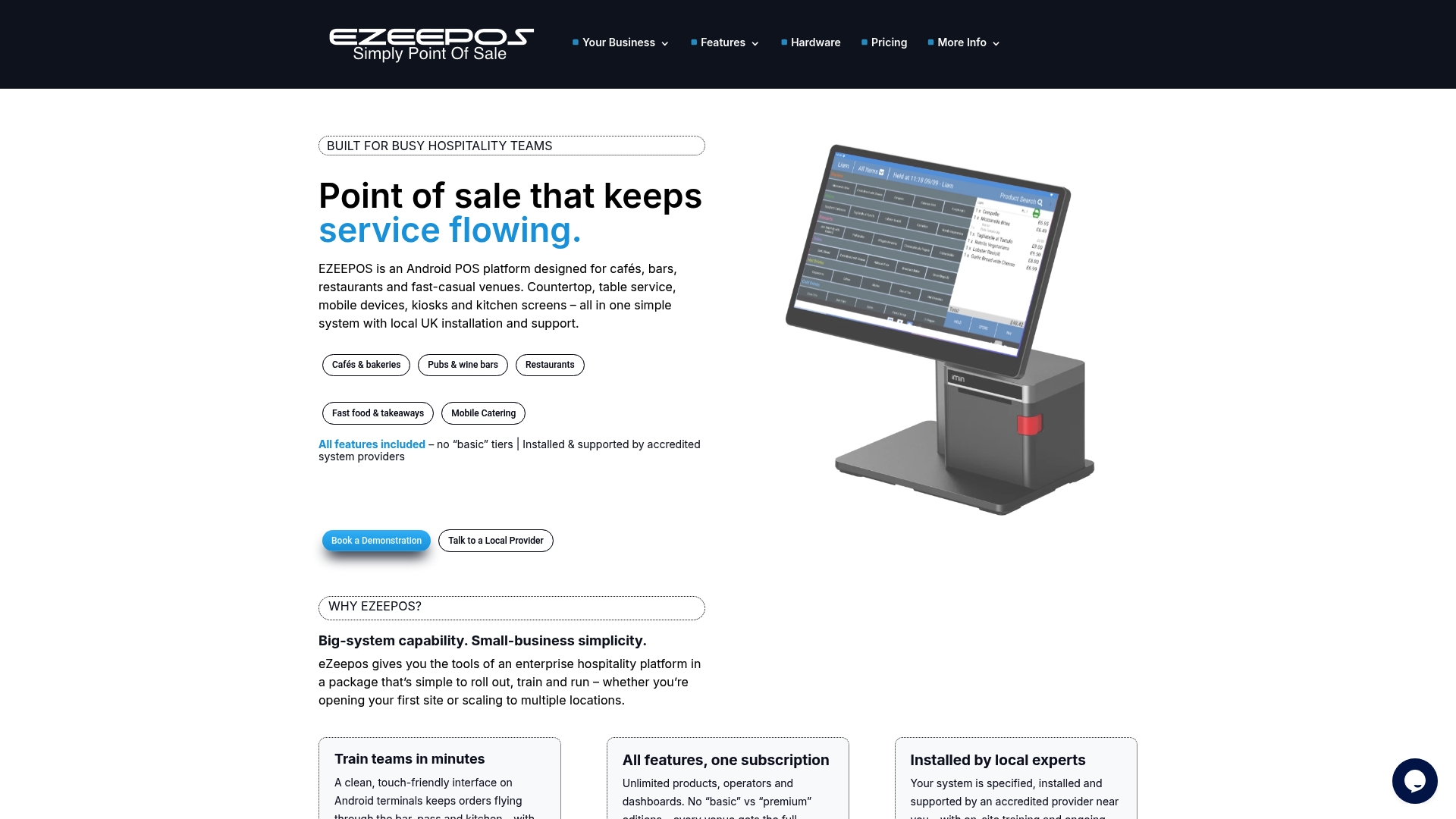
Whether you run a single café or a group of bars across multiple cities, Ezeepos provides unified POS benefits including centralised menu management, real-time inventory, staff management, and integrated kitchen screens, all without tiered pricing or locked-down features. UK-based installation and ongoing human support mean you are never troubleshooting alone. If you are ready to see how a properly architected hybrid POS performs in a real hospitality environment, the Ezeepos team is ready to walk you through it.
FAQ
What is hybrid POS architecture?
Hybrid POS architecture combines a local on-site database for transaction processing with a cloud layer for management, reporting, and multi-site synchronisation. It allows a venue to operate fully without internet connectivity while retaining all the visibility benefits of a cloud system.
How does a hybrid POS system handle offline transactions?
The local database processes and stores every transaction instantly, then syncs to the cloud once connectivity returns. Background workers manage the sync automatically without any action required from staff.
What are the main benefits of hybrid POS for hospitality venues?
The primary benefits include uninterrupted operation during internet outages, centralised reporting across multiple locations, significantly reduced order errors, and the ability to push menu and pricing updates to every terminal from a single back office.
Is hybrid POS more complex to implement than cloud-only systems?
Yes. Hybrid POS requires careful management of local hardware, data identity strategies such as UUIDs, and conflict resolution processes for offline sync. Most businesses work with an accredited provider to handle installation and ongoing maintenance rather than managing it in-house.
When should a hospitality business choose a hybrid POS over cloud-only?
If your venue experiences any internet unreliability, operates across multiple sites, or runs high-volume service where every second at the counter matters, a hybrid point of sale is the more resilient choice. Single-site venues with consistently stable connectivity and no expansion plans may find cloud-only sufficient.
Recent Comments