

TL;DR:
- Modern POS systems are essential for UK hospitality compliance with GDPR, HMRC, and allergen laws.
- They automate accurate record-keeping, enhance security, and streamline audits, reducing errors.
- Upgrading to compliant POS improves operational efficiency, reduces downtime, and future-proofs regulatory adherence.
Most hospitality managers think of their point of sale system as a glorified till. It takes orders, processes payments, and prints receipts. That view is costing venues real money. A modern POS is one of the most powerful compliance tools available to UK hospitality businesses, sitting at the intersection of GDPR obligations, HMRC record-keeping requirements, allergen management, and operational efficiency. This guide walks through exactly how a well-chosen POS protects your business from regulatory risk, automates your financial records, and delivers measurable efficiency gains across your operation.
Table of Contents
- Understanding compliance challenges in UK hospitality
- How modern POS systems enable GDPR-compliant data practices
- Creating reliable financial records and audit trails for HMRC
- Efficiency benchmarks: Compliance and operations working together
- Practical steps to choose a POS that futureproofs compliance
- Why compliance should drive POS upgrades, not just convenience
- Discover POS solutions that simplify compliance
- Frequently asked questions
Key Takeaways
| Point | Details |
|---|---|
| POS simplifies compliance | A modern POS handles data security and records automatically, reducing regulatory risks. |
| Automated audits and reporting | POS systems create digital trails that make HMRC audits faster and stress-free. |
| Efficiency and futureproofing | Choosing the right POS increases uptime, streamlines service, and adapts to changing laws. |
| Expert-guided selection | Evaluating POS features for compliance ensures your business stays ahead and avoids costly errors. |
Understanding compliance challenges in UK hospitality
Running a hospitality venue in the UK means navigating a dense web of legal obligations. These are not optional extras. They carry real penalties, and the burden is growing every year.
The core compliance challenges facing hospitality operators today include:
- GDPR and data protection: Any time you collect a customer’s name, email, or payment detail, you are handling personal data under UK GDPR. Mishandling it can result in fines from the Information Commissioner’s Office.
- HMRC record-keeping: HMRC expects accurate, tamper-evident records of every transaction. Under Making Tax Digital (MTD), digital submissions are increasingly mandatory.
- Allergen management: The Natasha’s Law requirements mean menus and orders must carry clear allergen information. Errors here are not just a compliance failure; they are a safety risk.
- Financial controls: Cash handling, till reconciliation, and staff access all require documented controls to prevent fraud and pass external audits.
“Hospitality must meet GDPR and HMRC requirements; manual approaches increase risks and errors.” The POS benefits in hospitality are most visible precisely when compliance pressure is highest.
Manual methods simply cannot keep pace. A spreadsheet updated at the end of a busy Saturday service is already out of date, likely contains errors, and offers no audit trail. Paper consent forms for marketing opt-ins are nearly impossible to manage at scale. When an HMRC inspector or a data protection officer asks for records, the difference between a venue with an integrated POS and one relying on manual processes is the difference between a confident response and a costly scramble.
The need for an integrated system is not about technology for its own sake. It is about building a business that can withstand scrutiny and scale without adding administrative headcount.
How modern POS systems enable GDPR-compliant data practices
With the regulatory landscape in mind, here is how POS systems specifically tackle the complexities of data protection.
A hospitality-grade POS handles customer data in a fundamentally different way to a basic till. Every interaction that involves personal information, whether that is a loyalty sign-up, a table booking, or a card payment, is governed by rules under UK GDPR. A modern POS is built to enforce those rules automatically.
Key data protection features you should expect from a compliant POS include:
- Encrypted data storage: Customer records are stored with encryption, meaning that even if hardware is lost or stolen, data cannot be read.
- Role-based access controls: Staff can only see the data they need to do their job. A front-of-house team member does not need access to full customer purchase histories.
- Opt-in consent management: Any loyalty programme or marketing list must be built on explicit consent. A good POS captures and logs that consent at the point of interaction.
- Data retention policies: GDPR requires you to keep personal data only as long as necessary. A POS with configurable retention settings automates this process.
- Audit logs: Every access to personal data is recorded, giving you a clear trail if you ever face a subject access request or a regulatory inquiry.
The GDPR in hospitality requirements are not going away. If anything, enforcement is tightening. A POS that secures customer data and supports data protection is not a luxury feature. It is a baseline requirement for any venue collecting customer information.
Pro Tip: Schedule a quarterly review of your POS privacy settings. Check that consent options are visible to customers, that access controls reflect your current team structure, and that data retention periods are correctly configured.
The hospitality POS definition has evolved considerably. Today it encompasses data governance as much as transaction processing.
Creating reliable financial records and audit trails for HMRC
Solid data security is vital, but financial compliance goes further. Here is how POS automates records for stress-free HMRC audits.
| Record type | Paper-based method | POS-generated record |
|---|---|---|
| Daily sales totals | Manual till roll, error-prone | Automated, timestamped, tamper-evident |
| VAT calculations | Spreadsheet, manual entry | Real-time VAT split by product category |
| Inventory movements | Periodic stock counts | Continuous tracking, linked to sales |
| Staff transactions | Paper log or memory | Digital log with staff ID and timestamp |
| Refunds and voids | Often undocumented | Flagged, authorised, and recorded |
The contrast is stark. A paper-based approach depends entirely on human diligence at every stage. A POS-generated record is consistent, complete, and available instantly.
When HMRC comes calling, here is how a venue with a modern POS responds:
- Export the relevant period: Sales, VAT, and inventory data for any date range can be pulled in minutes, not days.
- Provide tamper-evident logs: Every transaction carries a timestamp and a staff identifier, making it impossible to alter records without leaving a trace.
- Cross-reference inventory: POS inventory records link purchases to sales, so stock discrepancies are immediately visible and explainable.
- Demonstrate VAT accuracy: Real-time VAT calculations remove the risk of miscategorisation that manual methods routinely produce.
- Show audit trail for exceptions: Voids, refunds, and discounts are all logged with authorisation details, demonstrating robust financial controls.
The auditable POS records produced by a modern system reduce errors and give HMRC exactly the structured data they expect. Direct integration is always preferable to manual exports. Every manual step is an opportunity for error or omission, and HMRC takes a dim view of incomplete records. The POS impact on pub audits demonstrates this clearly: venues with integrated systems resolve audits faster and with fewer follow-up requests.

Efficiency benchmarks: Compliance and operations working together
Beyond simply ticking boxes, compliance-focused POS can transform day-to-day operations. Here are measurable results that matter.
| Feature | Legacy till | Modern POS |
|---|---|---|
| Service speed | Baseline | Up to 22% faster service |
| Downtime risk | High, no failover | Cloud POS cuts downtime by up to 80% |
| Inventory accuracy | Manual, weekly counts | Real-time, continuous |
| Reporting time | Hours of manual work | Minutes, automated |
| Compliance readiness | Reactive, stressful | Proactive, always ready |
The efficiency benchmarks for POS are compelling. Cloud POS cuts downtime 80%, hybrid systems reduce outages that can cost venues up to £8,000 per day, service speeds improve by 22%, and inventory tracking supports gross profit margins of 25 to 35%.
These are not abstract figures. A venue turning over £5,000 on a Saturday night that loses its POS system mid-service faces lost revenue, frustrated customers, and potential compliance gaps in its records. A hybrid or cloud system prevents that scenario.
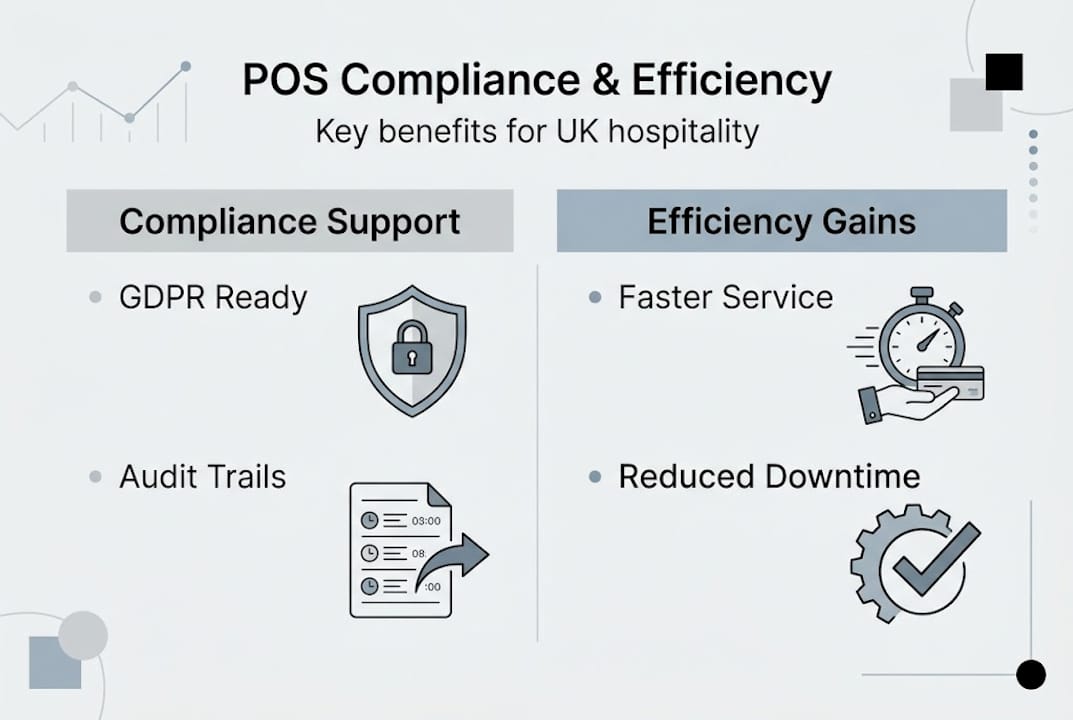
The tangible efficiency gains from a compliance-focused POS include:
- Faster table turns: Integrated ordering and payment reduces wait times and increases covers per session.
- Elimination of manual reporting: End-of-day reports generate automatically, freeing managers for higher-value tasks.
- Rapid compliance checks: Any regulatory query can be answered from the back-office dashboard without disrupting service.
- Reduced staff errors: Guided order entry and allergen prompts reduce mistakes that could trigger complaints or legal action.
- Better cash management: Automated reconciliation flags discrepancies immediately, reducing the risk of undetected losses.
Pro Tip: If your venue has unreliable WiFi, a hybrid POS that operates offline and syncs when connectivity is restored is essential. Do not let a broadband outage become a compliance gap in your records.
The POS efficiency in pubs case makes clear that the return on investment from a modern system is not measured in years. For many venues, it is measured in months.
Practical steps to choose a POS that futureproofs compliance
With results on the table, here is how to ensure any POS upgrade truly keeps your business safe and future-ready.
Choosing the right system requires more than comparing price lists. Here is a structured approach:
- Verify direct HMRC integration: HMRC integrations and compliance should be direct API connections, not manual exports. Ask vendors specifically whether their system connects directly to MTD-compliant reporting tools.
- Audit GDPR features: Check for built-in consent management, data encryption, role-based access, and configurable retention periods. These should be standard, not add-ons.
- Assess cloud versus hybrid: Review your venue’s connectivity. A cloud POS selection guide will help you weigh the benefits of full cloud against the resilience of a hybrid system.
- Evaluate local support: A POS that breaks down on a Friday night needs a support team that answers the phone. Prioritise vendors with local UK installation and ongoing human support.
- Plan for regulatory change: Regulations evolve. Ask vendors how their system handles software updates when new compliance requirements come into force. A system that requires expensive reconfiguration every time rules change is a liability.
Prioritising HMRC-approved direct integrations over manual exports, checking for GDPR compliance features, and considering hybrid options for connectivity resilience are the three non-negotiables in any POS evaluation.
Pro Tip: Align your POS review cycle with the regulatory calendar. HMRC’s MTD rollout continues to expand, and UK GDPR enforcement is becoming more active. Reviewing your system annually against the current regulatory landscape, rather than waiting for a crisis, is the approach that protects your margins.
The question of why use cloud POS is answered partly by convenience and partly by compliance. Both matter. And local POS support is what turns a good system into a reliable one.
Why compliance should drive POS upgrades, not just convenience
Most venues that upgrade their POS do so because their old system is slow, clunky, or simply broken. That is understandable. But it means compliance is almost always an afterthought, evaluated only after the shortlist is already drawn up.
This is the wrong order. Compliance risk is escalating. HMRC’s MTD programme is expanding. ICO enforcement of UK GDPR is becoming more assertive. Allergen legislation is tightening. The venues that treat compliance as the primary driver of their POS investment are the ones that avoid penalties, pass audits without drama, and build customer trust on solid foundations.
A modern POS does not just shield you from fines. It turns compliance into a competitive advantage. When your records are always audit-ready, your data practices are transparent, and your financial controls are robust, you operate with a confidence that shows in every interaction. That is what why POS upgrades matter is really about. Not faster service, though that matters too. But the peace of mind that comes from knowing your business is built on solid ground.
Discover POS solutions that simplify compliance
If the compliance landscape feels complex, the right POS partner makes it manageable. At Ezee POS, we work with hospitality venues across the UK to implement systems that handle GDPR, HMRC record-keeping, and operational efficiency from day one.
Explore what a purpose-built solution looks like by reading about learn about hospitality POS or discover how the right system drives POS for restaurant success. For venues looking to tighten up stock control alongside compliance, our smart inventory tools offer real-time tracking that links directly to your sales and financial records. Speak to a local accredited provider and find out how quickly compliance can become your strength rather than your stress.
Frequently asked questions
How does a POS system help with GDPR compliance in hospitality?
A POS secures customer data through encryption and access controls, captures opt-in consent for marketing, and maintains audit logs that satisfy UK GDPR requirements.
What features should a compliant POS have for HMRC audits?
It should automate sales and inventory records with tamper-evident timestamps, provide clear audit trails for every transaction, and connect directly to HMRC-compliant reporting systems.
Does using cloud or hybrid POS improve compliance reliability?
Yes. Cloud POS cuts downtime by up to 80%, while hybrid systems maintain local operation during outages, preventing gaps in your compliance records.
How can POS systems futureproof compliance as regulations evolve?
Systems with direct HMRC integrations and automatic software updates adapt to new requirements without costly reconfigurations, keeping your records compliant as legislation changes.
Recent Comments