
Why data security matters in POS systems
TL;DR:
- POS security involves systemic risks across hardware, network, and staff practices, beyond just the device itself.
- Maintaining compliance with PCI DSS is a baseline; real security requires continuous monitoring, layered controls, and operational discipline.
Your POS terminal is not just a till. Every time a customer taps their card at your bar or restaurant, that device is handling cardholder data, personal identifiers, and transaction records that travel through your entire network. Understanding why data security matters in POS goes far beyond buying a secure device. The real risk is systemic: it sits in your router configuration, your staff’s login habits, your cloud integrations, and the software versions you may have skipped updating. This article covers what POS data security actually involves, why the stakes are high for hospitality businesses specifically, and what you can do about it today.
Table of Contents
- Key takeaways
- The real scope of POS data security
- Compliance and regulatory frameworks
- Practical security controls you can implement now
- Common misconceptions and challenges
- My perspective on POS security in hospitality
- How Ezeepos supports your POS security
- FAQ
Key takeaways
| Point | Details |
|---|---|
| POS security is systemic | Risk extends across terminals, credentials, networks, and third-party integrations, not just the device itself. |
| Financial exposure is severe | A single data breach costs businesses an average of $4.44 million globally, making prevention far cheaper than recovery. |
| Compliance is not enough | PCI DSS sets a baseline, but real protection requires layered operational and technical controls beyond certification. |
| Access control is a frontline defence | Strong authentication, unique user accounts, and least-privilege access reduce your most common attack vectors. |
| Security is daily practice | Continuous monitoring, staff training, and regular patching are habits, not one-off tasks. |
The real scope of POS data security
Most hospitality business owners think about POS security in terms of the terminal on the counter. That framing misses most of the actual risk. POS security scope includes terminals, card readers, network routers, employee credentials, kitchen screens, cloud-connected back-office tools, and any third-party integrations your system uses. A breach does not need to start at the terminal. It can start anywhere connected to it.
The common weak points in hospitality venues are often operational rather than technical:
- Unpatched software on terminals or back-office systems
- Shared login credentials used across multiple members of staff
- Default router passwords left unchanged during installation
- Cloud dashboard access with no multi-factor authentication
- Peripheral devices with unrestricted network access
When attackers compromise a hospitality POS environment, the consequences are not limited to stolen card numbers. You face fraudulent chargebacks, potential downtime during peak service, regulatory investigations, and the kind of reputational damage that sends regulars to a competitor. The average global breach cost in 2025 was $4.44 million, with US businesses facing costs exceeding $10 million. Even a fraction of that figure is devastating for an independent restaurant or bar group.
The hospitality sector carries particular exposure because payment environments are physically accessible, staff turnover is high, and the pressure of service makes shortcuts tempting. Understanding the importance of data security in POS starts with accepting that your environment is more complex than a single device on a counter.
Compliance and regulatory frameworks
Defining POS data security properly means acknowledging the regulatory structure around it. The Payment Card Industry Data Security Standard, known as PCI DSS, is the framework every business that accepts card payments must follow. Three requirements are especially relevant for hospitality POS operators.
- Requirement 3: Protect stored cardholder data. Stored card data must be encrypted, truncated, or tokenised. Sensitive authentication data such as CVV codes or full magnetic stripe data cannot be stored at all, even in encrypted form. If your POS system retains this data anywhere, you are already non-compliant and exposed.
- Requirement 4: Encrypt data in transit. Cardholder data in transit must be encrypted across any open or public network, and across internal networks where unauthorised access is possible. TLS 1.2 or higher is the accepted standard for this.
- Requirement 9: Physical security. Physical access to POS devices must be controlled and monitored. In a busy bar or café, a terminal left unattended or a card reader that has been tampered with overnight creates real exposure.
| Control type | Compliance requirement | Practical hospitality example |
|---|---|---|
| Data storage | Requirement 3 | No CVV data stored in cloud back office |
| Data in transit | Requirement 4 | TLS encryption across all network traffic |
| Physical access | Requirement 9 | Terminal access logs, tamper checks at opening |
Here is the critical point many operators miss. Achieving PCI DSS compliance does not mean your business is secure. It means you meet a defined baseline. Real security requires continuous monitoring, layered controls, and operational discipline that goes beyond ticking certification boxes. Compliance is where you start, not where you stop.
Practical security controls you can implement now
This is where the role of data security in POS becomes genuinely operational. The good news is that most effective controls are not expensive. They require consistency and management attention.
Authentication and access control sit at the top of any practical security list. The role of access control in POS is straightforward: every member of staff should have their own unique login, and weak authentication practices such as shared passwords or default credentials are among the most exploited vulnerabilities. Implement multi-factor authentication wherever your system allows it. Assign access privileges based on role, and revoke credentials immediately when staff leave.

Pro Tip: Run a quarterly audit of active user accounts on your POS system. You will almost certainly find former staff accounts still active. Each one is an open door.
Software updates and patching are less glamorous but equally critical. Attackers routinely target known vulnerabilities in older software versions. Set a regular schedule for checking and applying updates across your POS software, payment terminals, and connected devices.
Network segmentation means separating your POS network from your guest Wi-Fi and general business network. If a device on your customer-facing network is compromised, segmentation stops that breach from reaching your payment environment. Most modern routers support VLAN configuration to achieve this. Good contactless payment security depends on this kind of network separation being in place from the start.
Encryption and tokenisation protect data at rest and in transit. When payment data is tokenised, the actual card number is never stored or transmitted in readable form. Your payment processor handles the sensitive data, and your system only ever sees a meaningless token.
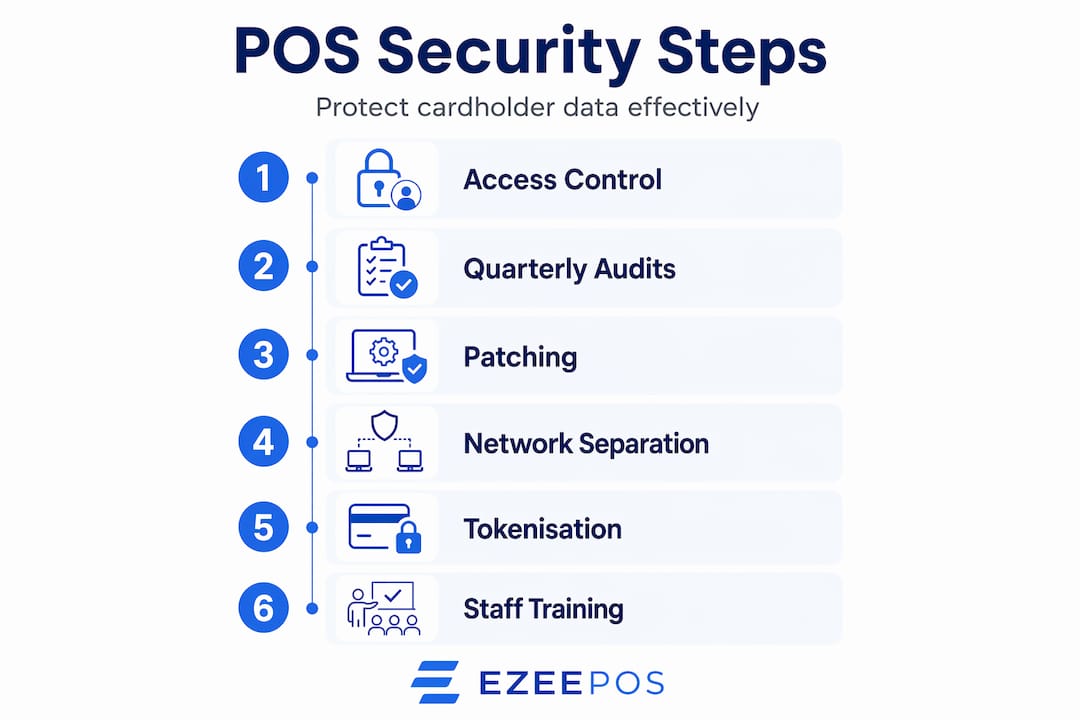
Staff training is where many venues fall short. Your team does not need to understand cryptography. They do need to know not to write passwords on paper, to lock screens when leaving a terminal unattended, and to report anything suspicious about card readers. Managing staff access carefully and training your team on security fundamentals reduces your human-factor risk significantly.
Monitoring and logging mean you know something has gone wrong faster. Faster breach detection cuts the average breach lifecycle and reduces overall cost. Enable transaction logging, review access logs periodically, and set up alerts for unusual activity.
Common misconceptions and challenges
One of the most persistent misconceptions in hospitality is that PCI DSS compliance means the business is protected. It does not. Compliance is a point-in-time assessment. Your environment changes constantly as you add integrations, change staff, and update systems. A continuous assurance mindset focused on authentication, least-privilege access, and ongoing monitoring is what actually reduces your attack window.
“Security is not a product you buy once. It is a behaviour you practise every day.”
Another underestimated risk is integration sprawl. Every new dashboard, export tool, booking system, or loyalty platform you connect to your POS is a potential entry point. Integration sprawl with multiple exports and connected systems dramatically increases breach risk. Each integration should be justified, reviewed for security, and removed when no longer needed.
Physical security is also routinely underestimated. A card skimmer fitted overnight to a terminal at a quiet bar counter, an unattended tablet left in a service corridor, or a kitchen screen accessible to delivery drivers all represent real exposure. The physical environment around your POS deserves the same attention as your network architecture.
Finally, the pressure of a busy Saturday night service is itself a security risk. When systems are slow and queues are long, staff skip security steps. Attackers know this. The controls that protect you are the ones that work under pressure, not the ones that only hold up when trade is quiet.
My perspective on POS security in hospitality
I have seen hospitality businesses treat data security as an IT problem, something to hand off to a technician and forget about. That approach is why so many breaches start with operational failures rather than sophisticated attacks.
In my experience, the venues that handle security well are the ones where the owner or manager treats it as a business priority, not a technical footnote. They know which staff have system access, they check it regularly, and they update it when people leave. They ask questions about their software updates and their network setup. They are not necessarily technical people. They are just engaged with the risk.
What I have found genuinely matters is the habit layer beneath the technical controls. Encryption and tokenisation are necessary, but they do not help if your staff manager’s account has admin access and a password that has not changed since installation. Cybersecurity safeguards protect customer experience and business reputation directly. In hospitality, your reputation is your business.
The businesses I have seen recover fastest from security incidents are the ones with layered defences. No single control works perfectly. But encryption plus access control plus staff training plus monitoring creates a situation where an attacker has to beat multiple independent barriers. That dramatically reduces the likelihood of a successful breach and the cost of any incident that does occur.
Invest in your POS security the same way you invest in your kitchen. It underpins everything else.
— John
How Ezeepos supports your POS security
Running a secure POS environment is significantly easier when your platform is built with security as a foundation rather than an afterthought.
Ezeepos delivers a unified POS platform designed specifically for UK hospitality venues, with integrated access controls, encrypted payment processing, and cloud-based back-office management. Every staff member gets individual login credentials, and permission levels are managed centrally so you always know who can access what. The system supports PCI-compliant payment integrations out of the box, and local UK installation means your setup is configured correctly from day one rather than left to chance. If you want a POS solution that takes data protection seriously and scales with your venue, explore Ezeepos and speak to an accredited local provider about your specific requirements.
FAQ
What does POS data security actually cover?
POS data security covers the full payment environment including terminals, network routers, employee credentials, cloud tools, and third-party integrations. Risk is systemic and extends well beyond the physical device at the counter.
Is PCI DSS compliance enough to protect my business?
No. PCI DSS compliance is a baseline requirement, not a complete security solution. Real protection requires continuous monitoring, strong access controls, staff training, and regular patching on top of compliance certification.
What is the role of access control in POS security?
Access control limits who can interact with payment systems and transaction data. Unique user accounts, multi-factor authentication, and role-based permissions are the most effective measures for reducing credential-based breaches in hospitality environments.
How much can a POS data breach cost a hospitality business?
The global average breach cost is $4.44 million, but even smaller incidents carry significant costs through chargebacks, downtime, regulatory penalties, and reputational damage that affects future revenue.
How often should I review my POS security controls?
Security controls should be reviewed at least quarterly. This includes auditing active user accounts, checking software update status, reviewing access logs, and inspecting physical devices for tampering. Staff training should be refreshed whenever your team changes significantly.
Recent Comments