
TL;DR:
- Quick service technology in 2026 includes integrated systems focused on reliability and adaptability.
- Prioritize customer value drivers like quality and convenience over speed alone for better results.
- Successful deployment relies on pilots, narrow automation scope, and contingency planning for edge cases.
Speed is the first word most venue owners reach for when describing quick service technology. But the operators genuinely winning in the UK market know it’s far more layered than that. Quick service technology in 2026 covers everything from point of sale systems and kitchen displays to self-ordering kiosks and integrated payments, and each component must work in harmony with what your customers actually value. This guide cuts through the noise, defines what quick service technology really means for UK venues, and gives you a practical framework for evaluating, implementing, and getting lasting value from it.
Table of Contents
- What is quick service technology?
- How UK venues align technology with customer value drivers
- Overcoming operational realities and edge cases
- Evaluating automation scope and implementation risks
- Why the speed-obsessed view of quick service technology is outdated
- Unlock the benefits of advanced quick service solutions
- Frequently asked questions
Key Takeaways
| Point | Details |
|---|---|
| Beyond speed | Successful quick service technology goes beyond speed to deliver on quality, convenience, and value for UK customers. |
| Handle edge cases | Plan for ambient noise, custom requests, and unexpected scenarios when assessing or piloting technology. |
| Align with customer drivers | Select systems that map to what your local customers value, not just industry buzz. |
| Incremental automation | Implement automation in stages and always have a human fallback for smooth, reliable service. |
What is quick service technology?
Quick service technology is the collection of integrated systems that enables a hospitality venue to receive, process, and fulfil customer orders efficiently and accurately. That includes your point of sale platform, kitchen display screens, self-service kiosks, and payment terminals. Together, these components form a connected operational layer that keeps your team, your kitchen, and your customers in sync.
But here’s where many operators go wrong: they treat quick service technology as a speed lever. In reality, it’s a reliability and adaptability tool first. A system that processes orders in two seconds is worthless if it collapses under a lunchtime rush or fumbles a dairy-free customisation.
As QSR technology experts note, quick-service tech must be engineered for edge cases and operational reality, not just average conditions. That means designing for the unexpected: custom orders shouted over ambient noise, correction requests mid-transaction, hardware faults at peak time, and the moments when a customer changes their mind at the last second.
The best way to think about it is the contrast between a speed-first approach and a value-alignment approach.
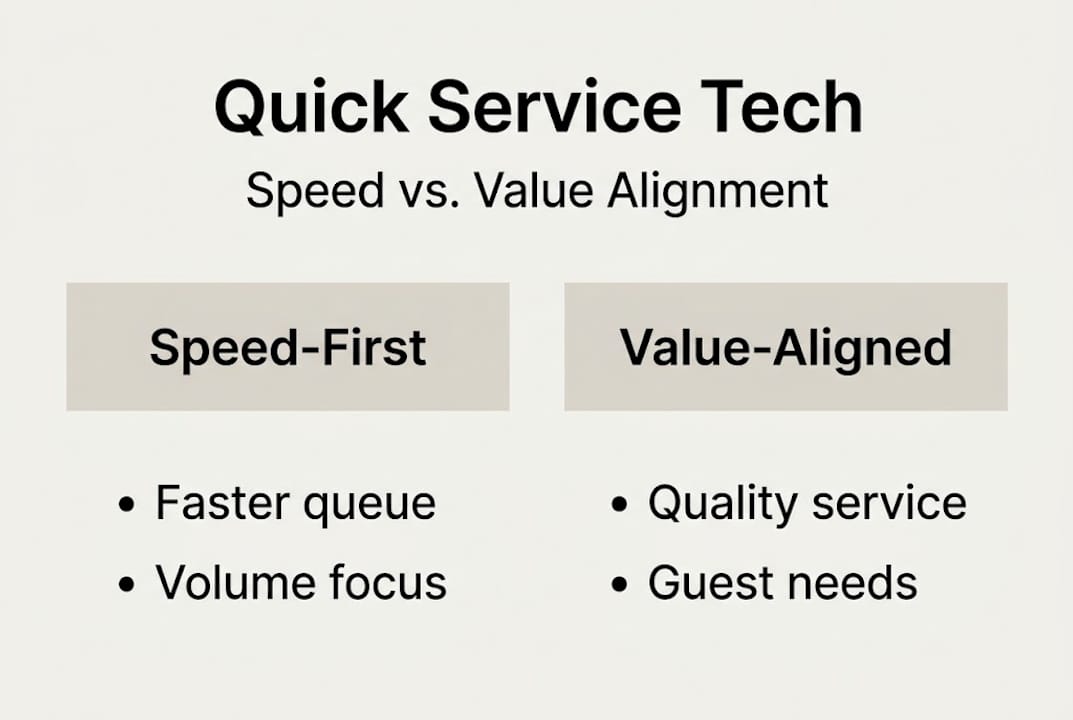
| Factor | Traditional quick service | Modern tech-enabled quick service |
|---|---|---|
| Primary goal | Reduce transaction time | Align with customer value drivers |
| Customisation handling | Manual and error-prone | Integrated and guided |
| Integration ease | Siloed systems | Unified platform |
| Customer experience | Transactional | Personalised and consistent |
| Reliability under pressure | Variable | Engineered for peak conditions |
When you evaluate hospitality technology examples in the field, the venues thriving are not just the fastest. They are the most consistent. And consistency under pressure is what technology must deliver.
According to YouGov’s 2026 UK QSR rankings report, UK QSR choice is dominated by quality, convenience, and value. Speed is a hygiene factor, not a differentiator. Your technology decisions must reflect that truth.
- Integrated POS with kitchen display connectivity
- Self-service kiosk options for high-traffic periods
- Real-time inventory updates to avoid disappointment
- Flexible payment terminal integration
- Reporting tools that surface what’s actually selling
How UK venues align technology with customer value drivers
Now that we’ve defined quick service technology, let’s see how top UK operators select and apply it for real business impact.
The starting point is always the customer, not the catalogue. Consumer choice is driven by food quality, location, and overall perceived value, not technology speed alone. Yet many procurement decisions still lead with processing speed benchmarks. That is a significant disconnect.
| Customer driver | Ranking importance | Technology that supports it |
|---|---|---|
| Food quality | 1st | Kitchen display accuracy, allergen prompts |
| Convenient location | 2nd | Mobile POS for events and off-site service |
| Overall value | 3rd | Promotions engine, loyalty integration |
| Digital experience | 4th | Kiosk UX, app connectivity |
| Speed of service | 5th | Counter POS throughput, queue management |
This data reframes the entire technology conversation. A kiosk that upsells poorly or confuses customers does more damage than a slightly slower counter system that gets the order right every time.
Here’s a stepwise approach to aligning your technology with what your customers actually care about:
- Identify your local customer priorities. Survey regulars, read your reviews, and map where complaints cluster. Is it wait time, wrong orders, or perceived value?
- Map technology to those specific drivers. If value is the issue, a promotions engine or loyalty feature matters more than a faster POS screen.
- Pilot against measurable metrics. Before full rollout, test self-service kiosks against your baseline order accuracy and average spend data.
- Measure the customer experience, not just throughput. Gather feedback specifically on how the technology made the visit feel.
“UK QSR preference still starts with quality. Technology is a supporting actor, not the lead.”
Smart operators also use technology to improve the journey rather than simply accelerate it. Counter POS systems that display allergen information during ordering reduce errors. Kitchen screens that colour-code priority items reduce kitchen stress. These are not speed plays. They are quality and experience plays, and they pay off in repeat visits. For venues also managing finances across multiple sites, pairing operational tech with solid hospitality bookkeeping practices helps you see the full picture of where technology investment is generating returns.
Overcoming operational realities and edge cases
Understanding value drivers is just the start. Here’s what UK operators really face in day-to-day tech deployments.
The gap between a product demo and a busy Friday lunchtime is enormous. AI-driven ordering systems fail with ambient noise, customisations, and edge requests, and sales can dip during transitions from old to new systems. This is not a reason to avoid technology. It is a reason to deploy it with your eyes open.
Common pitfalls include integration breakdowns between POS and kitchen systems, order duplication errors during peak periods, and staff reverting to workarounds that undermine the entire workflow. These are not software failures in isolation. They are organisational failures dressed up as technical ones.
Pro Tip: Always pilot new technology under real rush-hour conditions before committing to a full rollout. A Tuesday morning test tells you almost nothing. A Saturday lunchtime pilot tells you everything.
Here are the edge cases most likely to trip up your deployment:
- Loud peak periods where verbal orders are misheard or kiosk audio is ignored
- Order corrections requested after confirmation but before kitchen pickup
- Special dietary requests that fall outside preset menu options
- Hardware faults such as a frozen screen or printer failure during a queue
- Connectivity drops that take cloud-dependent systems offline
Mitigation starts with keeping humans in the loop. Mobile POS deployments work best when staff carry handheld devices as a fallback to fixed kiosk systems. Multi-step correction processes, where a staff member can override or amend an order before it fires to the kitchen, dramatically reduce downstream errors. Review hospitality software examples from comparable venues to understand what correction workflows look like in practice. Also, study real implementation failures from the QSR sector for an honest picture of what poor deployment costs.
Evaluating automation scope and implementation risks
Having covered pitfalls and edge cases, here’s how to set your technology scope and manage implementation for long-term gains, not just headline speed.
The instinct to automate everything is understandable. But automation experts consistently advise that automation should be narrow, with pilots measured in real rush conditions and careful human oversight maintained throughout. Trying to automate edge cases before your core flows are flawless is the fastest route to an expensive rollback.
Here is a practical checklist for a robust technology pilot:
- Define a single, clear use case. Start with one workflow, such as counter ordering or kitchen display routing, not the entire operation.
- Baseline your current performance. Measure order accuracy, average transaction time, and customer satisfaction before the pilot begins.
- Run the pilot under stressed conditions. Include at least two peak trading sessions to surface failure modes.
- Maintain human oversight throughout. Designate a staff member to monitor the technology and intervene when needed.
- Measure any dips honestly. Temporary performance drops are normal but must be tracked and understood, not ignored.
- Set a recovery benchmark. Decide in advance what performance level signals that the technology is ready to scale.
Pro Tip: Do not automate edge cases until your core service flows are flawless. Automation amplifies both your best processes and your worst ones.
For café operators, streamlining POS in cafés often means starting with counter service integration before layering on table ordering or loyalty. Similarly, venues focused on fast food order processing benefit most from a phased approach that proves reliability at each stage before expanding scope. Phased rollouts protect your revenue during transition and build staff confidence in the new system incrementally.
Why the speed-obsessed view of quick service technology is outdated
Let’s step back and reconsider how to measure the true value of quick service technology in hospitality.
Speed is a necessary baseline. Customers will not tolerate a queue that stretches out the door. But speed is the floor, not the ceiling. The operators who treat it as the ceiling end up with technology that is impressively fast at doing the wrong things.
We have seen too many rollouts where the technology processed orders quickly but the wrong orders, in the wrong sequence, with no mechanism to catch allergen errors. The speed metric looked great. The customer experience was a liability.
Ignoring edge cases and operational reality leaves real revenue at risk. A system that performs brilliantly in a demo but falters when a customer asks for oat milk in a coconut cup with no lid is not a quick service system. It is a fragile one.
The operators gaining the most from their technology investments are those who build for operational resilience. They match systems to quality, convenience, and value drivers. They treat technology as a support layer for their team, not a replacement for judgement. And they maintain the human safety net until the system has proved itself under every realistic condition their venue throws at it. That is the standard worth measuring against.
Unlock the benefits of advanced quick service solutions
Ready to move from theory to action? The principles in this guide only pay off when you apply them with the right platform behind you.
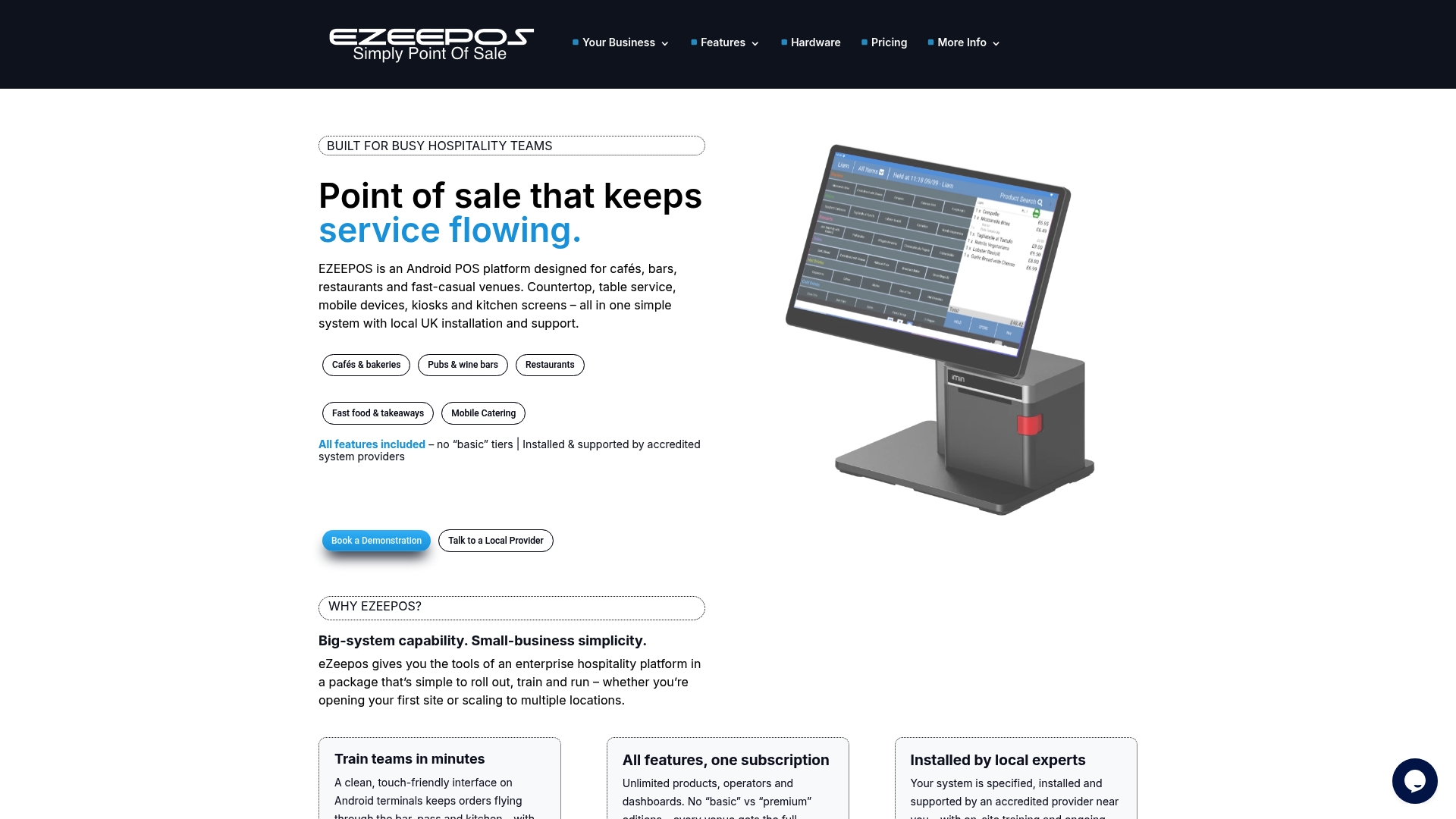
At eZeepos, we’ve built our unified POS platform specifically for the realities of UK hospitality venues, from busy café counters to multi-site fast casual operations. Our quick-service POS solutions are designed to handle the edge cases, the peak rushes, and the customisation demands that generic systems stumble over. Explore our detailed hospitality technology guidance to see how leading UK venues are aligning technology with what their customers genuinely value. When you’re ready, our local UK team is here to walk you through a real-world demonstration tailored to your venue’s specific needs.
Frequently asked questions
What are examples of quick service technology in UK hospitality?
Typical examples include integrated POS systems, digital kitchen displays, mobile ordering platforms, and self-service kiosks used in cafés, QSRs, and fast casual restaurants. Quick-service tech spans POS, kitchen displays, self-ordering kiosks, and integrated payment systems working as a unified whole.
What should UK operators look for when choosing quick service technology?
Prioritise technology that is robust against customisations, noisy environments, and integrates well with your venue’s workflow, not just one that processes orders quickly. Quick-service tech must be engineered for edge cases and operational reality to deliver lasting value.
How can UK venues avoid costly quick service technology failures?
Run pilots during real rush times, keep automation scope narrow, and ensure staff are always ready to intervene during edge cases. Automation gains are undermined by edge cases and implementation risk, so pilots must be measured in real rush conditions with human fallback in place.
Does speed still matter most to UK quick service customers?
Speed is important, but the top drivers are food quality, convenient location, and great value. UK QSR choice is dominated by quality, convenience, and value, so your technology must support all of these factors to truly perform.
Recent Comments