
TL;DR:
- Selecting integrated, reliable, and UK-supported technology is essential for effective venue operations in 2026.
- Core systems include POS, online ordering, integrated payments, inventory management, and staff scheduling tools.
- Building a scalable, phased rollout with thorough testing ensures smooth adoption and long-term success.
Choosing the right technology for your venue has never been more complicated. The UK hospitality market in 2026 is flooded with platforms, integrations, and hardware options, each promising to transform your operations. Yet 80% of UK operators consider integrated POS essential, and inventory management alone can decrease food waste by up to 15%. The real challenge is not finding technology; it is knowing which tools genuinely earn their place in your venue. This checklist cuts through the noise, giving you a practical framework, honest comparisons, and expert tips to build a tech stack that actually works for your team and your bottom line.
Table of Contents
- How to create your 2026 restaurant technology short-list
- Five essential restaurant technologies for UK venues
- POS system options: Comparing top providers in 2026
- Future-ready features: AI, automation and sustainability in 2026
- Checklist for a seamless, scalable rollout
- What most guides miss: The hidden costs of fragmented restaurant tech
- Get expert support for your tech transformation
- Frequently asked questions
Key Takeaways
| Point | Details |
|---|---|
| Focus on integration | Choose connected systems that prevent tech fatigue and allow for easy scaling. |
| Prioritise core tools | Start with POS, online ordering, payments, inventory, and staff scheduling to build a stable foundation. |
| Match tech to venue | Pick technology based on your size and service type, not just trends or features. |
| Phase adoption | Implement technology in manageable stages for effective staff training and smoother rollouts. |
| Keep an eye on future | Monitor AI, automation, and sustainability as emerging essentials, but prioritise proven systems first. |
How to create your 2026 restaurant technology short-list
Before you spend a penny, you need a clear method for separating must-have systems from the nice-to-haves. Without this, you risk purchasing tools that overlap, confuse staff, or simply gather digital dust.
Start by mapping your core operational pain points. Is order accuracy the problem? Are you losing track of stock? Is payroll eating too much management time? Your answers should drive every purchasing decision. A useful framework is to split potential technology into two columns: operational essentials (things that directly affect revenue, compliance, or service speed) and growth enablers (tools that improve efficiency or customer experience over time).
When it comes to budgeting, the numbers are telling. UK tech spend rose to 9% of sales by 2022, and 85% of operators plan further investment through 2025 and beyond, with 54% prioritising online ordering and delivery in 2026. Use 9% of projected annual sales as your baseline budget, then allocate accordingly.
For any system you shortlist, insist on these critical features:
- Offline mode so service continues during Wi-Fi outages
- UK-based customer support with real human contact
- VAT compliance built into reporting and receipts
- Cloud-based back-office access from any device
- Phased staff training resources or on-site setup support
“The best technology is the kind your team actually uses. If it takes three days to train someone on a new system, it is already costing you money.”
Exploring 2026 restaurant tech trends before you finalise your short-list will also help you avoid investing in systems that are already becoming obsolete. Equally, reviewing key hospitality technologies that are proven in UK venues gives you a realistic benchmark.
Pro Tip: Involve at least one front-of-house and one back-of-house team member in your shortlisting process. Their daily frustrations will surface requirements that management often overlooks.
Five essential restaurant technologies for UK venues
Now that you have your criteria, here are the five technologies that form the backbone of a successful UK venue in 2026. These are not optional extras; they are the foundation.
| Technology | Core function | Key benefit |
|---|---|---|
| POS system | Processes orders and payments | Central hub for all operations |
| Online ordering platform | Takes orders digitally | Reduces missed orders, increases revenue |
| Integrated payments | Handles card, contactless, multi-currency | VAT compliance, faster checkout |
| Inventory management | Tracks stock in real time | Cuts food waste by up to 15% |
| Staff scheduling software | Manages rotas and labour costs | Reduces overstaffing and admin time |
The core technology categories for a complete UK restaurant tech stack in 2026 include all five of the above, and skipping any one of them creates a gap that affects the others.
Here is what to look for in each:
- POS system: Table ordering, counter service, and kitchen screen integration. Must support offline mode and UK VAT reporting. Reviewing the types of POS systems available helps you match hardware to your service style.
- Online ordering: Commission-free options are preferable. Look for direct integration with your POS to avoid double entry.
- Integrated payments: Contactless, chip and PIN, and QR code payments as standard. Multi-currency support is increasingly relevant for tourist-heavy venues.
- Inventory management: Automatic low-stock alerts, supplier order triggers, and waste logging. Real-time data is non-negotiable.
- Staff scheduling: Rota building, shift swapping, and labour cost forecasting in one place.
Pro Tip: Do not treat your POS as just a till. A well-configured POS system ties together payments, inventory, and reporting, making it the single most impactful investment you will make.
POS system options: Comparing top providers in 2026
With the essentials listed, a closer look at the dominant POS options makes your short-list more actionable. Not every system suits every venue, and the differences matter.
| Provider | Best for | Standout feature | Pricing model |
|---|---|---|---|
| Square | Small cafes, pop-ups | Free plan available | Transaction-based |
| Lightspeed | Multi-site, chains | Advanced inventory | Monthly subscription |
| Epos Now | UK venues needing local support | UK-based helpdesk | Hardware plus software |
| Toast | Full-service, complex operations | End-to-end restaurant tools | Custom pricing |
| EzeePOS | Cafes, bars, quick service | Android-based, no tiered pricing | Flat-rate |
Key POS providers for UK restaurants in 2026 each serve different needs: Square suits cafes and small venues with its free plan, Lightspeed handles multi-location inventory, Epos Now offers UK-based support, and Toast is built for complex full-service operations.
A few points worth highlighting:
- Android-based POS systems carry approximately 25% lower total cost of ownership compared to proprietary hardware, making them attractive for independent venues watching margins.
- Small cafes and quick-service venues benefit most from simple, flat-rate systems with minimal setup time.
- Pubs and bars need robust tab management and split-billing, so check for those features specifically.
For quick-service environments, exploring quick service POS software comparisons gives you a side-by-side view of what each platform handles under pressure. If you run a pub, the best pub POS systems guide is worth reading before committing.
Stat to note: Android POS platforms deliver up to 25% lower total cost of ownership than proprietary systems, a significant saving over a three-year contract.
Future-ready features: AI, automation and sustainability in 2026
Having compared core options, it is worth understanding what is coming next and which emerging features can give your venue a genuine competitive edge without distracting from the basics.
AI and automation are widely seen as future differentiators, but operators consistently rate them as lower immediate priority compared to ordering and payment tools. That is the right instinct. Build your foundation first, then layer in the advanced features.
Here are the emerging technologies worth watching in 2026:
- Predictive stock ordering: AI analyses sales patterns and automatically suggests or places supplier orders, reducing both waste and shortages.
- Smart staff scheduling: Automation tools that factor in historical footfall, weather data, and local events to build optimised rotas.
- Sustainability dashboards: Real-time tracking of food waste, energy consumption, and carbon metrics, increasingly important for meeting customer expectations and regulatory requirements.
- Voice-activated ordering: Still early-stage in UK venues, but growing in quick-service environments where speed is critical.
- Mobile-first customer experiences: QR ordering, digital receipts, and loyalty programmes accessed entirely via smartphone.
“Sustainability is no longer a marketing angle. Customers, staff, and suppliers increasingly expect venues to demonstrate measurable environmental responsibility.”
The key distinction is adoption pace. These tools are differentiators today, not table stakes. Venues that integrate emerging hospitality tech thoughtfully, after core systems are stable, will see the best return.
Checklist for a seamless, scalable rollout
You know what to buy. Here is how to actually implement new systems and secure team alignment without disrupting service.
A poorly planned rollout can undermine even the best technology. Phased training is critical for adoption, and ensuring VAT compliance, offline capability, and multi-currency support are verified before go-live prevents costly surprises.
Follow this rollout checklist:
- Confirm VAT compliance: Check that your POS produces VAT-compliant receipts and reports before processing a single live transaction.
- Test offline mode: Simulate a Wi-Fi outage and confirm the system continues to process orders and payments without interruption.
- Verify support contacts: Know exactly who to call and when. UK-based support during trading hours is non-negotiable.
- Phase your training: Train managers first, then senior staff, then the full team. Never attempt a full-team rollout on day one.
- Set feedback loops: Schedule a two-week review after launch to capture staff frustrations and fix them before they become habits.
- Define your ROI metrics: Agree in advance on what success looks like: order accuracy rates, average transaction time, stock waste percentages.
Pro Tip: Run your new system in parallel with your old one for at least three trading days before fully switching over. This safety net catches configuration errors before they affect real customers.
Measuring ROI is not just about revenue. Track staff confidence, error rates, and time spent on admin tasks. These softer metrics often reveal the true impact of a technology upgrade far faster than the profit and loss account does.
What most guides miss: The hidden costs of fragmented restaurant tech
All the checklists aside, here is a hard-won lesson from years of observing UK venue tech rollouts: fragmentation is the silent killer of operational efficiency.
Most venues do not fail because they chose the wrong individual tool. They fail because they chose five decent tools that do not talk to each other. A POS that cannot share data with your inventory system means manual reconciliation every night. An online ordering platform that does not sync with your kitchen screens means reprinting tickets and missed orders during a busy Friday service.
Prioritising integrated, cloud-based systems with genuine UK support is worth the up-front effort, even if the individual tools cost slightly more. The alternative is paying in staff time, errors, and eventual system replacement.
The other trap is superficial feature buying: choosing a platform because it has a sustainability dashboard or an AI tool, when the basic reporting is unreliable. Features impress in demos. Reliability impresses at 7pm on a Saturday.
Our honest recommendation is to use the comprehensive tech checklist as a filter, not a wish list. Every tool you add should reduce complexity for your team, not increase it. Simplicity and resilience win every time.
Get expert support for your tech transformation
Upgrading your venue technology is a significant decision, and getting the detail right matters enormously for your team and your customers.
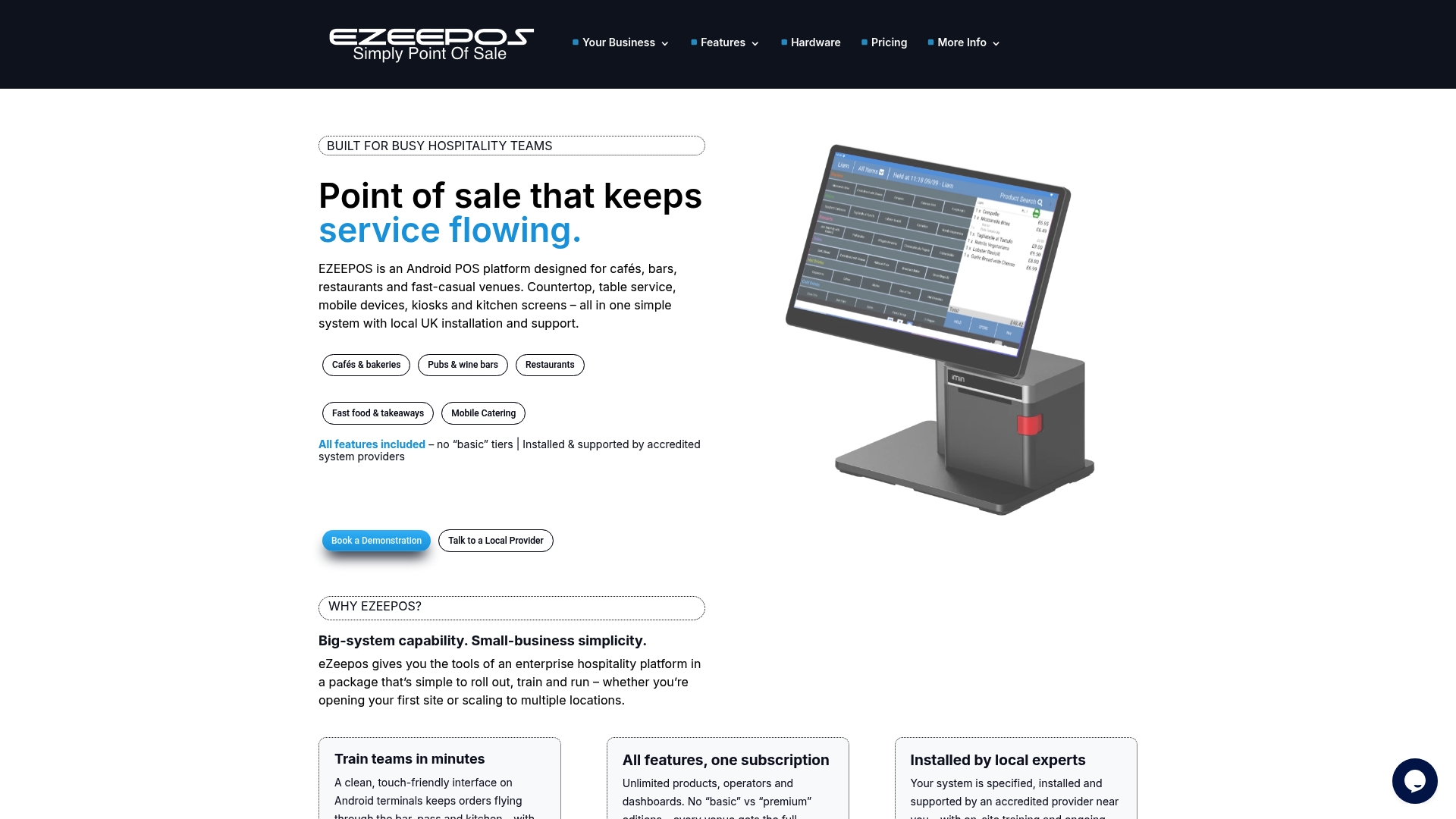
At EzeePOS, we work with UK hospitality venues every day to match the right systems to the right operations. Whether you need to compare POS solutions side by side, get practical inventory management guidance tailored to your venue type, or simply talk through your options with someone who understands UK hospitality, we are here to help. Find out more about how we support venues from initial setup through to ongoing training and local accredited installation.
Frequently asked questions
What are the absolute essentials for a restaurant tech stack in 2026?
The core essentials are a robust POS system, online and contactless ordering tools, integrated payments for VAT compliance, real-time inventory control, and staff scheduling software. All five categories are considered non-negotiable for UK venues operating at scale in 2026.
How much should UK venues budget for technology upgrades?
UK tech spend reached 9% of sales by 2022, and most operators plan to increase that figure in 2026, particularly for online ordering and automation tools. Use 9% of projected annual sales as your starting benchmark.
Which POS provider is best for small cafes in the UK?
Square suits small venues due to its ease of use, free entry-level plan, and low transaction-based pricing. It is a practical starting point before scaling to a more feature-rich platform.
How can tech help UK restaurants reduce food waste?
Modern inventory management systems can cut food waste by up to 15% through real-time stock tracking, automatic low-stock alerts, and waste logging that highlights patterns over time.
Should independent restaurants prioritise AI and automation in 2026?
AI and automation offer genuine long-term value but should not take priority over foundational systems. Get your POS, ordering, and inventory tools working reliably first, then explore automation as a next step.
Recent Comments