
TL;DR:
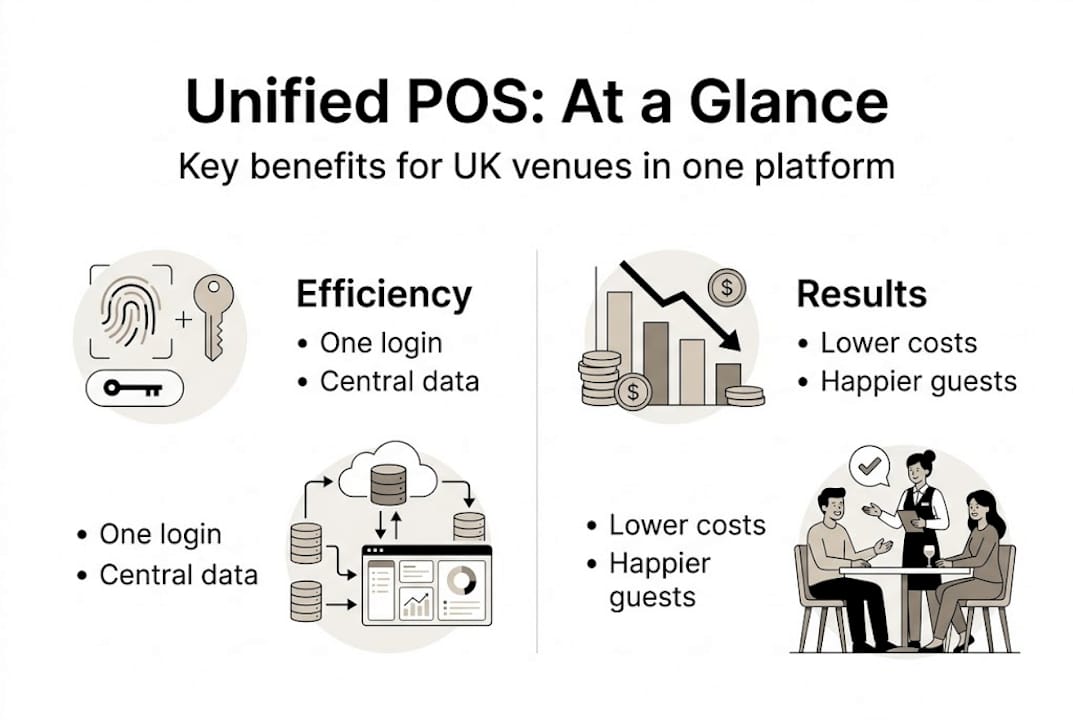
- Unified POS platforms centralize sales, inventory, staff management, and reporting, reducing errors and costs.
- Switching to a true unified POS can cut admin time by 30-40% and food waste by up to 45%.
- It enhances customer experience through real-time data sharing, personalization, and consistent service.
Running a hospitality venue on separate, siloed systems is like trying to cook a full service with every chef in a different kitchen. The orders get confused, the timings fall apart, and someone always ends up guessing. Many UK venues still juggle distinct POS terminals, standalone inventory tools, and disconnected staff management software, each doing its own thing. The hidden cost is enormous: duplicated data entry, reconciliation errors, and staff wasting precious minutes switching between platforms. Unified POS platforms centralise sales, inventory, staff management, and reporting, ending the fragmented system chaos that quietly erodes your margins and your team’s morale.
Table of Contents
- What is a unified POS platform?
- How unified POS transforms operations and cuts costs
- Enhancing customer experience and loyalty
- Selecting the right unified POS for your venue
- Why most venues underestimate the power of true unification
- Ready to streamline your venue operations?
- Frequently asked questions
Key Takeaways
| Point | Details |
|---|---|
| Unified POS means true integration | A unified POS connects sales, inventory, staff, and reporting in one system, ending fragmented tech headaches. |
| Efficiency cuts costs fast | Venues achieve 30-40% administrative time savings, less downtime, and rapid ROI from operational streamlining. |
| Guest experience improves | With a unified POS, service is consistent and personalised from bar to takeaway, driving repeat visits. |
| Assess systems before committing | Only platforms built as truly unified—not patched together—deliver lasting reliability and measurable results. |
What is a unified POS platform?
A unified POS platform is a single system that handles everything your venue needs: sales transactions, stock control, staff scheduling, customer data, and real-time reporting, all from one place, on one provider’s infrastructure. There is no patching together of third-party apps. There is no hoping that tonight’s integration does not break during a Friday evening rush.
It helps to understand the three types of systems in the market. True unified POS is built by one provider, sharing a single database and native architecture throughout. Best-of-breed is where you choose the strongest specialist tool for each function, then attempt to connect them via APIs. Patchwork systems are the most common trap: a venue buys what feels like one product, but underneath it is a collection of acquired tools bolted together with fragile connections.
| System type | Architecture | Reliability risk | Innovation speed |
|---|---|---|---|
| True unified POS | Single provider, native | Low | High |
| Best-of-breed | Multi-vendor APIs | Medium | Variable |
| Patchwork | Acquired bolt-ons | High | Slow |
The patchwork trap is especially common in the UK market, where legacy providers have grown by acquisition rather than by building. As Hospitalitynet notes, beware platforms that present themselves as unified but are, in reality, patchwork integrations. True unification uses native, single-provider architecture for reliability and ongoing innovation.
“A patchwork system will always show its seams at the worst possible moment: a Saturday night with a full house and an API timeout.”
Pro Tip: Ask any POS provider directly whether all modules share a single database. If they hesitate or describe ‘seamless integration between partners,’ that is a red flag worth noting.
Exploring the benefits of unified POS before committing to any purchase will give you the questions you need to ask suppliers.
How unified POS transforms operations and cuts costs
The operational case for a unified POS is not theoretical. The numbers are striking. Venues switching to genuine unified platforms report a 30 to 40% reduction in admin time, an 80% drop in system downtime, a 10 to 20% decrease in overall operational costs, and a 15 to 25% reduction in food and drink waste. Venues using AI-driven inventory features within unified systems have seen waste fall by up to 45%.
Why does this happen? Because data flows in real time across every function. When a bartender marks a cocktail sold, stock levels update instantly. When a chef updates an ingredient count, the front-of-house system reflects it immediately. There is no duplicate entry and no reconciliation headache the morning after.
Here is what changes day to day when you make the switch:
- Admin time falls sharply. Staff stop manually cross-referencing systems.
- Stock waste drops. Real-time inventory means over-ordering becomes visible before it happens.
- Staffing costs align with demand. Reporting tools surface peak periods and quiet patches with precision.
- Errors at the till reduce. One source of truth means no mismatched pricing between departments.
For venues serious about streamlining workflow with POS, the gains compound quickly. Consider a busy café running separate stock software: every morning, a manager reconciles last night’s sales manually against the fridge count. With a unified system, that reconciliation is automatic and complete before anyone arrives for the breakfast shift.
Pro Tip: Cloud-based unified POS platforms deliver the fastest return on investment because updates are automatic, downtime is minimised, and you can access reports from anywhere. Explore cutting downtime in UK venues to understand the operational advantage. Pairing this with smart POS integration for cost reduction compounds your savings further.
Enhancing customer experience and loyalty
Efficiency savings matter, but so does what your guests actually feel when they walk through your door. Unified POS has a direct and measurable impact on service quality. When your bar, restaurant, and takeaway counter all draw from the same system, the guest experience becomes consistent. An order placed at the bar is visible in the kitchen instantly. A dietary note added to a customer’s profile appears at every service point.
CRM features within unified platforms take this further. Staff can see returning guests’ preferences, flag allergens, and make personalised recommendations without any awkward pausing to look things up. This is the kind of attentive service that drives repeat visits. As research shows, unified POS enhances guest experience through consistent service, accurate orders, personalised recommendations, and higher rates of repeat visits.
Here is how it plays out across a typical multi-service venue:
- A guest orders at the bar and requests a table when one becomes available.
- Staff can see real-time table status without phoning the floor.
- The guest’s order history and preferences are visible when they sit down.
- Their favourite dish is flagged as available tonight, and they are told without being asked.
For venues working to improve guest service with POS, this level of personalisation was once only possible at high-end establishments with expensive bespoke software. Now it is available to any venue on a unified platform.
“The most profitable loyalty is the kind the guest does not notice consciously. They just keep coming back because every visit felt right.”
Pubs in particular stand to benefit significantly. Managing a busy bar alongside a restaurant and a Sunday carvery requires real-time menu and stock consistency across every counter. Efficiency in pubs improves dramatically when the system behind the bar knows exactly what the kitchen has in stock.
Selecting the right unified POS for your venue
Knowing unified POS is valuable is one thing. Choosing the right one takes a structured approach. The market is full of providers making bold claims, so verifying those claims matters enormously.
Follow this process when evaluating suppliers:
- Map your venue’s needs first. List every function you currently use across all your systems: stock management, table plans, staff rotas, reporting, payment processing.
- Ask for a live demo on a single database. If the demo requires switching between modules or logging into separate screens, the system is not truly unified.
- Demand verified UK case studies. Request contact details for real UK venues using the platform, not just written testimonials.
- Confirm local support arrangements. Who answers the phone at 7pm on a Saturday when the system goes down?
- Assess scalability. Can the system grow with you from one site to five?
When assessing ROI, the key metrics to track in your first quarter include admin hours saved per week, stock waste percentage, table turn time, and repeat guest visits. As implementation evidence confirms, ROI is typically visible within 1 to 3 months through admin savings and profit improvements.
Pro Tip: Only invest in platforms that can prove real UK venue results. Ask specifically for venues similar to yours in size and service style. It is also worth knowing when to upgrade your POS to avoid investing in a system you will outgrow in a year.
For venues prioritising stock accuracy, reviewing how POS supports inventory control will clarify what to look for in a genuine unified platform.
Why most venues underestimate the power of true unification
There is a pattern we see repeatedly in UK hospitality: managers know their current setup is imperfect, but they stick with it because changing feels riskier than staying. The familiar patchwork of systems feels manageable, even if it means a weekly reconciliation headache and a team that loses faith in the data.
This caution is understandable but expensive. The real cost is not just wasted admin hours. It is the slow erosion of decision-making confidence when your reports from three different systems never quite agree. It is the team member who stops trusting the stock count and starts guessing.
Unified POS systems offer a single source of truth, directly addressing the tight margins and rising costs that define UK hospitality in 2026. This is not just a technology decision. It is a leadership decision about whether your venue operates with clarity or chronic guesswork. The venues pulling ahead are not those with the most complex tech stacks. They are the ones where every team member trusts the same data, every morning, without question.
Ready to streamline your venue operations?
If the operational gains and service improvements described here resonate, the next step is straightforward. Exploring what a genuinely unified system looks like in practice is far more revealing than reading another brochure.
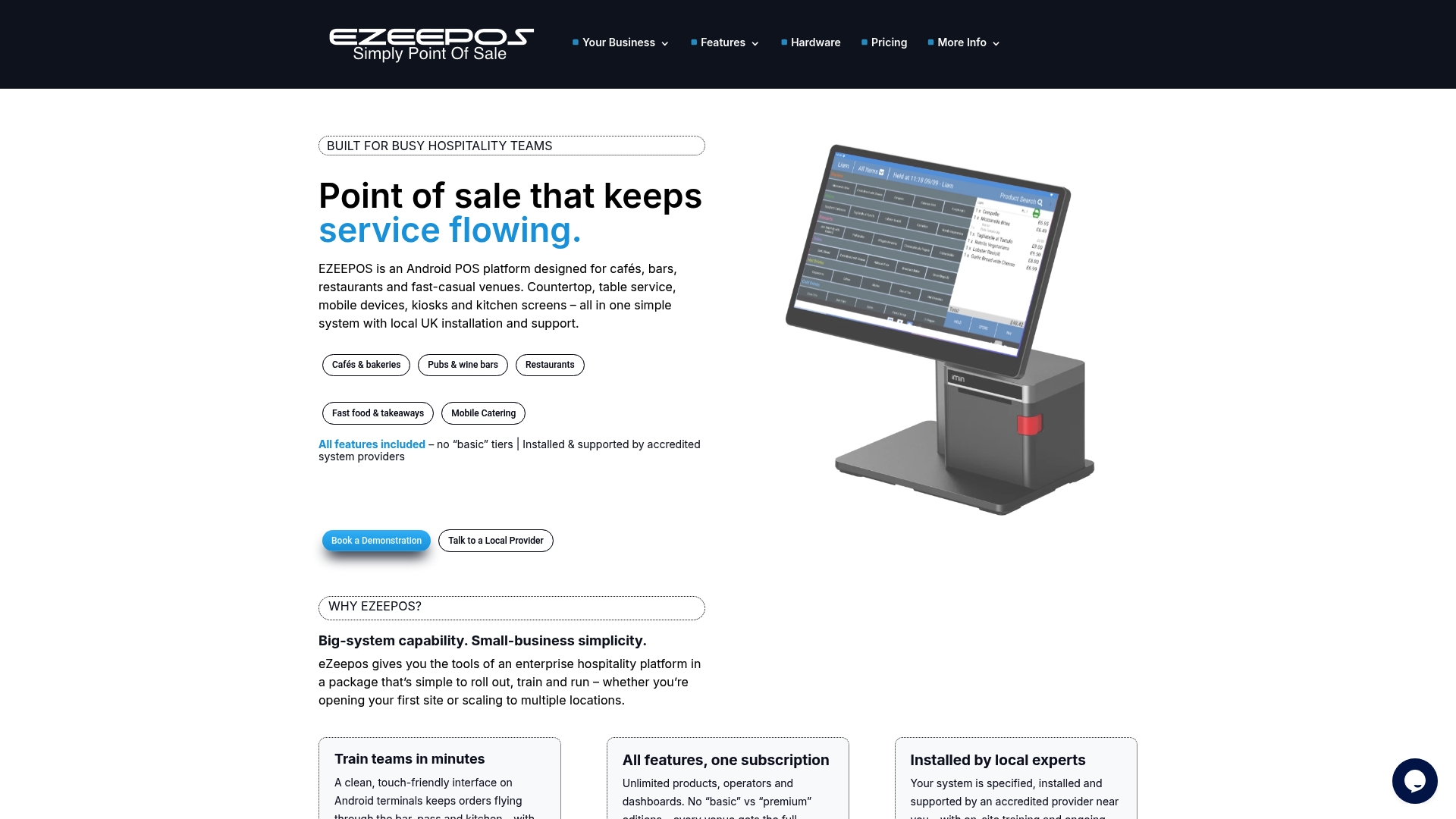
The eZeepos unified POS platform is built specifically for UK hospitality venues, from busy city bars to multi-service restaurants and mobile catering. With local installation, accredited UK support, and no tiered feature restrictions, it delivers everything in this article in one place. You can see the full unified POS benefits before committing, or explore the cloud POS technology that keeps venues running even when everything else is under pressure.
Frequently asked questions
How does a unified POS platform differ from integrated POS?
A unified POS uses a single provider for all functions on one native architecture, while integrated POS patches together separate systems that can cause reliability issues and innovation delays.
What specific cost savings can UK venues expect from unified POS?
UK venues typically see a 10 to 20% reduction in operational costs and a 15 to 25% drop in food waste once a unified platform is in place.
How quickly can I measure ROI after switching to a unified POS?
Most venues find ROI appears within 1 to 3 months, driven by reduced admin workloads, lower waste, and higher table profitability.
Can a unified POS improve multi-service venues with bars, restaurants, and takeaways?
Absolutely. Unified systems ensure menu and inventory consistency across every service point without duplicate entry or conflicting stock counts.
Recent Comments