
TL;DR:
- An integrated EPOS system seamlessly connects sales, inventory, kitchen, and reporting functions, transforming hospitality operations. It reduces manual errors, speeds service, and provides real-time data vital for multi-site management and compliance. Proper implementation depends on reliable network, staff training, and choosing user-friendly, resilient solutions tailored for UK venues.
Most venue owners know they need a point of sale system. Far fewer realise that a basic till and a genuinely integrated EPOS are worlds apart in what they can do for a busy hospitality business. The top-performing cafés, restaurants, and bars in the UK are not succeeding by luck. They are using integrated systems that silently connect every transaction, stock movement, kitchen order, and sales report into one seamless operation. Understanding what that actually means, and how to apply it, could be the most practical decision you make for your venue this year.
Table of Contents
- What does integrated EPOS really mean?
- How integrated EPOS transforms hospitality operations
- Key features to look for in an integrated EPOS
- Potential challenges and how to overcome them
- How to select the best integrated EPOS for your venue
- Why the best integrated EPOS solutions put people before tech
- Discover integrated EPOS designed for UK hospitality
- Frequently asked questions
Key Takeaways
| Point | Details |
|---|---|
| Integrated EPOS definition | An integrated EPOS unifies sales, inventory, and operations for seamless hospitality management. |
| Business impact | A well-chosen EPOS system improves speed, accuracy, and guest satisfaction in busy venues. |
| Key features to prioritise | Look for inventory sync, offline mode, kitchen display integration, and multi-site support. |
| Pitfalls to avoid | Network outages can halt operations, so always check for offline capabilities and robust support. |
| People over technology | The best EPOS empowers staff and complements real-world hospitality, not just flashy features. |
What does integrated EPOS really mean?
EPOS stands for Electronic Point of Sale, and it is a term widely used across the UK hospitality sector. The word “electronic” distinguishes it from a manual till, but that alone tells you very little. What genuinely separates a modern integrated EPOS from a standalone system is the depth of connection between its components.
A truly integrated EPOS brings together:
- Sales processing across all service points, whether that is a bar counter, a table, or a self-service kiosk
- Inventory management that automatically deducts stock with every order placed
- Payment processing, supporting card, contactless, and mobile payments without a separate terminal
- Kitchen display systems that relay orders instantly without paper tickets
- Reporting and analytics that pull live data from every part of the business
- Customer management, including loyalty schemes, accounts, and purchase history
A standalone POS, by contrast, handles the transaction and little else. You might export a daily sales figure, but there is no automatic link to your stock levels, no kitchen communication, and no unified reporting. You are left filling in the gaps manually, which costs time and introduces error.
The distinction matters because many hospitality venues have purchased so-called “modern” systems that are still, functionally, isolated terminals. If you are learning the hospitality EPOS essentials for the first time, understanding this gap is where your thinking should start.
It is also worth noting that integrated systems, particularly cloud-based ones, depend heavily on network reliability. As specialists at Splash Access observe, if connectivity fails, venues may need offline resilience or fallback workflows, including local operation or alternative payment routes. This is not a reason to avoid integrated EPOS, but it is an important consideration when choosing one.
Network resilience should be part of your checklist from day one, not an afterthought.
How integrated EPOS transforms hospitality operations
Once you understand what integration means, you can start to appreciate the real difference it makes on the floor. Think about a Friday evening service at a mid-sized restaurant. Without integration, a server writes down an order, walks to a terminal, inputs it, and hopes the kitchen printer does not jam. Stock is updated at end of day, possibly by hand. Payment involves a separate card machine. Mistakes happen. Time is lost.
With an integrated EPOS, the same scenario looks like this:
- A server takes the order at the table on a handheld device
- The kitchen display screen updates instantly, with no paper ticket
- Inventory is automatically deducted as dishes are prepared
- The bill is ready at the table before the guest even asks
- End-of-day reports are generated automatically from live data
- Management can review performance from any device, anywhere
That is not a marginal improvement. It is a structural change in how your venue operates.
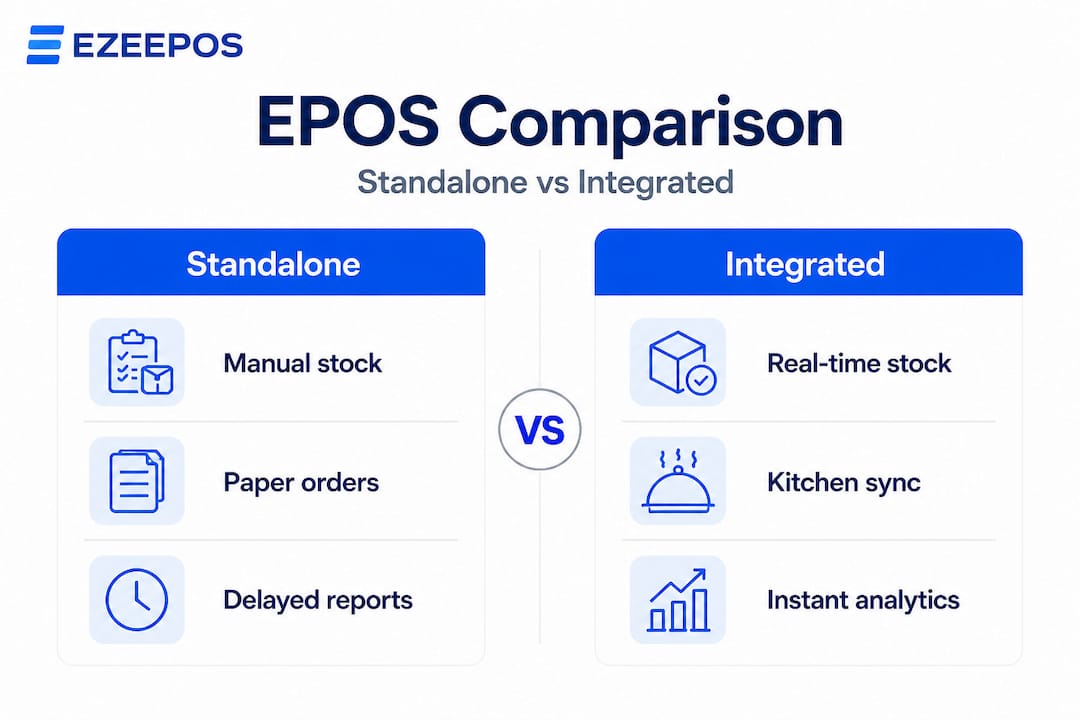
| Feature | Standalone till | Integrated EPOS |
|---|---|---|
| Real-time stock updates | No | Yes |
| Kitchen communication | Manual | Automated |
| Sales reporting | End of day, manual | Live and automated |
| Payment integration | Separate terminal | Unified |
| Multi-site management | Not possible | Yes |
| Staff error reduction | Limited | Significant |
The impact compounds across a multi-site operation. When inventory control with POS is unified across venues, managers can compare performance, transfer stock intelligently, and identify which locations are over-ordering or running low before it becomes a problem. The unified POS benefits for operators running more than one site are particularly significant in terms of time saved and data quality.
There are excellent hospitality business optimisation strategies available for venues looking to sharpen their overall efficiency, and nearly all of them assume you have a solid data foundation. Integrated EPOS is what creates that foundation.
Pro Tip: During peak service, the biggest risk is human error under pressure. An integrated system removes several manual steps, which means fewer mistakes reach the kitchen or the payment terminal. Train your team on the system during a quieter period so it becomes second nature before the rush.
Key features to look for in an integrated EPOS
Not all integrated EPOS solutions are created equal. When you are evaluating options for your venue, there are specific features that will define whether the system genuinely supports your operation or simply adds another layer of complexity.
Here is what to look for:
- Real-time inventory tracking that updates automatically with each sale, preventing over-selling and reducing waste
- Kitchen display system (KDS) integration so orders flow from front of house to kitchen without delay or miscommunication
- Flexible payment options including card, contactless, split bills, and tabs, all processed within the same system
- Cloud-based back office giving you access to reports, staff schedules, and stock data from any device, at any time
- Customer accounts and loyalty features to support repeat business and targeted promotions
- Multi-site capability if you operate or plan to operate more than one venue
- Open API or modular add-ons so the system can integrate with booking platforms, accounting software, or delivery services as your needs grow
- Offline mode as a genuine operational safeguard. As connectivity issues show, cloud EPOS systems need fallback options when the network drops
Understanding the different types of POS systems is helpful when comparing providers, because the hardware configuration matters as much as the software. A kiosk setup in a quick-service environment has very different requirements from a tablet-based system for table service.
It is also worth thinking about why integration matters not just for efficiency but for compliance. UK venues have obligations around VAT reporting, allergen information, and staff wage tracking. A well-integrated EPOS can pull much of this data automatically, reducing the manual burden on management.
Pro Tip: Do not be dazzled by feature lists. Ask each provider to demonstrate exactly how their system handles your busiest service scenario. If they cannot show it live, that tells you something important about how it will perform under real-world pressure.
Potential challenges and how to overcome them
Integrated EPOS can transform your venue, but going in without awareness of the challenges is a mistake. Most venues encounter at least one significant friction point during implementation or ongoing use. Knowing them in advance puts you in a far stronger position.
| Challenge | Operational impact | Recommended solution |
|---|---|---|
| Network outages | Payments fail, orders stall | Choose a system with offline mode and fallback procedures |
| Staff resistance | Slow adoption, errors increase | Invest in proper onboarding and hands-on training |
| Data migration | Historical stock and sales data lost | Plan migration carefully with provider support |
| Hardware failure | Service disruption | Use cloud-synced systems so data is never on a single device |
| Poor support | Unresolved issues during service | Choose a provider with UK-based, responsive human support |
The connectivity issue deserves particular attention. Cloud EPOS reliability depends on your broadband connection, and a poor or intermittent signal during a busy service is not just inconvenient, it is costly. Before committing to any system, test your venue’s connectivity honestly and ask your provider what happens when it drops.
Staff adoption is the other major variable. A technically brilliant system will underperform if your team does not trust it or understand how to use it. The most effective venues approach this by involving staff in the selection process, running practice sessions during off-peak hours, and appointing an internal champion who can answer questions on the floor.
“Even the best integrated EPOS is only as effective as the team using it. Systems that prioritise intuitive design and fast training cycles consistently outperform those with more features but steeper learning curves.”
Support responsiveness is non-negotiable. If something goes wrong during a Saturday evening service, you need someone answering the phone, not a chatbot or a three-day email queue. Prioritise providers with dedicated UK-based support teams. Resources on streamlining POS operations are useful for refining your approach once the system is live.
Some further practical safeguards to build in:
- Keep a documented offline procedure your team can follow if the system goes down
- Ensure at least two members of staff are trained as system administrators
- Schedule regular system audits to check that stock data and sales figures are aligned
How to select the best integrated EPOS for your venue
Knowing what features to look for and what challenges to avoid is valuable, but the actual selection process needs structure. Here is a practical approach designed specifically for UK hospitality venues.
-
Assess your current operation honestly. Where are the bottlenecks? Is it order accuracy, stock visibility, payment speed, or reporting? Your biggest pain point should drive your selection criteria.
-
Shortlist providers with hospitality-specific experience. Generic retail POS systems are not built for the rhythms of food and drink service. Focus on vendors who specialise in your sector.
-
Evaluate integration depth. Ask specifically how the system connects sales, inventory, kitchen, and payment. Request a live demonstration, not just a slide deck.
-
Test ease of training with your actual staff. Bring two or three team members to a demo. If they are confused by the interface within 20 minutes, that system will cause problems on the floor.
-
Check references from UK hospitality venues. A case study from a pub or restaurant group that operates in a similar environment to yours carries far more weight than generic testimonials.
-
Review the support model in detail. Ask who answers the phone at 7pm on a Saturday and what the average response time is. This is not a trivial question.
-
Confirm offline capability and network requirements. As network resilience guidance consistently emphasises, venues need to know what happens when connectivity is interrupted, before they are in the middle of a busy service.
Reviewing what strong back office POS efficiency looks like in practice can also help you frame the right questions for potential providers.
Pro Tip: Prioritise vendors who offer dedicated hospitality onboarding, not just a PDF guide and a helpdesk number. Onboarding that includes hands-on setup at your venue, tailored to your menu and service style, dramatically reduces the time to confident use and prevents early errors.
Why the best integrated EPOS solutions put people before tech
There is a tendency in the technology conversation around hospitality to focus relentlessly on features. Contactless ordering, AI-driven upselling, real-time dashboards. These things have value, but they are not what separates venues that use EPOS well from those that struggle.
The best operators we have encountered treat their EPOS as a force multiplier for their staff, not a replacement for human judgement. A great kitchen team supported by a reliable kitchen display system is more effective than an average team overwhelmed by a complicated interface. The technology should make people better at their jobs, not add cognitive load during peak service.
What genuinely distinguishes a strong integrated EPOS in the real world is resilience and simplicity. Can it handle a busy Friday service without freezing? Does it keep working if the broadband drops? As operational guidance confirms, connectivity resilience is not a luxury feature, it is a fundamental operational requirement. A venue that cannot take payments or communicate orders to the kitchen for 20 minutes during a full service loses money, trust, and reviews.
We also believe that hospitality-centric design, the kind built around how a café or restaurant actually operates rather than around a software developer’s assumptions, is worth more than any individual feature. Choosing POS in fine dining or any other environment should start with the question: does this system make my team’s job easier and my guests’ experience better? If the answer is yes, everything else follows.
Discover integrated EPOS designed for UK hospitality
Running a busy hospitality venue means you cannot afford systems that slow you down or leave your team guessing. eZeepos is built specifically for UK hospitality venues of all types, from independent cafés to multi-site pub groups, and delivers the kind of seamless integration this article has described.
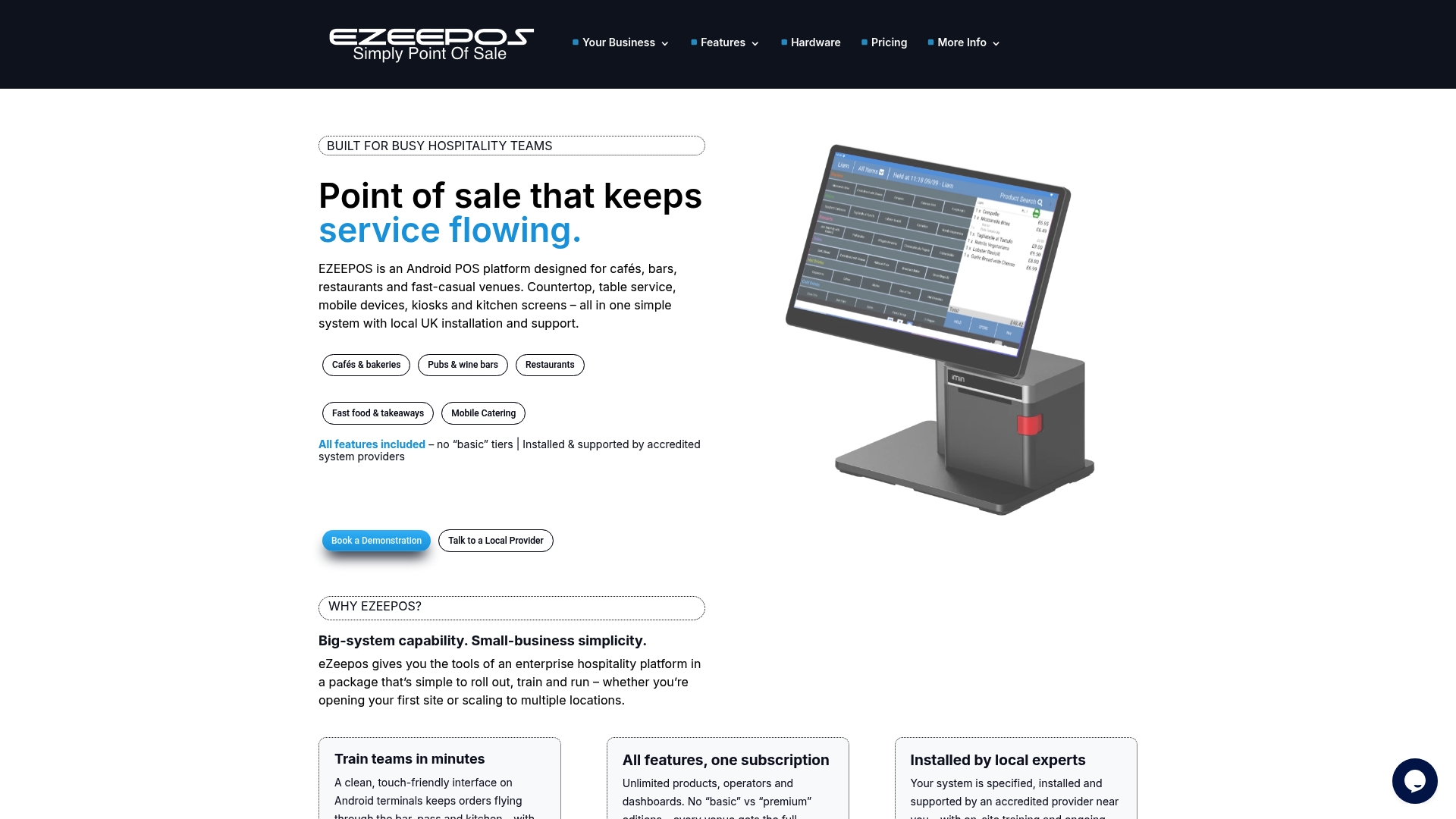
Whether you run counter service, table ordering, self-service kiosks, or a combination of all three, eZeepos connects every part of your operation in one unified platform. There are no tiered pricing structures that lock features away, and every installation is supported by accredited UK providers who know the hospitality sector. Explore the full range of benefits of unified POS and discover what hospitality EPOS solutions look like when they are designed around real venues. Request a demo and see it working in an environment that mirrors your own.
Frequently asked questions
How is integrated EPOS different from a regular POS?
Integrated EPOS joins inventory, sales, kitchen communication, and reporting in real-time, whereas a basic POS handles the transaction in isolation with no automatic data sharing between systems.
Do I need an internet connection for integrated EPOS to work?
Most integrated EPOS solutions rely on cloud connectivity, so a reliable internet connection is essential, though reputable providers offer offline operating modes as a backup for when the network is disrupted.
What is the biggest benefit of integrated EPOS for hospitality venues?
The single biggest benefit is the elimination of manual handoffs between systems, which reduces errors, speeds up service, and gives management accurate, live data without end-of-day manual reconciliation.
What support do I need to run integrated EPOS successfully?
You need a stable broadband connection, responsive UK-based technical support, and structured staff training. All three are essential because a system is only as reliable as the infrastructure and the people operating it, as connectivity best practices for EPOS consistently confirm.
Recommended
- What is hospitality EPOS? Essential systems for UK venues
- Role of POS in Catering: Streamlining UK Hospitality
- How the back office boosts POS efficiency in UK hospitality
- Hospitality Promotions Workflow: Cut Errors 40% & Boost Sales
- Hotel and Restaurant Business Optimization — Wits End
- Restaurant customer experience best practices for loyalty
Recent Comments