

Many hospitality venue owners assume all point of sale systems deliver the same results. That assumption costs money, time, and customer satisfaction. Enterprise-level POS systems offer advanced capabilities that transform multi-site operations, streamline service, and drive measurable revenue growth. This guide explains what sets enterprise-level POS apart from basic solutions, backed by real-world performance data from UK hospitality venues. You’ll discover the operational benefits, technical challenges, and practical selection criteria that help mid-sized businesses choose the right system for sustainable growth.
Table of Contents
- What Enterprise-Level POS Means For UK Hospitality Venues
- Operational Benefits And Performance Benchmarks Of Enterprise-Level POS
- Technical Challenges And Integration Nuances Of Enterprise POS
- Choosing And Implementing Enterprise POS Solutions For UK Mid-Sized Venues
- Explore Reliable Enterprise-Level POS Systems For UK Hospitality
Key takeaways
| Point | Details |
|---|---|
| Centralised multi-site control | Enterprise POS enables unified management across multiple venues with consistent configuration and reporting |
| Measurable performance gains | Systems deliver 25% faster transactions, 40% fewer order errors, and 15% revenue growth through operational efficiency |
| Local UK support matters | UK-based providers ensure HMRC Making Tax Digital compliance and responsive support tailored to hospitality challenges |
| Offline resilience essential | Advanced queuing and synchronisation maintain operations during network failures and peak service periods |
| Scalability without disruption | Enterprise systems grow with your business through phased implementation and flexible deployment models |
What enterprise-level POS means for UK hospitality venues
Enterprise-level POS systems provide centralised governance and scalability across multiple sites, distinguishing them fundamentally from single-location solutions. These platforms enable hospitality groups to manage several venues from one unified back office, maintaining consistent pricing, menus, promotions, and reporting across every location. When you update a menu item or adjust pricing, the change propagates instantly to all terminals across your estate.
Scalability sits at the core of enterprise POS architecture. As your business expands from three locations to ten, the system adapts without requiring wholesale replacement or costly migrations. Advanced reporting aggregates data across venues, revealing patterns in sales, inventory movement, and staff performance that single-site systems simply cannot surface. You gain visibility into which dishes perform best at each location, where wastage concentrates, and how service speed varies by site and shift.
Enterprise systems integrate seamlessly with third-party services including accounting software, inventory suppliers, delivery platforms, and payment processors. This interoperability eliminates manual data entry and reduces errors that plague disconnected systems. HMRC Making Tax Digital compliance comes built in, automating VAT reporting and maintaining audit trails that satisfy regulatory requirements.
Contrast this with SMB POS solutions designed for single locations. These systems lack centralised control, forcing managers to configure each terminal individually. Reporting remains siloed by location, requiring manual consolidation. Integration options prove limited, creating data islands that demand duplicate entry. For mid-sized hospitality groups managing multiple venues, these limitations create operational friction that compounds as you grow. Defining hospitality POS helps clarify which features matter most for your specific service model.
Key enterprise-level capabilities include:
- Cloud-based central management for real-time oversight across all locations
- Role-based access controls ensuring staff see only relevant functions
- Advanced inventory tracking with automated reordering and wastage alerts
- Comprehensive analytics dashboards revealing trends and opportunities
- API connectivity for seamless third-party integrations
Operational benefits and performance benchmarks of enterprise-level POS
Data from UK hospitality venues demonstrates concrete performance improvements from enterprise-level POS implementation. The Laine pub company achieved 25% faster transactions, 40% reduction in order errors, and 15% revenue growth after deploying an integrated enterprise system across their estate. These metrics translate directly to better customer experiences and healthier profit margins.
Transaction speed improvements stem from optimised workflows and intuitive interfaces that reduce the steps required to process orders. When servers spend less time navigating complex menus or correcting entry mistakes, tables turn faster and queues shorten. A 25% reduction in transaction time means a venue processing 200 orders during peak lunch service saves roughly 50 minutes of cumulative wait time daily. That efficiency compounds across weeks and months.
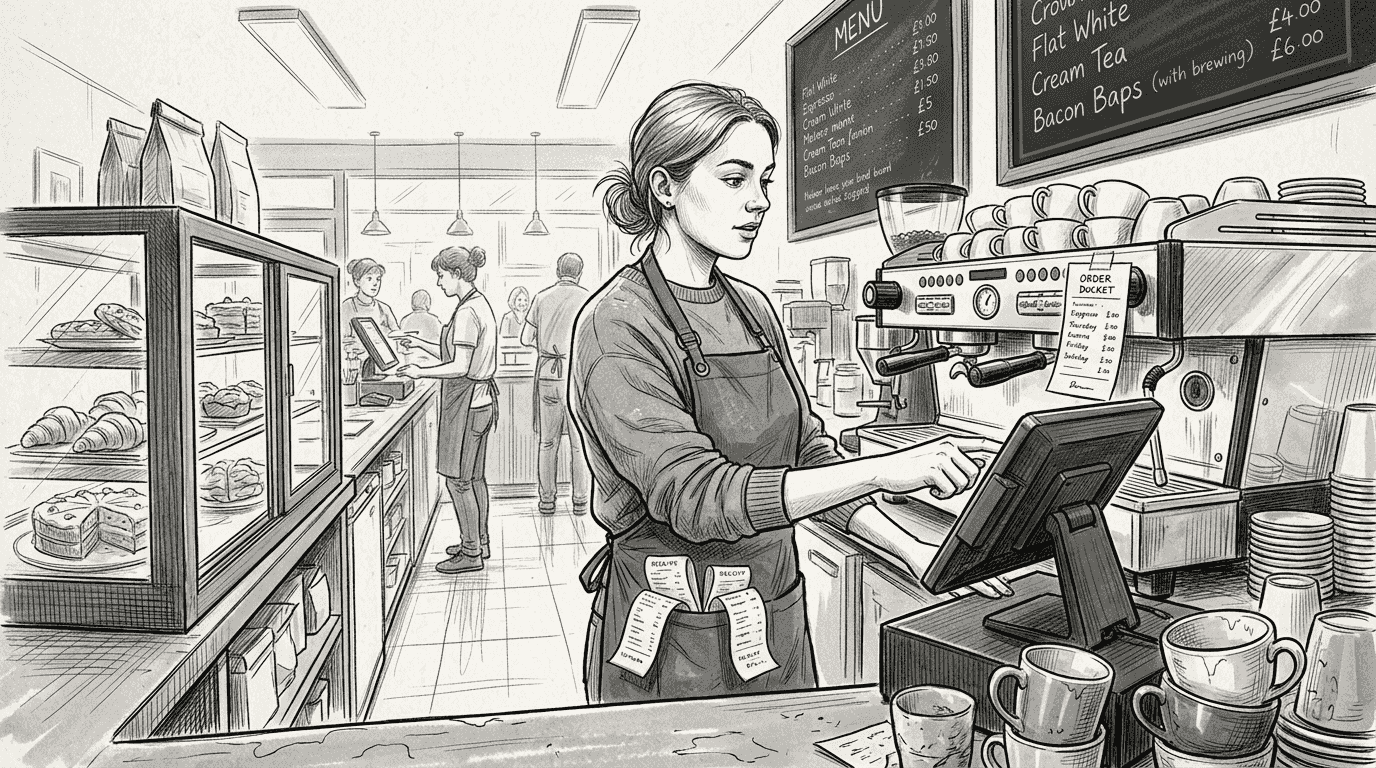
Order accuracy improvements deliver dual benefits. Fewer errors mean less food wastage from incorrect preparation, directly reducing cost of goods sold. Simultaneously, customer satisfaction rises when orders arrive as requested, reducing complaints and negative reviews. A 40% drop in order errors for a busy restaurant preparing 300 meals daily prevents 120 mistakes weekly, saving both ingredients and reputation.
Revenue growth of 15% emerges from multiple sources. Faster service enables higher table turnover during peak periods. Improved accuracy reduces comped meals and refunds. Better inventory management prevents stockouts of popular items whilst reducing over-ordering of slow movers. Detailed analytics reveal upselling opportunities and optimal pricing strategies. These factors combine to lift top-line revenue without proportional increases in costs.
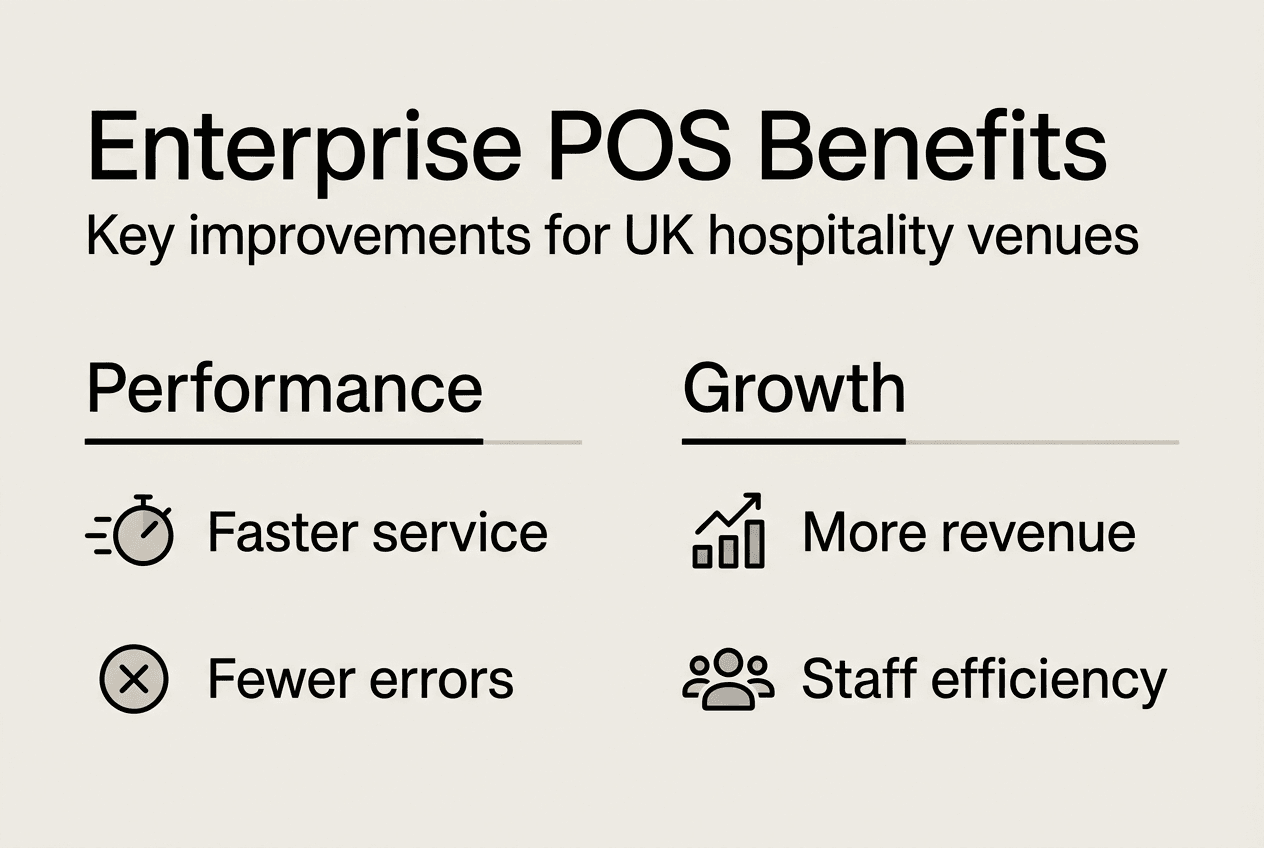
Cash-up time reductions free staff for customer-facing activities. Enterprise POS systems automate end-of-day reconciliation, reducing a 45-minute manual process to under 10 minutes. Managers spend less time counting tills and more time coaching teams or engaging with guests. Understanding hospitality POS success requires examining these operational efficiency gains in context.
| Metric | Improvement | Business Impact |
|---|---|---|
| Transaction speed | 25% faster | Higher table turnover, shorter queues |
| Order accuracy | 40% fewer errors | Reduced wastage, improved satisfaction |
| Revenue growth | 15% increase | Better margins without proportional cost rises |
| Cash-up time | 75% reduction | More staff time for customer service |
Pro Tip: Track baseline metrics before implementing enterprise POS, then measure monthly for six months post-deployment. This data proves ROI and identifies areas needing workflow adjustments.
Technical challenges and integration nuances of enterprise POS
Fragmented POS terminal deployments create cascading failures that disrupt service and corrupt data. When integration failures cascade through ordering and payment systems, a single misconfigured terminal can trigger order routing errors affecting kitchen displays, payment processing, and inventory tracking simultaneously. These failures amplify during peak service when staff lack time to troubleshoot.
Configuration drift poses a subtle but serious threat to multi-site operations. As individual locations make local adjustments to menus, pricing, or workflows, inconsistencies emerge across the estate. A customer ordering the same dish at two different venues encounters different prices or ingredients. Centralised configuration management prevents this drift by enforcing consistency whilst allowing controlled local variations where genuinely needed.
Offline operation capability proves essential during network outages or peak demand periods that saturate connectivity. Enterprise POS systems queue transactions locally when internet connectivity drops, then synchronise automatically once connection restores. This resilience ensures uninterrupted service during failures that would paralyse cloud-only systems. Venues in areas with unreliable connectivity or those experiencing extreme peak loads require robust offline modes.
Hybrid deployment models combining cloud and on-premises infrastructure provide redundancy and performance. Core data resides in the cloud for centralised access and backup, whilst local servers cache frequently accessed information and process transactions with minimal latency. This architecture delivers cloud benefits without cloud vulnerabilities. If internet fails, local processing continues seamlessly.
“Integration failures don’t just slow service—they create data inconsistencies that take days to reconcile and erode trust in your reporting. Robust enterprise POS prevents these cascading failures through proper architecture.”
Common technical challenges include:
- API versioning conflicts when third-party services update without coordination
- Database synchronisation delays causing temporary inventory discrepancies
- Payment gateway timeouts during high-volume periods
- Kitchen display screen lag affecting order preparation timing
- Backup and disaster recovery complexity across distributed systems
Addressing these challenges requires selecting unified POS platforms designed specifically for multi-site hospitality environments. Generic retail POS systems lack the specialised features needed to handle table service, kitchen routing, and split billing that hospitality demands. Purpose-built platforms anticipate these requirements and architect solutions accordingly.
Pro Tip: Demand detailed service level agreements covering uptime guarantees, maximum response times for critical failures, and compensation for prolonged outages. These contractual protections matter when system failures directly impact revenue.
Choosing and implementing enterprise POS solutions for UK mid-sized venues
Selecting the right enterprise POS provider requires systematic evaluation of capabilities, support quality, and alignment with your operational model. UK venues should prioritise providers with local support, offline mode, and HMRC MTD compliance to ensure regulatory adherence and responsive assistance when issues arise. International providers may offer feature-rich platforms but lack understanding of UK-specific hospitality challenges and tax requirements.
Follow this structured selection process:
-
Assess current and projected scale: Document your current venue count, transaction volumes, and planned expansion over three years. Enterprise POS should accommodate 2-3x growth without architectural changes.
-
Evaluate UK hospitality experience: Request case studies from providers demonstrating successful deployments in similar venues. Generic retail experience doesn’t translate to hospitality’s unique requirements.
-
Test offline resilience: Simulate network failures during demonstrations to verify offline queuing and synchronisation work as claimed. Many providers oversell this capability.
-
Verify HMRC Making Tax Digital compliance: Confirm the system generates compliant VAT reports and maintains required audit trails. Non-compliance creates serious regulatory risk.
-
Examine support infrastructure: Identify support hours, response time commitments, and escalation procedures. UK-based support teams understand local context and respond during your operating hours.
-
Review integration ecosystem: Catalogue your existing accounting, inventory, and delivery platform integrations. Ensure the POS connects seamlessly without custom development.
-
Calculate total cost of ownership: Include hardware, software licences, implementation services, training, and ongoing support over five years. Cheap upfront costs often hide expensive long-term commitments.
-
Plan phased implementation: Roll out to one pilot location first, refine workflows, then expand systematically. Simultaneous deployment across all venues amplifies risk.
Implementation planning minimises disruption to ongoing operations. Schedule initial deployment during slower periods when staff can focus on training without peak service pressure. Maintain legacy systems in parallel for two weeks, allowing fallback if critical issues emerge. Assign super-users at each location who receive advanced training and serve as first-line support for colleagues.
Exploring hospitality POS systems for UK venues reveals the range of deployment models and feature sets available. Consider whether you need full restaurant POS with table management, quick-service focused systems, or hybrid platforms supporting multiple service styles. Your specific operational model determines which capabilities matter most. When ready to modernise, understanding how to upgrade POS system infrastructure ensures smooth transitions.
Explore reliable enterprise-level POS systems for UK hospitality
Mid-sized hospitality venues across the UK face unique operational challenges that demand purpose-built technology solutions. The right enterprise-level POS transforms multi-site management from a coordination headache into a strategic advantage. Trusted UK providers deliver systems designed specifically for hospitality workflows, combining advanced features with local support that understands your regulatory and operational context.
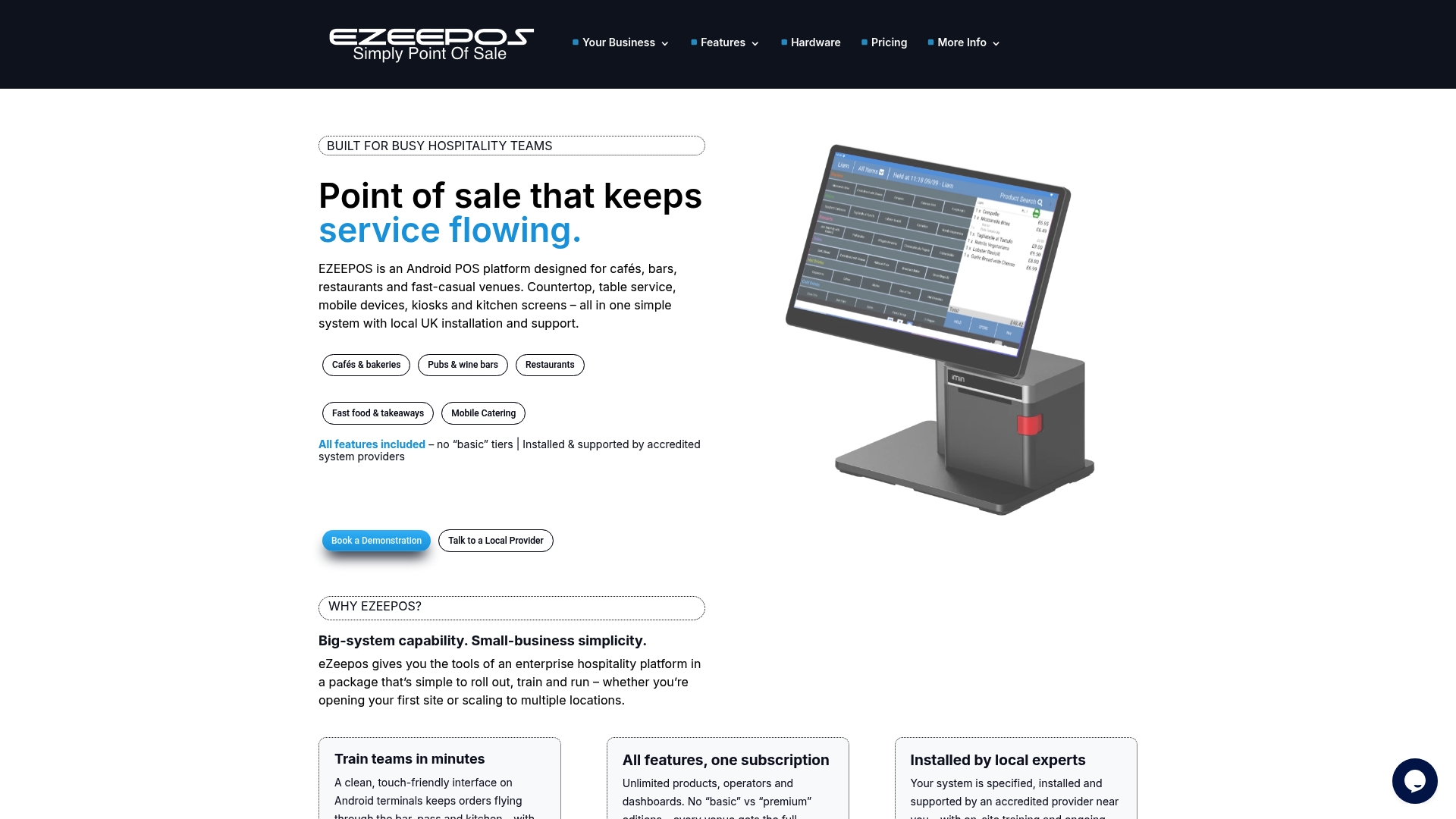
Discover comprehensive point of sale system UK hospitality solutions engineered for scalability and reliability. Explore the full range of types of POS systems for UK hospitality to identify which architecture suits your service model best. Implement proven tips for efficient POS operations that maximise your technology investment and elevate customer experiences across every location.
FAQ
What is the difference between enterprise-level and SMB POS systems?
Enterprise-level POS provides centralised control across multiple locations, advanced analytics, robust integration capabilities, and architecture designed for high-volume operations. SMB systems serve single locations well but lack the scalability, unified reporting, and sophisticated features required for multi-site hospitality groups. Enterprise platforms cost more upfront but deliver measurable ROI through operational efficiency and growth enablement.
How do enterprise POS systems handle offline operation and data syncing?
Enterprise POS queues transactions locally when network connectivity drops, allowing uninterrupted service during outages. Once connection restores, queued transactions synchronise automatically to central databases, updating inventory, sales reports, and accounting records. This architecture ensures resilience during peak periods or infrastructure failures that would paralyse cloud-only systems.
Why is choosing a UK-based POS provider beneficial for hospitality venues?
UK-based providers understand local hospitality challenges, ensure HMRC Making Tax Digital compliance, and deliver support during your operating hours. They architect systems around British service models, tax requirements, and payment preferences. Local providers respond faster to urgent issues and provide on-site assistance when remote troubleshooting proves insufficient.
How long does enterprise POS implementation typically take for mid-sized venues?
Phased implementation for a three to five location hospitality group typically requires 8-12 weeks from contract signing to full deployment. This includes hardware procurement, software configuration, staff training, pilot location rollout, refinement, and systematic expansion to remaining venues. Rushing implementation increases failure risk, whilst excessive delays prolong inefficiencies.
What ongoing costs should venues budget for enterprise POS systems?
Budget for software licence fees, payment processing charges, hardware maintenance, system updates, staff training, and support services. Expect annual costs of 2-4% of revenue for comprehensive enterprise POS, including all components. This investment delivers returns through faster service, reduced errors, better inventory control, and data-driven decision making that lifts profitability.
Recent Comments