

TL;DR:
- Understanding core hospitality tech terms reduces errors and improves operational efficiency.
- Proper system integration and staff training prevent costly overbookings and mischarges.
- Embracing AI, automation, and unified platforms enhances revenue and guest experience.
Misunderstanding a single tech term can cost a UK hospitality venue real money. A sync failure between systems can trigger overbookings, misapplied charges, and frustrated guests before anyone realises what went wrong. Yet most of these problems are entirely avoidable once your team understands the language behind the tools. This guide breaks down the core terminology you encounter daily, explains how these systems connect, and shows what happens in practice when you get it right. Whether you manage a busy bar, a boutique hotel, or a fast-casual restaurant, clearer tech understanding leads directly to smoother operations and a better guest experience.
Table of Contents
- Core hospitality tech terms every UK venue must know
- How hospitality tech systems connect and interact
- Recent advances: AI, automation, and dynamic pricing explained
- Putting the terminology into action: Real venue scenarios
- Why terminology is your best tech upgrade (our perspective)
- Next steps: Equip your venue with smart hospitality tech
- Frequently asked questions
Key Takeaways
| Point | Details |
|---|---|
| Key terms decoded | Clear definitions prevent confusion and costly mistakes in hospitality tech. |
| Integrated systems matter | Connecting core systems via APIs reduces errors like double bookings and boosts efficiency. |
| AI and automation benefits | AI-powered tools and automation can transform decision-making and revenue—when applied with care. |
| Operational clarity first | Training staff on terms and processes is as valuable as new technology upgrades. |
Core hospitality tech terms every UK venue must know
Tech jargon moves fast, and hospitality vendors rarely slow down to explain what their products actually do. Before you can make smart decisions about your venue’s systems, you need plain English definitions for the terms that come up again and again.
Here are the key terms and what they mean in practice:
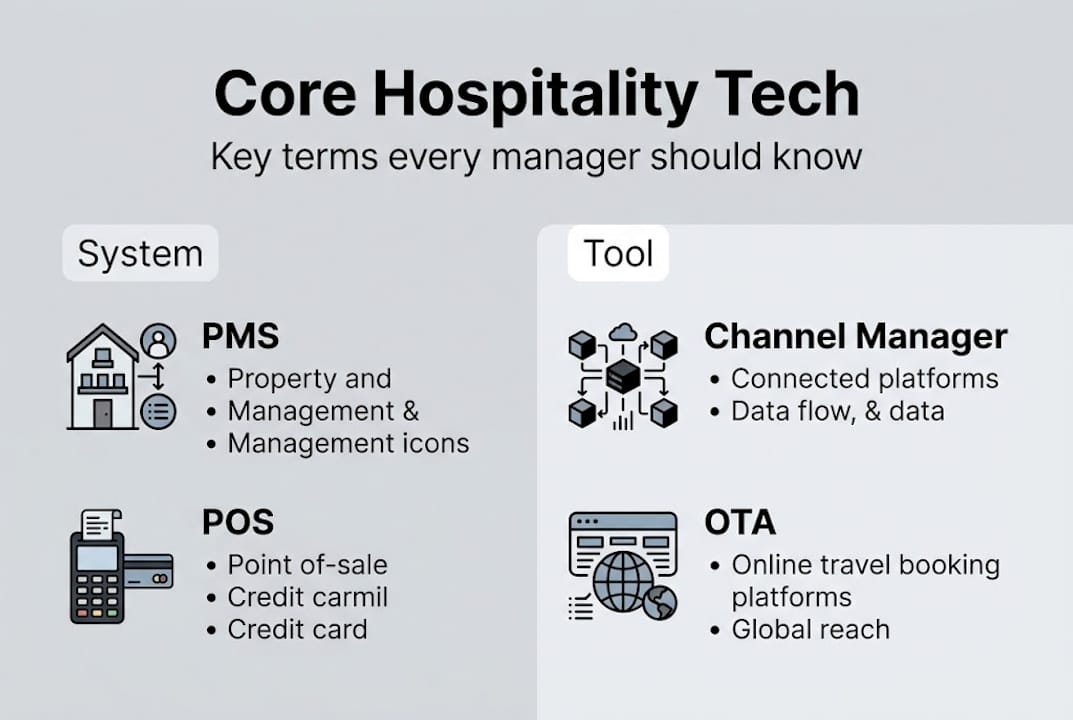
- PMS (Property Management System): The central hub for managing bookings, guest profiles, check-ins, and room or table allocation. Think of it as the brain of your operation.
- Channel manager: A tool that distributes your availability and rates across multiple booking platforms simultaneously, keeping inventory consistent everywhere.
- Booking engine: The direct booking widget on your own website, allowing guests to reserve without going through a third party.
- OTA (Online Travel Agent): Platforms like Booking.com or Expedia that list your venue for a commission, typically around 15% per booking.
- API (Application Programming Interface): The technical bridge that allows two different software systems to share data automatically and in real time.
- POS (Point of Sale): The system used to process orders and payments at the counter, table, or kiosk. You can explore defining hospitality POS for a fuller picture of what modern POS covers.
- AI in hospitality: Software that uses data patterns to automate decisions, such as adjusting pricing or flagging stock shortages, without manual input.
As systems work via API integrations, with the PMS central to operations, the channel manager distributing inventory, and the POS linking food and beverage to guest folios, each piece depends on the others functioning correctly.
| Term | Primary function | Where confusion arises |
|---|---|---|
| PMS | Manages bookings and guests | Often confused with booking engine |
| Channel manager | Distributes availability | Mistaken for PMS by new managers |
| Booking engine | Captures direct bookings | Confused with OTA listings |
| POS | Processes orders and payments | Seen as just a till, not a data tool |
| API | Connects systems | Treated as optional rather than essential |
For real-world context on how these tools appear in practice, hospitality technology examples show how UK venues are applying them right now. If your venue takes table orders, understanding table ordering technology specifically will help you see how POS fits into the wider picture.
Pro Tip: Where possible, prioritise platforms that bring multiple functions together. The fewer separate systems you need to connect, the lower your risk of integration failures.
How hospitality tech systems connect and interact
Knowing what each system does is only half the picture. Understanding how they talk to each other is where operational clarity really begins.
Here is the typical flow of information during a guest booking and stay:
- A guest visits an OTA and books a room or table. The OTA sends this booking via API to your channel manager.
- The channel manager updates your PMS instantly, reducing available inventory across all connected platforms.
- Your booking engine on your own website reflects the updated availability in real time.
- When the guest arrives and orders food or drinks, your POS system records the transaction and can post charges directly to the guest’s folio in the PMS.
- At checkout, the PMS consolidates all charges, room costs, and F&B spend into one accurate bill.
When this chain works, it is almost invisible. When it breaks, the consequences are immediate. Real-time API integrations dramatically reduce double bookings compared to manual or batch processes, where availability updates might lag by hours.
“OTA commissions typically sit around 15% per booking, which is why venues that invest in direct booking tools and a well-configured booking engine consistently see stronger margins.”
| Workflow type | Speed of update | Error risk | Staff workload |
|---|---|---|---|
| Manual updates | Hours or days | Very high | Heavy |
| Batch sync | Every few hours | Moderate | Moderate |
| Real-time API | Seconds | Very low | Minimal |
The POS is often underestimated in this chain. Beyond processing payments, a well-configured POS feeds sales data back into your inventory and reporting systems. Exploring POS in inventory control reveals how this single system can reduce waste and improve purchasing decisions across your entire venue.
Recent advances: AI, automation, and dynamic pricing explained
Once the basics of integration are clear, it is worth understanding the newer developments that are reshaping how UK hospitality venues operate.
Dynamic pricing means your room or cover rates adjust automatically based on demand, competitor pricing, local events, and historical data. Rather than setting a fixed rate and leaving it, the PMS analyses patterns and suggests or applies price changes in real time. Venues using dynamic pricing through their PMS see measurable RevPAR improvements, with AI agents automating operational decisions and handling imperfect data, though they require workflow redesign to function well.
RevPAR stands for Revenue Per Available Room, and it is the standard measure of how effectively a property is monetising its capacity. Even a modest improvement in RevPAR, achieved through smarter pricing alone, can significantly outperform a costly refurbishment in terms of return.
Automation in hospitality covers a broader range of tasks:
- Sending pre-arrival emails triggered by booking confirmation
- Flagging low stock levels in the kitchen before service begins
- Automatically applying promotional rates during slow periods
- Routing orders from the POS directly to the correct kitchen station
AI goes further by learning from patterns over time. It can identify which menu items slow down service, predict busy periods based on historical data, and flag anomalies in stock usage that might indicate waste or errors.
However, a common mistake is automating a broken process. If your current workflow is inefficient, automation simply makes the inefficiency faster. Reviewing best POS systems for your venue type is a good starting point, but always map your existing workflow first.
Pro Tip: Focus automation on outcome-driven tasks. Ask yourself: what specific result do I want this to achieve? If you cannot answer clearly, the process is not ready to automate.
Putting the terminology into action: Real venue scenarios
With the latest trends in mind, it is time to see how this terminology governs real-world, day-to-day operations at a typical UK venue.
Imagine a mid-sized hotel with a restaurant and bar. Here is how a single guest journey touches every system:
- The guest books via Booking.com (an OTA). The channel manager updates the PMS and closes that room across all platforms.
- The guest calls to request an early check-in. Staff check the PMS and note the request against the folio.
- On arrival, the front desk checks in the guest via the PMS. A welcome drink voucher is applied automatically through a promotional rule.
- The guest orders dinner. The POS records the order, sends it to the kitchen screen, and posts the charge to the guest folio in the PMS.
- At checkout, the PMS produces a consolidated bill. The guest pays via the integrated payment terminal linked to the POS.
Now consider what happens when terminology is misunderstood. A manager who confuses the booking engine with the channel manager might update rates in only one place, leaving OTA listings showing the wrong price. A member of staff unfamiliar with folio posting might charge the guest twice. These are not technology failures. They are training and communication failures.
Double bookings and sync failures are massively reduced when systems are well-integrated and venue staff are trained on core terminology and systems. The technology works. The gap is usually human understanding.
To audit your venue quickly, ask these questions: Does every team member know what the PMS does? Can your bar staff explain what happens when they process a payment through the POS? Is your channel manager syncing in real time or on a schedule?
Pro Tip: Create a one-page terminology cheat sheet for your team. Pin it in the back office and update it whenever you adopt a new system. It takes an hour to produce and saves days of confusion. For practical guidance on reducing friction at the till, efficient POS tips offer a useful starting point.
Why terminology is your best tech upgrade (our perspective)
The hospitality industry spends enormous sums on software upgrades, hardware refreshes, and new integrations. Yet many of the most expensive tech project failures we see have nothing to do with the technology itself. They fail because the team implementing the system and the team using it are speaking different languages.
When a general manager does not understand what an API does, they cannot ask the right questions during a vendor demo. When bar staff do not know what a folio is, they cannot flag a posting error before it reaches the guest. These are not small gaps. They compound daily.
Investing in a shared vocabulary across your team delivers a better return than most software upgrades. It costs almost nothing and reduces errors, speeds up onboarding, and makes every future tech decision sharper. You can see examples of hospitality tech in action across UK venues, but the venues getting the most from their systems are almost always the ones where the whole team understands the tools.
“Tech clarity beats tech clutter every time. A team that understands five systems deeply will always outperform one that barely uses fifteen.”
Before you chase the next feature, invest in understanding the ones you already have.
Next steps: Equip your venue with smart hospitality tech
Understanding the terminology is the foundation. The next step is choosing tools that make it easy to put that knowledge to work without adding unnecessary complexity.
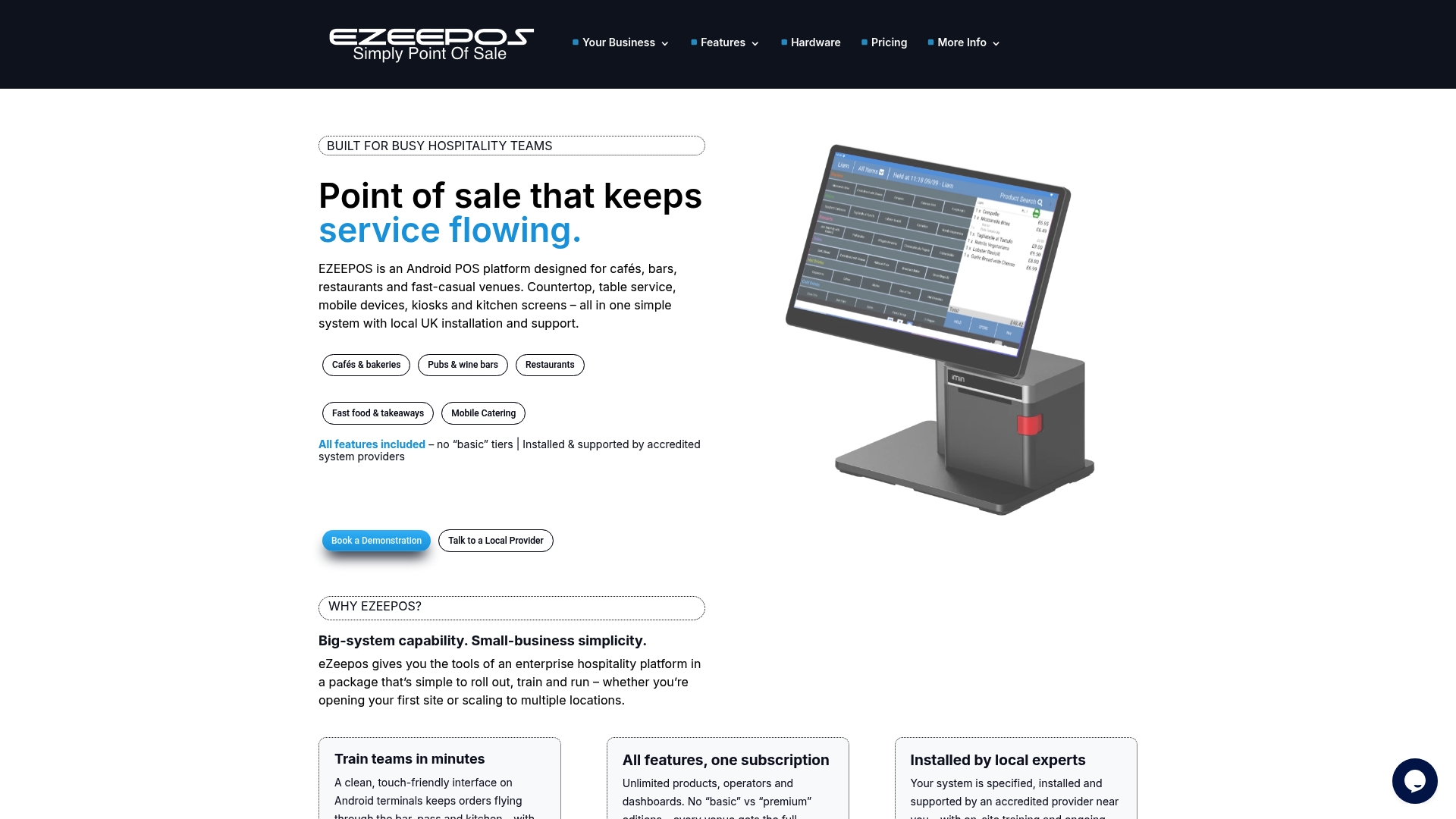
At eZeepos, we build POS solutions specifically for UK hospitality venues, from busy bars and cafés to fast-casual restaurants and mobile catering operations. Our platform is designed to integrate cleanly with your existing systems, removing the guesswork from connectivity. If you want to explore how the right POS fits into your wider tech stack, start with hospitality POS systems or learn about the benefits of unified POS for venues managing multiple service points. For venues looking to tighten stock control, our inventory management guide is a practical next read. Speak to one of our UK-based specialists to see the platform in action.
Frequently asked questions
What does PMS stand for in hospitality tech?
PMS stands for Property Management System, the central hub for managing bookings, guest profiles, and venue operations. It is the core system that most other hospitality tools connect to.
How does a channel manager prevent overbookings?
A channel manager syncs room availability across all platforms in real time, with real-time API syncs reducing the risk of double bookings far more effectively than manual updates. This means a booking on one platform immediately reduces availability everywhere else.
What is an OTA and why does it matter?
OTA stands for Online Travel Agent, and it matters because OTA commissions are typically around 15% per booking, making direct bookings significantly more profitable for your venue.
Can AI handle messy booking data in hospitality?
Yes, agentic AI can automate tasks and process imperfect booking data, but it works best when your underlying workflows have been reviewed and redesigned first. Automating a broken process simply accelerates the problem.
Recent Comments