
The role of upselling in POS for hospitality venues
TL;DR:
- Upselling in hospitality involves embedding timely, automated prompts into POS workflows to generate measurable revenue. Success depends on configuration, staff training, data analysis, and balancing technology with authentic service. Effective culture and management support turn POS prompts into consistent, valuable guest experiences.
Most hospitality managers think of upselling as a pushy sales tactic their team either does naturally or does not do at all. That framing costs real money. The role of upselling in POS goes far beyond a staff personality trait. It is a structured, technology-supported discipline that, when embedded correctly into your point of sale workflows, generates measurable incremental revenue without compromising guest experience. This article unpacks how to build that structure, what your POS system should be doing to support it, and why the human element still decides whether it works.
Table of Contents
- Key takeaways
- The role of upselling in POS systems
- Technical and operational enablers
- Practical techniques and scripts for staff
- Measuring and refining with POS data
- Balancing technology and people
- My perspective on upselling culture in hospitality
- How Ezeepos supports your upselling strategy
- FAQ
Key takeaways
| Point | Details |
|---|---|
| POS timing governs everything | Upsell offers must be triggered at the right stage in the transaction or reservation workflow to convert. |
| Automation outperforms manual upselling | Automated upsell systems generate up to four times more ancillary revenue per booking than manual approaches. |
| Scripts and training reduce inconsistency | Structured upselling frameworks give staff confidence and remove reliance on personality alone. |
| Data reveals what to fix | Conversion rates, attachment rates, and incremental revenue figures show exactly where upsell performance breaks down. |
| Technology supports, people close | POS prompts create the opportunity; trained, empowered staff determine whether the guest says yes. |
The role of upselling in POS systems
In hospitality, suggestive selling is the widely recognised industry term for the practice of offering guests relevant upgrades or add-ons at the point of transaction. The role of upselling in POS sits within this broader discipline, and it is more precise than most operators realise. Upselling via a POS or property management system (PMS) means embedding offer logic directly into the transaction workflow so that the right upgrade appears at the right moment, whether that is a room type upgrade during a reservation, an early check-in offer, or a premium dish suggestion at the counter.
Oracle OPERA PMS, one of the most widely deployed systems in full-service hotels, handles this by displaying valid upgrade options linked to current room rates within the reservation screen. Once an upsell is applied, the system locks the rate and adjusts the reservation data accordingly. This matters because it shows upselling is not a verbal afterthought. It is a transactional event with technical implications.
The main upsell categories in hospitality include:
- Room or accommodation upgrades at or before check-in
- Time-based additions such as early check-in or late check-out
- Food and beverage add-ons at the counter, table, or via pre-order
- Experience packages such as spa access, dining credits, or event tickets
Pro Tip: If your current POS cannot surface a contextual upsell prompt based on what a guest has already ordered or booked, you are leaving the entire burden on your staff’s memory and confidence. That is not a training problem. It is a system design problem.
Understanding the distinction between manual and automated upselling is critical. Manual upselling depends entirely on staff initiative. Automated upselling uses rules configured in your POS or PMS to surface relevant offers without staff needing to remember when or what to suggest. Both have a place, but the data heavily favours a system-led approach as the foundation.
Technical and operational enablers
Getting upselling to work consistently across your venue requires more than switching on a feature. It requires deliberate operational design. Here is what that looks like in practice:
-
Configure upsell rules within your POS workflow. Define which offers trigger at which point in the transaction. An integrated POS setup connects front-of-house prompts to inventory, pricing, and availability in real time so offers are always accurate.
-
Respect system timing constraints. As Oracle OPERA’s workflow demonstrates, upsells cannot be applied after a guest has checked in. Dead-end offers damage trust and frustrate staff. Know your system’s boundaries and build offers around them.
-
Use POS data to choose the right moment. Conversion rates for early and late check-in upsells run at 15 to 25 percent when offers are automated and timed correctly. Generic, sporadic attempts fall below 12 percent consistently.
-
Build staff accountability into the system. Real-time performance dashboards linked to POS data transform upselling from occasional ad hoc attempts into a measurable daily discipline. Staff see their own conversion numbers. Managers can coach with specific evidence rather than general encouragement.
-
Incentivise correctly. Financial bonuses help, but recognition and clear targets tied to POS reports often move the needle more reliably across a full team.
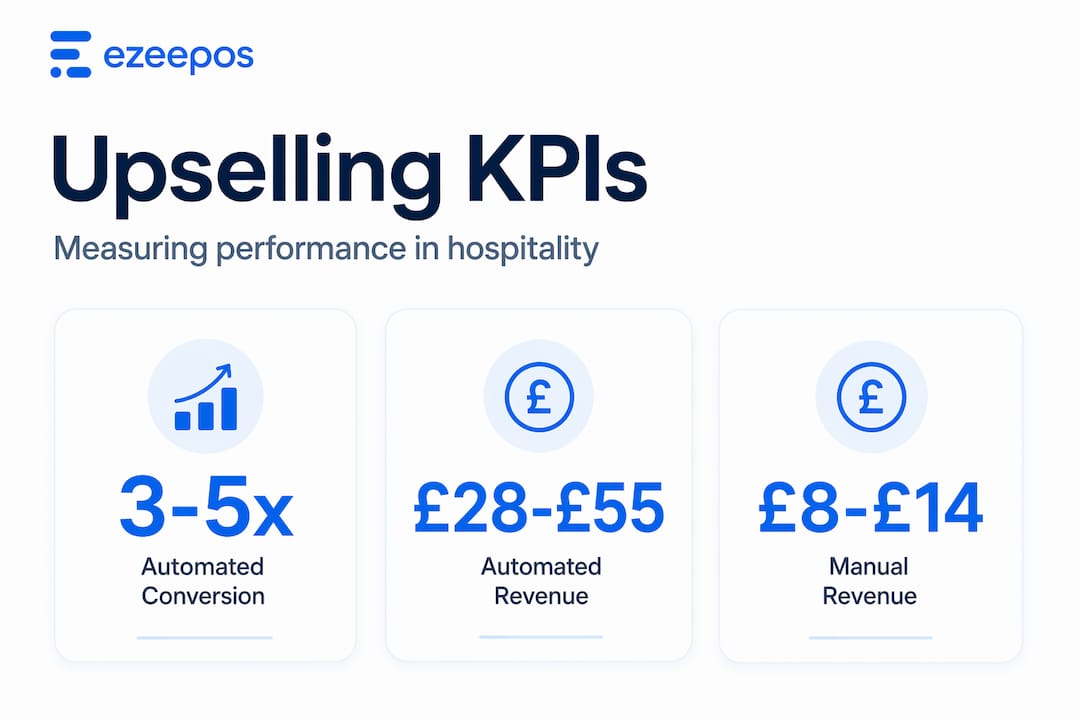
The financial argument for automation is compelling. Automated upsell systems generate between £28 and £55 in ancillary revenue per reservation, compared to £8 to £14 for manual approaches. That gap is not explained by better products or higher prices. It is explained by consistency and timing.
| Upselling approach | Revenue per reservation | Conversion rate |
|---|---|---|
| Manual, ad hoc | £8 to £14 | Below 12% |
| Automated, timed | £28 to £55 | 15 to 25% |
| AI personalised targeting | Up to 20 to 30% of total revenue | 3 to 5x above untargeted |
Pro Tip: Start by auditing which upsell types your POS currently supports and map them against your busiest transaction windows. You will almost always find at least one high-value offer that is never being triggered simply because the workflow was never configured.
Practical techniques and scripts for staff
Defining upselling in hospitality correctly changes how you train for it. It is not sales training. It is service training. The goal is not to push a higher price point onto a guest. It is to surface an option the guest would genuinely value if they knew it existed.
Upselling approached as a service skill depends on three things: listening to the guest, reading the timing, and framing the offer as helpful rather than commercial. When staff understand this distinction, resistance drops sharply.
Practical techniques that work in hospitality environments include:
- The relevant offer. Tie the upsell directly to something the guest has already indicated. “You mentioned it’s a special occasion. We do have a garden table available this evening if you’d prefer something a bit more private.” This is not a script. It is active listening producing a contextual offer.
- The POS-prompted suggestion. Your system surfaces a prompt based on the order or booking profile. The staff member adds a conversational line. “The kitchen’s also got the sharing board on tonight, which goes well with what you’ve ordered. Worth adding?”
- The pre-emptive framing. Before a guest finishes ordering, mention what complements the choice. Not after, when the moment has passed.
- The clean objection handle. If a guest declines, acknowledge and move on without pressure. “No problem at all. Let me get that sorted for you.” The relationship remains intact and future upsell opportunities stay open.
Avoid bundling multiple upsell suggestions into a single interaction. One clear, relevant offer converts far better than three competing ones. Your POS system should help you enforce this by prioritising the highest-value contextual prompt rather than displaying everything available.
You can explore more on pairing service techniques with operational structure to see how dining venues make this work end to end.
Measuring and refining with POS data
The impact of upselling on sales is only visible if you are measuring the right things. Most venues track total revenue but not the incremental portion generated by upsell activity specifically. That blind spot makes it impossible to improve.
The metrics that matter most are:
| KPI | What it tells you |
|---|---|
| Upsell conversion rate | Percentage of eligible transactions that include an upsell |
| Incremental revenue per cover or booking | Average additional spend generated above the baseline order |
| Attachment rate by offer type | Which upsell categories are performing and which are being ignored |
| Staff-level conversion comparison | Who on the team converts consistently and who needs support |
Industry benchmarks give you a realistic performance baseline. AI-driven personalised upsells convert three to five times better than untargeted offers, with ancillary revenue reaching 20 to 30 percent of total revenue in high-performing properties. If your current attachment rate is below 10 percent, the issue is usually one of three things: offers are poorly timed, they are not property-specific enough, or staff are not being prompted clearly.
Property-relevant offers sent consistently dramatically outperform generic upsells applied sporadically. Use your POS reporting to segment performance by day part, service area, and staff member. Review monthly. Adjust offer pricing, sequencing, and trigger points based on what the data shows rather than intuition.
The most common pitfalls are underpricing upsells so the margin gain is negligible, and offering upgrades at points in the workflow where acceptance is structurally impossible. Both are fixable once you have the reporting in place to see them.
Balancing technology and people
The advantages of upselling strategies built on technology alone are limited. The system creates the opening. The person in front of the guest decides whether it converts.
Upselling delivered as authentic hospitality transforms a transactional prompt into a genuine recommendation. Staff confidence and engagement rise measurably when they are supported by both training and real-time POS tools. This is the combination that produces sustainable revenue growth rather than a one-month spike followed by drift.
“Effective upselling in hospitality blends tech automation with human engagement. The tech enables consistency while employees provide trusted service.” — Hospitality Net
The best venues treat their POS as a coaching tool, not just a transaction engine. When a team member sees their daily upsell conversion rate in the same view as their sales total, it shifts upselling from an optional extra to a visible part of their daily performance. That visibility, combined with structured coaching sessions and clear incentives, produces the kind of consistent execution that compounds over time. Explore how upgrading your POS system can build this feedback loop into daily operations.
My perspective on upselling culture in hospitality
I have worked with hospitality managers long enough to recognise the pattern: technology gets purchased, a brief training session happens, and six weeks later upsell conversion rates look identical to before the system was installed. The technology was not the problem. The culture was.
What I have found consistently is that venues treating upselling as a revenue discipline rather than a personality trait get fundamentally different results. When your POS surfaces a prompt, that is not a reminder for a naturally confident team member. It is a structured opportunity for every member of your team, including the quieter ones who never felt comfortable initiating a sales conversation but are absolutely capable of delivering a helpful recommendation.
The misconception I encounter most often is that better technology will fix poor upsell culture on its own. It will not. The most underutilised revenue engine in hospitality is still the frontline team, and the system only performs as well as the people using it. What changes outcomes is combining genuinely useful POS prompts with a deliberate coaching programme, clear KPIs, and a manager who reviews the data and has honest conversations about it weekly. That combination is rarer than it should be.
— John
How Ezeepos supports your upselling strategy
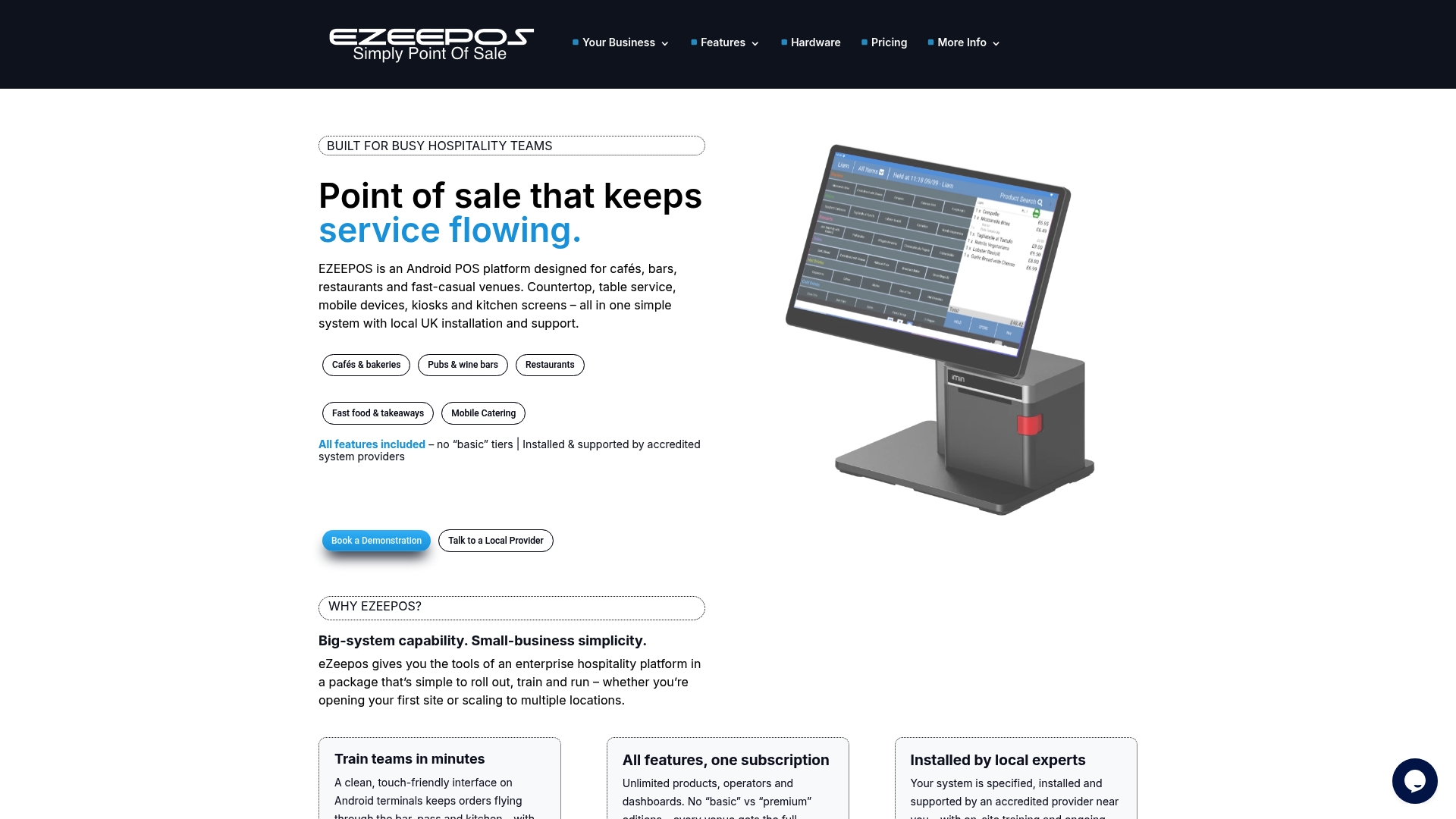
Ezeepos is built specifically for UK hospitality venues, from busy quick-service counters to full-service restaurants and bars. The platform gives your team real-time upsell prompts at the point of transaction, backed by cloud-based reporting that tracks attachment rates, conversion performance, and incremental revenue by staff member and service period. There are no tiered pricing traps or hidden feature locks. Every venue gets full access to the tools that make hospitality POS work effectively, including promotions, modifiers, and upsell workflows configured to your menu and service style. If you want to see how Ezeepos can put a measurable upselling structure into your daily operations, visit Ezeepos to find out more.
FAQ
What is the role of upselling in POS for hospitality?
Upselling in a POS system means embedding contextual upgrade and add-on prompts directly into the transaction workflow so staff receive the right suggestion at the right moment, turning occasional recommendations into a consistent revenue practice.
Why does timing matter so much in hospitality upselling?
Upsell offers must align with specific stages in the transaction or booking lifecycle. Systems like Oracle OPERA prevent upsells after check-in, meaning poorly timed offers simply cannot be applied and represent lost revenue.
How much more revenue do automated upsells generate?
Automated upsell systems generate between £28 and £55 in ancillary revenue per reservation compared to £8 to £14 from manual approaches, with conversion rates of 15 to 25 percent when offers are timed and configured correctly.
How should hospitality staff approach upselling without seeming pushy?
Framing upselling as a service skill rather than a sales technique makes the difference. Offers tied directly to what a guest has already requested, delivered with clarity and no pressure, improve both conversion rates and guest perception.
What KPIs should managers track to measure upsell performance?
The most useful metrics are upsell conversion rate, incremental revenue per cover or booking, attachment rate by offer type, and staff-level conversion comparisons. These figures, drawn from POS reporting, show exactly where performance can be improved.
Recent Comments