

TL;DR:
- Effective inventory control reduces waste and protects profit margins in ice cream shops.
- Implementing FIFO, demand forecasting, and POS integration enhances stock accuracy and minimizes spoilage.
- Combining technology with team discipline is key to successful inventory management and cost control.
Waste and spoilage can quietly destroy your margins before you even notice. For UK ice cream shops, poor inventory control can eat into 15 to 25% of your food costs, which is a significant hit for any independent operator. Getting inventory management right is not just about counting tubs in the freezer. It is about understanding what you have, what you need, and when you need it, so you can serve customers well, reduce waste, and protect your profit. This guide walks you through the essentials, from core strategies to quick wins, with practical advice tailored to UK ice cream shop owners and managers.
Table of Contents
- What is inventory management in ice cream shops?
- Core strategies and best practices
- Tackling common challenges in UK ice cream shops
- Measuring success: KPIs and case studies
- Getting started: Quick wins for your ice cream shop
- Why the smartest ice cream shops blend tech with teamwork
- Ready to upgrade your inventory management?
- Frequently asked questions
Key Takeaways
| Point | Details |
|---|---|
| Perishables drive risk | Short shelf-life and temperature sensitivity make accurate stock rotation essential in ice cream shops. |
| Tech makes tracking easier | EPOS/POS and AI tools help cut waste, automate alerts, and improve profits through smarter forecasting. |
| Small improvements save thousands | Strict stock control and reducing waste can boost profit margins and save up to £15,000 per year. |
| Team buy-in is key | The biggest gains come from combining technology with staff accountability and regular routines. |
What is inventory management in ice cream shops?
Inventory management in an ice cream shop means keeping accurate track of every item you use to serve customers. That includes your ice cream bases, cones, wafers, toppings, sauces, mix-ins, and even your packaging. Tracking perishable items like these requires more discipline than managing dry goods in a café or restaurant, because everything is time-sensitive and temperature-dependent.
What makes ice cream inventory particularly tricky is the combination of perishability and unpredictability. A hot weekend in July can triple your sales. A rainy bank holiday can leave you with surplus stock that slowly degrades in the freezer. Unlike shelf-stable products, ice cream and its accompaniments have short windows of optimal quality, and any lapse in storage or rotation can mean spoilage you cannot sell.
Here are the main categories you need to track:
- Ice cream bases and gelato mixes (fresh or pre-made)
- Cones, wafers, and cups
- Toppings: sauces, sprinkles, fruit, nuts
- Mix-ins: brownies, biscuits, sweets
- Packaging: tubs, lids, spoons, napkins
- Cleaning and hygiene supplies (often overlooked but essential)
“Effective inventory management is the backbone of a profitable ice cream business. Without it, waste accumulates silently and margins shrink fast.”
The direct link between inventory control and business survival is real. Shops that do not track stock accurately tend to over-order, which leads to freezer burn and spoilage. They also under-order at peak times, leading to lost sales and frustrated customers. Understanding POS benefits for ice cream shops is a strong starting point for getting this right, because the right technology makes tracking far simpler and more accurate.
Core strategies and best practices
Now that you know what inventory management covers, how can you implement it successfully in your shop? The good news is that several well-tested methods work particularly well for ice cream businesses.
Core methodologies like FIFO, JIT, demand forecasting, and POS integration form the foundation of effective inventory control. Here is how each one applies to your shop:
- FIFO (First In, First Out): Always use your oldest stock first. Label deliveries with the date received and physically rotate stock so newer items go to the back of the freezer. This simple habit alone can dramatically reduce spoilage.
- JIT (Just In Time): Order stock closer to when you actually need it rather than holding large quantities. This reduces the risk of freezer burn and frees up cash tied up in surplus inventory.
- Demand forecasting: Use your sales history, local weather forecasts, and seasonal patterns to predict what you will need. A sunny forecast for the weekend should trigger a stock review, not a panic order on Saturday morning.
- Regular audits: Count your stock at least weekly. Compare what you have against what your records say you should have. Discrepancies reveal waste, theft, or recording errors.
- Portion control: Use standardised scoops and recipes so every serving uses the same amount of product. Inconsistent portioning is one of the fastest ways to erode your margins.
- POS integration: A good POS inventory control system automatically deducts stock as sales are made, giving you real-time visibility without manual counting.
“Standardised recipes and integrated POS systems work together to give operators accurate, up-to-date stock data without hours of manual effort.”
Pro Tip: Set a weekly 15-minute stock review as a non-negotiable part of your routine. Use the data from your best POS solutions to spot trends before they become problems, not after.
Tackling common challenges in UK ice cream shops
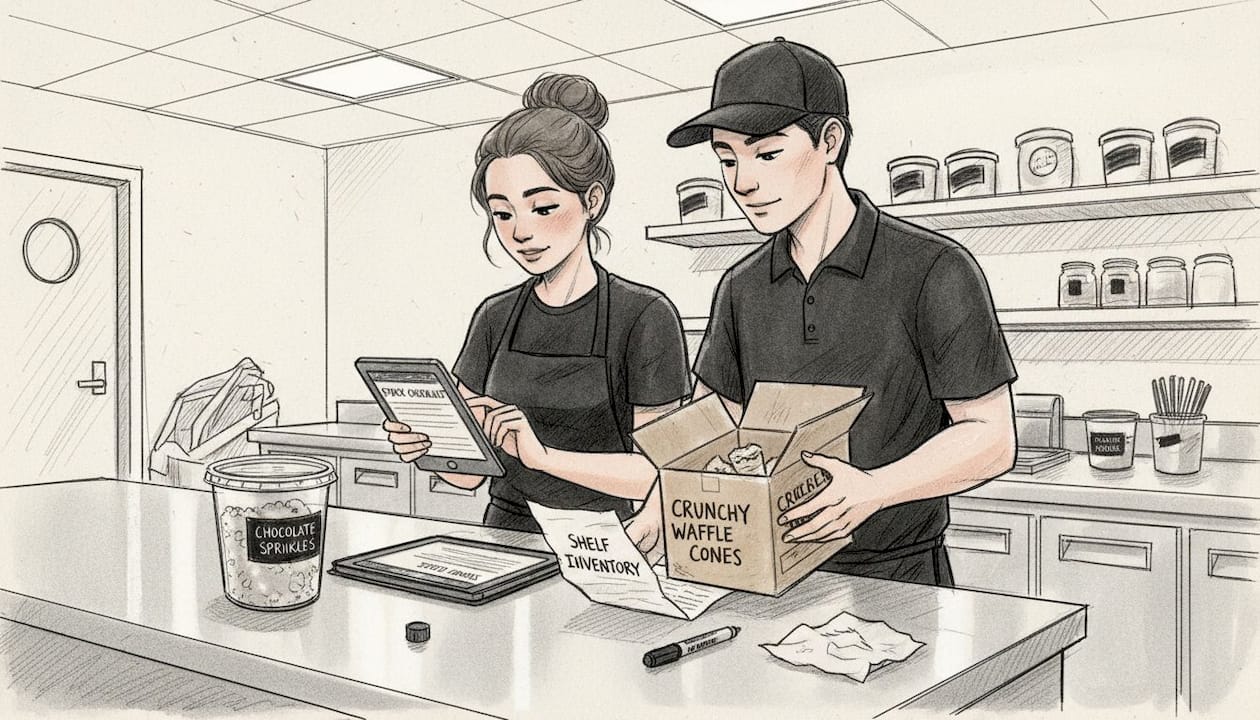
While best practices are useful, ice cream shops face some unique hurdles in the UK market. Seasonality, weather fluctuations, and freezer issues add layers of complexity that simply do not exist in other food businesses.
Here are the most common challenges and how to address them:
- Seasonal demand swings: UK summers are unpredictable. Build flexible ordering schedules that can scale up or down quickly. Maintain relationships with suppliers who can fulfil short-notice orders.
- Freezer burn and temperature control: Invest in a reliable freezer thermometer or digital temperature monitoring system. Even a brief power cut or door left ajar can ruin a batch of stock worth hundreds of pounds.
- Stock shrinkage: Melts, spills, and accidental overportioning all add up. Log every instance of waste so you can identify patterns and address the root cause.
- Theft: Internal theft is a real issue in hospitality. A POS system with staff login tracking helps you spot irregularities quickly.
- Tracking toppings and sundries separately: Many shops focus only on ice cream and forget that sauces, sprinkles, and cones also have costs and shelf lives. Include them in your regular stock counts.
- Equipment reliability: A good nugget ice maker or specialised equipment can support consistent service, but any equipment failure directly impacts your ability to trade.
Pro Tip: Use a simple waste log book or digital spreadsheet to record every item discarded, the reason, and the estimated cost. After four weeks, you will have clear data to guide smarter ordering decisions. The inventory guide for hospitality venues offers further frameworks you can adapt for your shop.
Measuring success: KPIs and case studies
Understanding practical challenges is one side of the coin. It is also crucial to know what good looks like. Setting clear benchmarks helps you measure progress and stay motivated.
| KPI | Target benchmark | What it tells you |
|---|---|---|
| Food cost as % of sales | 18 to 22% | Whether your pricing and waste are aligned |
| Waste and spoilage rate | Below 5% | How well your rotation and forecasting are working |
| Gross margin | 70 to 80% | Overall profitability of your product mix |
| Stock accuracy rate | Above 95% | How reliable your tracking systems are |
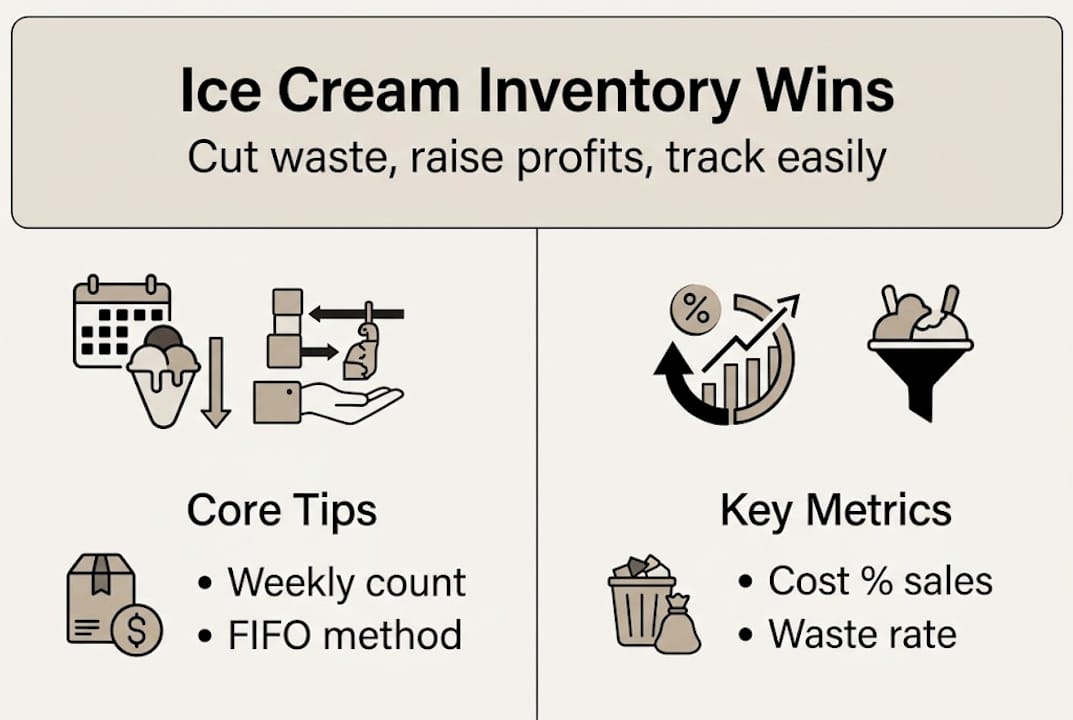
Food costs should sit at 18 to 22% of sales, and waste can be reduced from 15 to 25% down to around 5% with the right controls in place. AI-driven tools can cut waste by a further 20 to 30%, which is significant even for smaller operators using basic forecasting software.
Real-world examples bring these numbers to life. Swoon Gelato uses POS for multi-site stock tracking and portion controls, enabling consistent quality across locations. At a larger scale, Unilever applies weather-based demand forecasting to save 10% in raw material costs across its ice cream supply chain. You do not need enterprise-level AI to benefit from the same principles. Even a basic POS system paired with weekly audits can move your waste rate from the high teens down to single figures within a few months.
Use the inventory tips for efficiency available for hospitality operators to set your own targets and track improvement over time. Start with food cost percentage and waste rate. Review them monthly and adjust your ordering and portioning practices accordingly.
Getting started: Quick wins for your ice cream shop
If the full process feels daunting, here is how you can make progress in your shop today. You do not need to overhaul everything at once. Small, consistent improvements compound quickly.
Prioritising POS integration, FIFO systems, and frequent audits are the fastest routes to cutting waste and improving accuracy. Follow these steps to get moving:
- Start with a full stocktake: Count everything you currently have and record it. This gives you a baseline to measure against.
- Label all deliveries with the date received: Make FIFO rotation automatic by always placing new stock behind older stock in the freezer.
- Introduce a simple waste log: Note every item discarded, the quantity, and the reason. Review it weekly.
- Standardise your portion sizes: Use a fixed scoop size for every flavour and train your team to use it consistently.
- Integrate a POS system: Even a basic system that tracks sales by item will help you understand which products move fastest and when.
- Review your ordering schedule: Move from reactive ordering to planned ordering based on your sales data and the weekly weather forecast.
Pro Tip: Do not wait until you have the perfect system before you start. A basic spreadsheet and a weekly count is infinitely better than no tracking at all. The streamline catering inventory guide offers simple templates you can adapt immediately.
Why the smartest ice cream shops blend tech with teamwork
Here is something most guides do not say plainly: technology alone will not fix your inventory problems. We have seen shops invest in sophisticated POS systems and still struggle with waste because the team was not bought in or trained properly.
The shops that consistently hit their targets are the ones where managers treat inventory as a team habit, not a back-office task. When your staff understand why portion control matters, they enforce it naturally. When they see the waste log reviewed every week, they take it seriously. Utilising POS analytics is powerful, but only when someone is actually looking at the data and acting on it.
The most effective approach is incremental. Start with one or two improvements, build the habit, then layer in more. A shop running disciplined manual counts and FIFO rotation will outperform one with an expensive system that nobody uses correctly. Culture and consistency are the real differentiators. Tech amplifies good habits. It cannot create them.
Ready to upgrade your inventory management?
Taking control of your stock, waste, and margins starts with having the right tools in place. Ezeepos offers a POS system built specifically for UK hospitality venues, including ice cream shops, with real-time inventory tracking, sales reporting, and staff management all in one platform.
Whether you are starting from scratch or looking to replace a system that is not working for you, the detailed inventory guide is a great next step. You can also explore a demo to see how Ezeepos fits into your day-to-day operations. Smarter inventory management is closer than you think, and the first step is simply deciding to start.
Frequently asked questions
What are the main causes of stock waste in ice cream shops?
Spoilage, overportioning, and temperature sensitivity are the leading causes of waste, alongside inaccurate demand forecasting that leads to over-ordering before slow periods.
How often should ice cream shops conduct inventory audits?
Regular audits and cycle counts are essential for accuracy, with weekly checks recommended for perishable stock and more frequent reviews during busy summer periods or heatwaves.
What is FIFO and why does it matter for ice cream stock?
FIFO is a core method for stock rotation that ensures older products are used before newer ones, which is critical for short-shelf-life items like ice cream bases and fresh toppings.
How does seasonality impact inventory management in ice cream shops?
Extreme seasonality and weather-driven demand can shift sales dramatically week to week, making demand forecasting and flexible ordering schedules essential to avoid both overstocking and running out during peak days.
Recent Comments