
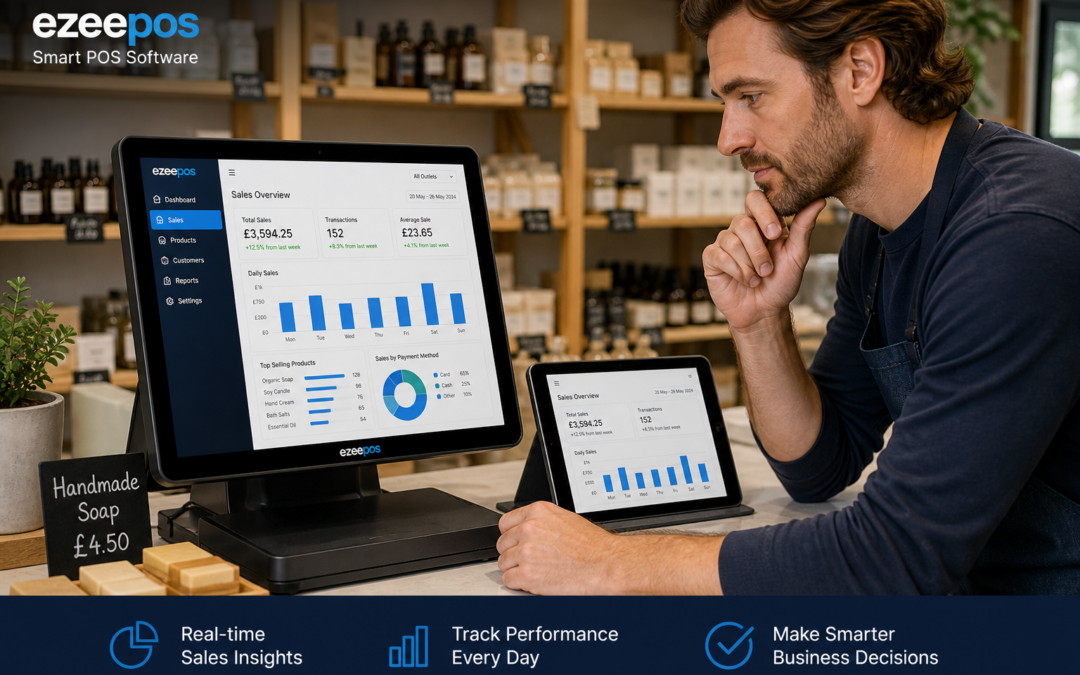
Good reporting is one of the most practical tools a small retailer can have. Instead of relying on guesswork, business owners can use sales data to understand what is selling, when trade is busiest and where small changes might improve performance. For independent shops, that can make everyday decisions feel much clearer.
With a modern EPOS system from eZeePOS, reporting can become part of normal day-to-day management rather than something to look at only at month end. It gives retailers a clearer picture of trading patterns without adding extra admin, which is especially useful in busy shops with limited time.
Why sales reporting matters in small retail
Small retail businesses often have to make quick decisions based on limited time and limited staff. Should a product line be reordered? Is the shop busiest in the morning or early evening? Are certain promotions worth repeating? Sales reporting helps answer those questions with actual figures rather than instinct alone.
For many independent retailers, the challenge is not collecting data. It is turning that data into something useful. A well-set-up POS system can present sales information in a way that is easy to read, giving owners a simple way to review performance without needing a spreadsheet-heavy process.
What useful reporting can show
Not every report needs to be complex. In fact, some of the most useful insights are often the simplest ones.
- Which products sell most often
- Which days or times are busiest
- How promotions are performing
- Which staff shifts or trading periods are strongest
- How sales compare across different categories
For a convenience store, gift shop, farm shop or pet shop, that kind of information can be incredibly valuable. It can help owners plan displays, adjust staffing, or decide which product ranges deserve more attention.
Making better decisions without overcomplicating the process
One of the main benefits of EPOS reporting is simplicity. A business does not need a complicated system to benefit from clear sales information. The best reports are the ones that can be checked quickly and used immediately.
For example, if a shop owner notices that sales of a particular seasonal item rise every Friday afternoon, that can influence ordering, merchandising and staffing. If another product is selling more slowly than expected, it may be time to review pricing, placement or supplier commitments. These are small decisions, but they add up over time.
That is why many independent retailers now see reporting as part of everyday trading, not just a finance task. It helps bridge the gap between what is happening on the till and what needs to happen next in the business.
Using reports to spot patterns
Patterns are often easier to see when sales are viewed over time. A single busy day might not mean very much on its own, but repeated busy periods can show when the shop really needs more staff, more stock on shelves or a different opening pattern.
Seasonal businesses, such as garden centres and farm shops, can find this especially useful. Even smaller convenience stores and gift shops can benefit from understanding weekly and monthly trends, especially when customer behaviour changes with the weather, holidays or local events.
When reporting is easy to access, owners are more likely to use it regularly. That means decisions can be made sooner and with more confidence.
How reporting helps different types of retail businesses
Different retailers use sales reporting in different ways, but the principle is the same: clearer information leads to better decisions.
Convenience stores
Convenience stores often need to respond quickly to fast-moving demand. Sales reporting can help identify reliable everyday sellers, peak trading times and product gaps that may be affecting basket value.
Gift shops
Gift shops often carry a wide mix of items, so reporting can help reveal which lines are consistently popular and which are only moving during certain periods of the year.
Farm shops and garden centres
These businesses often have mixed sales across food, gifts, seasonal products and café items. Reporting can help owners compare categories and plan for busy trading periods more effectively.
Fashion and clothing shops
For clothing retailers, reporting can help track which styles, sizes or categories are performing well, making it easier to focus on stock and displays that support actual demand.
Reporting and day-to-day retail planning
Good reporting does not just show what happened yesterday. It can also support practical planning for today and tomorrow.
When business owners understand what sells best, they can improve merchandising, plan staff cover more sensibly and make better use of shelf space. That can reduce waste, improve customer experience and help the business stay more organised.
In many shops, even a small improvement in planning can have a noticeable effect. Whether it is adjusting shift times, changing a promoted product or making a better decision on repeat orders, sales data provides a helpful starting point.
Why a modern EPOS system makes reporting easier
Legacy tills and manual records can still tell you some things, but they often make analysis slow and inconsistent. A modern EPOS system gives retailers a more practical way to access the numbers that matter.
With a solution like eZeePOS, sales information can be brought together in one place and reviewed more easily. That makes it simpler for small businesses to keep an eye on trading performance without needing to spend extra hours reconciling figures.
This is where EPOS reporting becomes more than a feature list item. It becomes a day-to-day business tool that supports clearer thinking and better decisions.
Choosing reports that actually help
It is easy for reports to become overwhelming if too much information is shown at once. For most small businesses, the best setup is one that focuses on the figures they will genuinely use.
That might mean daily takings, best-selling products, busy periods or simple category summaries. The aim is not to collect every possible number. It is to show the right information in a useful way.
For independent retailers, that balance matters. A useful reporting setup should save time, not create more of it.
A smarter way to manage retail trading
Sales reporting gives small businesses a more reliable view of how trade is really performing. For independent retailers, that can make a real difference to planning, staffing and stock decisions.
If you want an EPOS system that helps you see and use your sales data more clearly, eZeePOS is designed to support practical retail management for UK businesses. Learn more at www.ezeepos.co.uk.
Contact YCR Distribution at sales@ezeepos.co.uk or call 01924 438238.
Recent Comments