
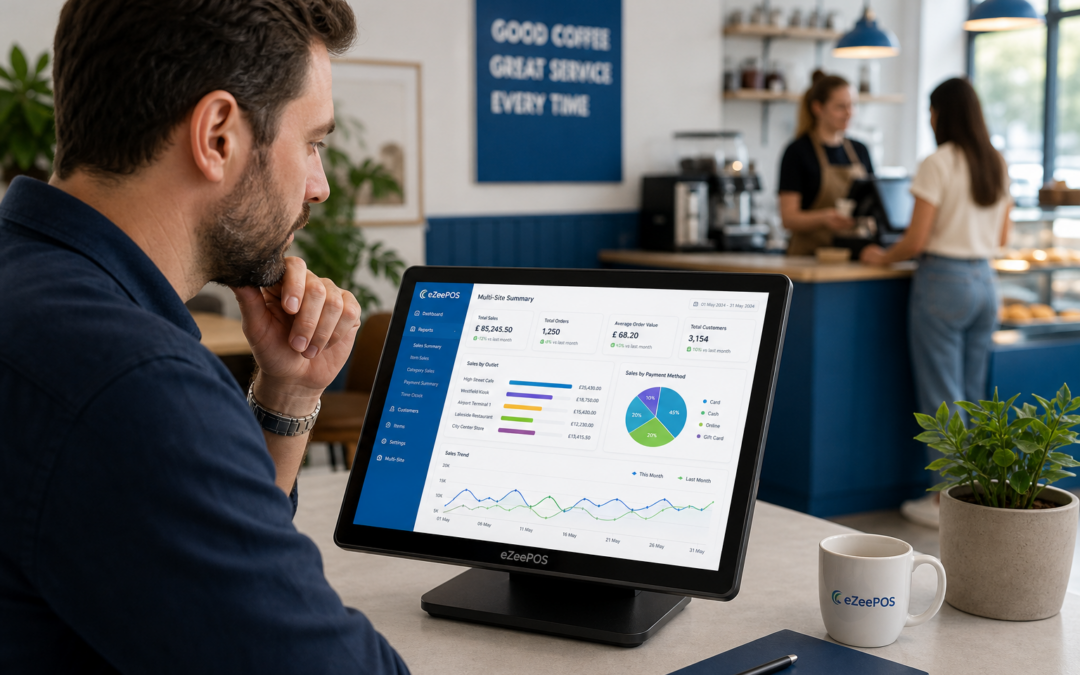
As a business grows from one site to two, three or more, it becomes harder to keep track of what is really happening across the whole operation. Sales may look healthy in one branch and flat in another, and without the right reporting it can be difficult to understand why. That is where multi-site reporting becomes especially useful.
For UK retailers, cafes, restaurants, takeaways and other hospitality businesses, multi-site reporting gives owners a clearer view of performance across every location. With a system such as eZeePOS, the aim is not to create more admin. It is to make the numbers easier to read so you can act on them with confidence. If you want to explore the platform first, visit www.ezeepos.co.uk.
Why multi-site reporting is useful
Once a business has more than one branch, looking at each location separately can quickly become time-consuming. You may need to compare sales totals, see which site is busiest at different times, and understand whether particular products or menu items are performing better in one place than another.
Multi-site EPOS reporting brings that data together in one place. Instead of hunting through separate spreadsheets or relying on end-of-day summaries from each team, you can review a broader picture and still drill down into the detail when needed. That makes it easier to spot patterns and manage performance with less guesswork.
What business owners can learn from it
- Which site is trading strongest over a set period
- How busy each location is by day or time of week
- Which branches are selling better on key lines or menu items
- Whether staffing levels appear to match trading patterns
- Where small changes could improve consistency
How it helps different business types
The value of multi-site reporting looks slightly different depending on the business, but the principle is the same: better visibility leads to better decisions.
For retailers
If you run multiple shops, reporting can help you compare performance across branches without treating every location the same. One store may do better with premium products, while another may sell more everyday essentials. A clearer view of sales by branch helps you adapt your buying, layout and staffing decisions to suit each location rather than relying on assumptions.
For cafes and restaurants
Hospitality businesses often need to manage trade by site, daypart and customer behaviour. One cafe might be stronger at breakfast, while another sees better lunch trade. A restaurant group may have one site with higher average spend and another with more covers but lower basket value. Multi-site reporting helps identify those differences so managers can focus on the right improvements.
For takeaways and quick-service businesses
When speed matters, knowing which locations are under pressure can be just as important as understanding total sales. If one site regularly outperforms another during the same hours, reporting can help highlight whether the issue is staffing, menu mix, service flow or local demand.
Better decisions without extra complexity
Many growing businesses start with simple tools such as card machine summaries, printed reports or manual spreadsheets. Those can work for a while, but they often become harder to manage once there are several locations involved.
A good multi-site EPOS setup reduces that friction. Instead of pulling together information from separate systems, you can review consistent reports across the business. That makes it easier to compare like with like and spend less time reconciling figures.
Common decisions supported by reporting
- Adjusting staffing levels for different branches
- Identifying slower trading days or periods
- Comparing the performance of local promotions
- Spotting branches that may need extra support
- Helping area managers focus on the right priorities
What to look for in a multi-site EPOS reporting setup
Not every reporting tool is equally helpful for a growing business. When you are choosing EPOS software, it is worth looking for reports that are easy to read, simple to compare and flexible enough to suit different types of sites.
Useful reporting features include:
- Clear sales summaries by site
- Time-based comparisons across branches
- Product or category performance by location
- Accessible dashboards that are easy for managers to use
- The ability to review multiple sites without switching systems
If your business uses different site formats, such as a main shop and a smaller popup location, a strong reporting setup can also help you compare trade more fairly. The key is to see the numbers in a way that reflects how each branch actually operates.
How reporting supports day-to-day management
Multi-site reporting is not only useful for monthly reviews or owner-level planning. It can also help with everyday management. A manager can quickly check how a branch is trading, identify unusual patterns and respond before small issues grow into larger ones.
It can also support conversation between head office and site teams. Rather than talking in broad terms about a branch doing ‘better’ or ‘worse’, you can refer to real figures. That makes conversations more practical and helps staff understand what is working.
Keeping reporting simple for busy teams
The best reporting tools do not get in the way of service. They should help busy teams, not add another layer of complexity. That is why many UK businesses prefer EPOS software that presents information clearly and allows owners or managers to look across the business at a glance.
For growing businesses using touchscreen tills, modern POS terminals or mixed site setups, this kind of visibility can be one of the most valuable parts of the system. It helps turn everyday sales data into something useful and actionable, without requiring specialist knowledge.
Why it matters for growing UK businesses
Growth is a positive sign, but it also brings new operational challenges. More sites mean more moving parts, more chances for variation and more data to interpret. Multi-site reporting gives owners a practical way to stay in control while still giving each branch room to operate effectively.
If you are managing more than one location and want a clearer view of performance, it may be worth reviewing how your current EPOS setup handles reporting. A better system can save time, improve decision-making and make it easier to run the business as one joined-up operation.
To learn more about a practical UK EPOS solution for retail and hospitality businesses, visit www.ezeepos.co.uk. Contact YCR Distribution at sales@ezeepos.co.uk or call 01924 438238.
Recent Comments