
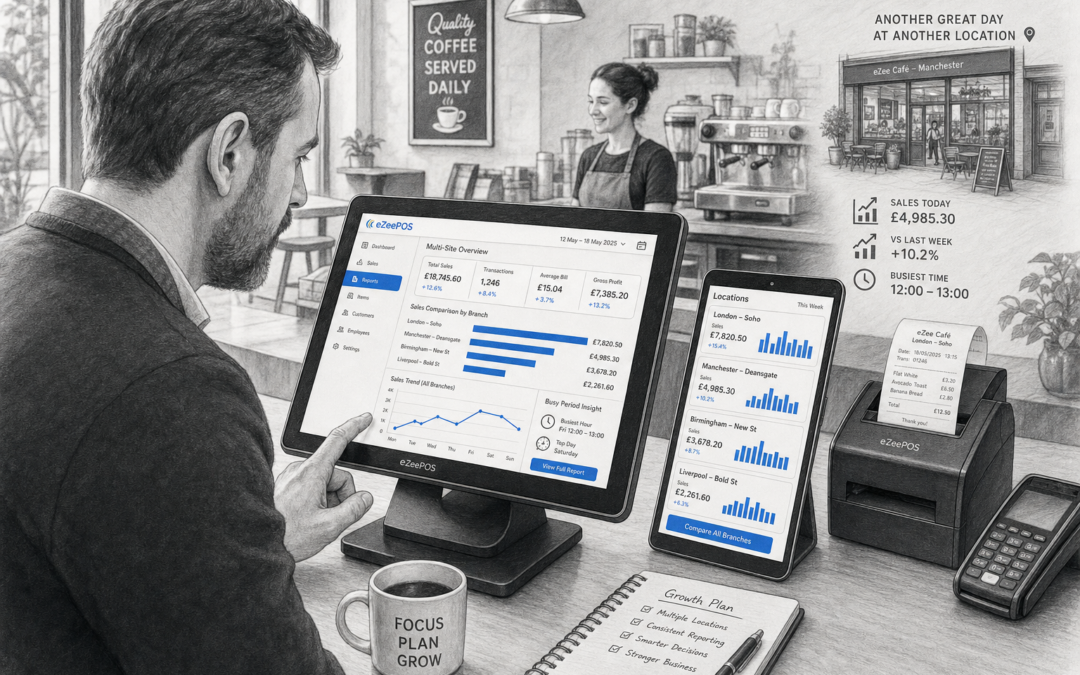
For many independent businesses, growth starts with one successful site and then moves on to a second, third or even more. That is a positive step, but it also makes day-to-day management more complex. Once you are no longer looking at a single counter, a single stockroom or a single service team, you need a clearer view of what is happening across the whole operation.
That is where multi-site reporting becomes especially useful. With a practical EPOS setup such as eZeePOS, business owners can move beyond separate tills and disconnected spreadsheets. Instead, they can review performance in a way that is easier to compare, easier to understand and much more useful when decisions need to be made quickly. You can learn more about the software at www.ezeepos.co.uk.
Why multi-site reporting matters
When each branch is left to report separately, it can be hard to see the bigger picture. One location may appear to be performing well simply because it is busier at certain times, while another may have stronger margins or a better mix of sales. Without a joined-up view, it is easy to miss the reasons behind the numbers.
Multi-site reporting brings those figures together so that owners and managers can compare locations in a more meaningful way. That makes it easier to ask practical questions such as:
- Which branch is busiest at lunch, at dinner or at the weekend?
- Which products sell best in each location?
- Are discounts being used consistently?
- Do staff levels need adjusting between branches?
- Are some sites delivering better average sales than others?
For retail and hospitality businesses alike, the value is not just in seeing totals. It is in seeing the differences that help you manage each site more effectively.
Better comparisons between branches
One of the most useful parts of multi-site reporting is the ability to compare like with like. A café in a high street location may perform very differently from one in a leisure park, and a shop in a town centre may trade in a different pattern from a branch in a local parade. The point is not to expect every site to behave the same. The point is to understand how each one is performing on its own terms.
When branch data is available in one place, owners can compare sales patterns, check whether certain products are stronger in one site than another, and identify where service or pricing may need attention. That helps remove guesswork and supports better planning.
Spotting seasonal and local trends
Different branches often serve different catchments. One site may be affected by school holidays, another by office traffic, and another by weekend visitors. Multi-site reporting makes these patterns easier to see. Rather than treating every branch as identical, the business can respond to the local trade each location actually receives.
That can be especially useful for retailers with mixed footfall, cafés with different customer types, or takeaways trading in areas with different demand patterns across the week.
Helping managers stay in control
When more than one site is involved, managers need data that is easy to use. If reporting takes too long or is too complicated, it often gets ignored until the end of the week or month. By then, it is harder to act on.
A good EPOS reporting setup should make it possible to check key numbers without unnecessary admin. That can help managers keep an eye on trading, resolve problems quickly and have better conversations with staff. If one branch is outperforming another, the reasons may be practical rather than dramatic: a better layout, stronger average spend, improved stock display or a smoother service flow.
When the figures are easy to compare, these improvements are easier to identify and repeat.
Useful information for owners, not just accountants
Reporting is often assumed to be something that matters mainly at the end of the month for bookkeeping or accounting. In reality, multi-site reporting is just as useful for day-to-day management. It can help answer practical questions such as:
- Which branch needs more staff during busy periods?
- Which location is underperforming on certain categories?
- Are offers working in one site but not another?
- Where are refunds, cancellations or voids happening most often?
That kind of information is valuable because it is operational. It helps owners make changes that affect trading now, not just in the next reporting period.
Keeping head office and branches aligned
For businesses with more than one site, consistency matters. Staff should be following the same processes, but the numbers need to show whether that is actually happening. Multi-site reporting can make it easier to spot variations in performance or procedure before they become bigger problems.
This is especially useful for businesses that are growing quickly. A new branch may have a different team, a slightly different customer base or a different menu or product mix. Reporting helps keep those differences visible without losing overall control of the business.
Supporting better decisions on staffing and trading
Once managers can see which branches are busiest and when, staffing decisions become easier to plan. The same applies to opening hours, promotions and category focus. Rather than relying on instinct alone, owners can use real data from across the business to guide the next step.
That is one reason multi-site reporting is so helpful for independent UK businesses trying to stay organised while continuing to grow. It allows more informed decisions without forcing the company into a complicated enterprise-style system.
A practical fit for retail and hospitality growth
Whether you run shops, cafés, restaurants, takeaways or a mixed hospitality operation, the challenge is similar: more sites mean more moving parts. A clear EPOS reporting view can make that easier to handle. It does not replace good management, but it gives managers and owners the information they need to stay ahead of problems and build on what is working.
If you are looking for a UK EPOS solution that can support growing businesses with practical reporting and a straightforward setup, eZeePOS is worth considering. It is designed to help independent retailers and hospitality businesses keep trading information organised as they expand.
Contact YCR Distribution at sales@ezeepos.co.uk or call 01924 438238.
To find out more, visit www.ezeepos.co.uk and see how eZeePOS can help bring your branch reporting together in one place.
Recent Comments