
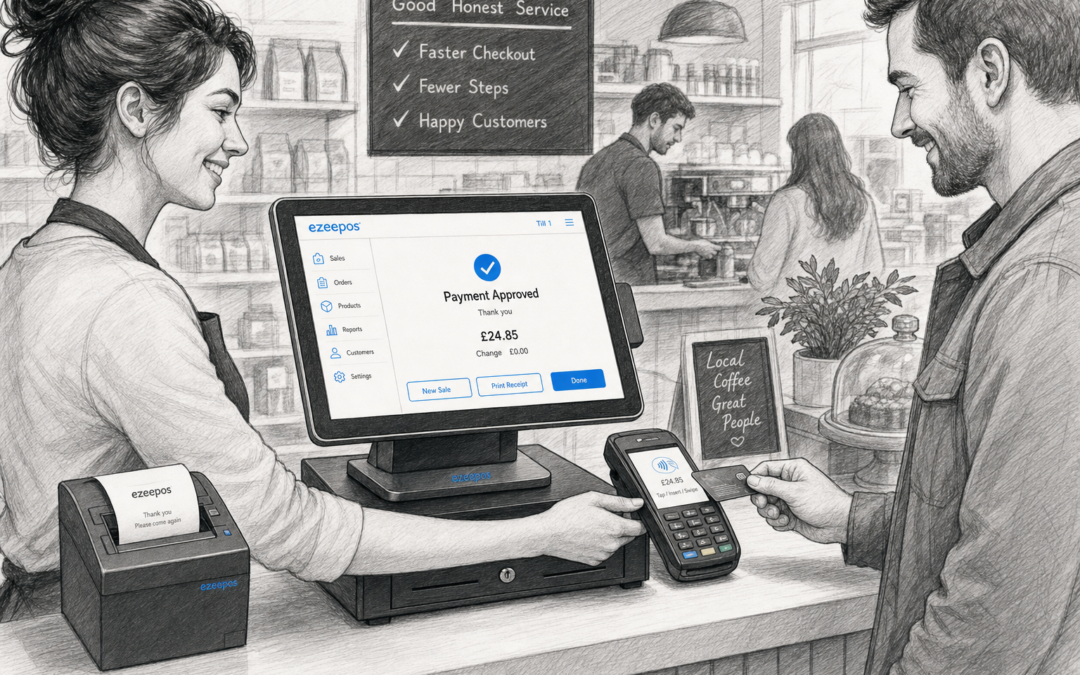
Why integrated card payments matter at the till
For many UK retailers, cafes, takeaways and other hospitality businesses, the checkout is where small delays soon add up. If staff are keying in amounts manually, checking totals twice or switching between systems, queues get longer and the customer experience can suffer. That is why integrated card payments have become such a useful part of a modern EPOS setup.
At eZeePOS, businesses can explore practical ways to make the till and payment process work together more smoothly. A well-planned setup can reduce avoidable mistakes, keep the counter moving and make day-to-day trading easier to manage.
What integrated card payments do differently
With a separate card machine, staff often have to enter the payment amount twice: once in the EPOS system and again on the terminal. That is not only slower, it also creates room for simple errors. An integrated setup links the sale and payment process more closely, so the amount taken at the terminal matches the transaction at the till more reliably.
For busy businesses, that can be a practical improvement rather than just a technical one. It helps reduce:
- Manual payment entry at the counter
- Mismatch between till totals and card receipts
- Time spent correcting mistakes during service
- Confusion when staff are busy or training new team members
Where the benefits show up most clearly
Retail shops with steady footfall
In convenience stores, gift shops, fashion shops and similar retail settings, speed matters from the moment a customer reaches the till. Integrated payments can help staff complete transactions more quickly, especially during lunch breaks, after-school rushes or weekend trading. That means less time spent waiting and more time serving.
Cafes, takeaways and counter-service hospitality
Hospitality businesses often deal with quick-fire orders, customer add-ons and changing totals. When the payment step is linked better with the EPOS, staff can focus more on service and less on correcting amounts. This is especially useful during busy service periods when every second counts.
Businesses with mixed payment habits
Some customers pay by card, some use contactless and some still prefer cash. A joined-up payment workflow helps the team keep everything organised without making the till more complicated. It also makes it easier for owners to understand what is happening at the point of sale.
How integrated payments can support accuracy
Payment speed is important, but accuracy is just as valuable. The more steps staff have to remember, the more likely a mistake becomes. Integrated card payments reduce the need for double handling, which can help with everyday accuracy in several ways.
For example, it can make it easier to:
- Take the correct amount on the first attempt
- Match card payments to the right order or sale
- Keep end-of-day checks simpler
- Reduce time spent investigating small discrepancies
That does not mean every checkout problem disappears, but it can remove one of the common causes of delay and admin.
Why it matters during busy periods
The real value of integrated payments often becomes clearer when the business is under pressure. A quiet counter can cope with a few extra steps. A busy one cannot. If staff are serving a queue, answering customer questions and dealing with a payment machine at the same time, even a small delay can affect the pace of service.
For independent businesses, that can lead to:
- Longer queues and more frustration for customers
- More pressure on staff, especially at peak times
- Greater risk of cashing up errors later on
- Less control over the flow of the front counter
A more integrated checkout workflow helps keep the process calmer and more predictable.
Payment integration options to consider
When businesses look at payment integration options, they often want something practical, familiar and suitable for their day-to-day trading. eZeePOS can support payment integration discussions for providers such as Teya and Dojo Payments, depending on the setup a business is exploring with YCR Distribution.
It is sensible to discuss the full setup before making a decision, including the till hardware, payment terminal arrangement and how transactions will be handled in real use. The main point is not to chase extra complexity, but to choose a payment flow that suits the business.
What to think about before changing your payment setup
Before moving to integrated card payments, it helps to think about how your team works now and where delays happen. Some businesses mainly need faster checkout. Others want fewer manual steps or better matching between sales and payments at the end of the day.
Useful questions to ask
- How many payments do we process during our busiest times?
- Where do mistakes tend to happen now?
- Do staff need a payment setup that is simple to learn quickly?
- Would a more joined-up workflow reduce queues or pressure at the till?
These questions are often more useful than looking at payment technology in isolation. The best setup is usually the one that fits the counter, the staff and the way the business actually trades.
A more practical checkout for independent businesses
Integrated card payments are not about replacing good service. They are about making service easier to deliver. For UK shops, cafes and takeaways, even modest improvements in checkout speed and accuracy can make a noticeable difference to the working day.
If you are reviewing your current setup, it may be worth looking at how eZeePOS could fit into a faster, more organised payment workflow. You can learn more at www.ezeepos.co.uk and see whether a more joined-up EPOS and payment approach suits your business.
Contact YCR Distribution at sales@ezeepos.co.uk or call 01924 438238.
Recent Comments