
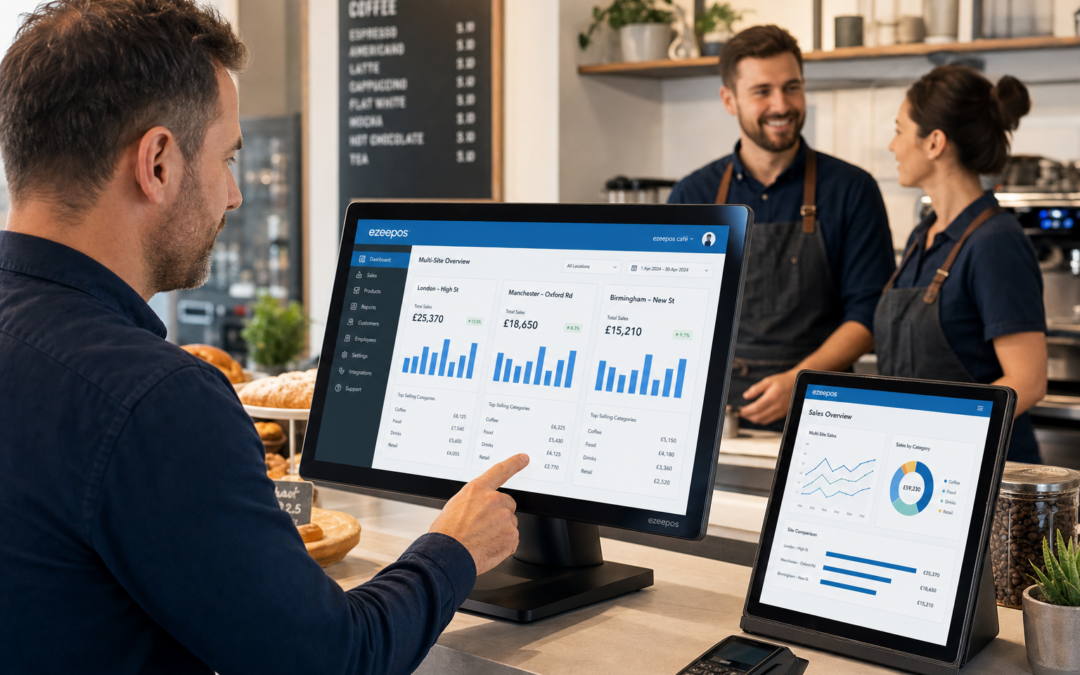
When a business opens a second site, the way you read your numbers changes. What once looked simple at one counter can quickly become harder to manage across different branches, teams and trading patterns. That is where multi-site reporting becomes especially useful. For UK retailers, cafés, restaurants, pubs and takeaways, it can help turn separate sets of sales data into a clearer picture of how the whole business is performing.
eZeePOS is designed to support practical EPOS use for independent businesses, including those that need to keep an eye on more than one location. Rather than relying on separate spreadsheets or pulling figures together manually at the end of the week, multi-site reporting gives managers a more structured way to review results and make better decisions.
What multi-site reporting actually helps you see
At its simplest, multi-site reporting lets you compare branch performance in one place. That might mean looking at daily takings, busiest trading periods, average transaction value or particular sales patterns across each site. For a business with one busy high street branch and another in a quieter area, those numbers are often very different. Being able to compare them side by side helps you understand why.
This is useful for more than just larger chains. Even a business with two cafés, a shop with a seasonal second site, or a takeaway operating from different locations on different days can benefit from clearer reporting. It gives owners a better way to answer questions such as:
- Which location is busiest at lunchtime?
- Which branch has the strongest weekend trade?
- Are offers performing differently in each site?
- Which location needs more staff at certain times?
Why it matters for growing UK businesses
Growth often creates inconsistency before it creates confidence. One site may run smoothly, while another needs more oversight. One manager may be excellent at cost control, while another needs stronger daily visibility. Multi-site EPOS reporting helps bridge that gap by making performance easier to review without needing to visit each site in person every day.
For independent businesses, that matters because time is limited. Owners rarely have the luxury of spending hours cross-checking paper records or asking different branches to send reports in different formats. A well-organised EPOS system can reduce that admin and present the information in a way that is easier to use.
That can support better decisions around staffing, opening hours, promotions and local management. It can also help highlight which branches need support before problems become bigger.
Useful reporting views for multiple locations
Daily sales comparisons
Daily sales are often one of the first reports business owners check. Across multiple sites, those figures become even more valuable when viewed together. You can quickly see whether one branch is outperforming the others, whether a location is under pressure or whether a quiet day is normal for that site.
Peak trading times
Knowing when each branch is busiest is just as important as knowing total sales. A restaurant may be strongest in the evening, while a café performs best mid-morning. A retail shop in a town centre may trade differently from one in a retail park. Multi-site reporting helps you spot these patterns so rotas and opening hours can match demand more closely.
Product and menu trends
Different sites often sell differently. One branch may do well with breakfast items, while another sells more lunch trade or seasonal lines. In retail, the best-selling products in one location may not be the same in another. Compared with manual checking, EPOS reporting makes those differences easier to spot and act on.
Branch-level performance
When a business has more than one manager, branch-level reporting can help keep expectations clear. Owners and area managers can review the same information without relying on guesswork. That makes conversations about performance more practical and less personal.
How multi-site reporting supports day-to-day control
The strongest benefit of multi-site reporting is not just visibility; it is control. It helps business owners stay informed without becoming trapped in day-to-day operations at each branch. That matters whether you run shops, hospitality sites or a mix of both.
Here are a few practical ways it can help:
- Staff planning: match staffing levels to actual trading patterns rather than assumptions.
- Budgeting: compare sites and plan more accurately for quieter or busier periods.
- Promotions: see whether offers work better in one location than another.
- Manager accountability: review performance consistently across branches.
- Expansion planning: use real data to understand what a stronger site looks like before opening again.
Retail and hospitality use cases
For retail businesses, multi-site reporting can highlight which locations are strongest for certain product ranges, how different branches respond to seasonal trading and where customer demand is shifting. This is useful for shops with more than one branch, mobile retail operations or businesses that split trade between a permanent site and a pop-up.
For hospitality businesses, it can be just as valuable. A group of cafés may want to compare morning trade. A pub operator may need to watch weekend performance across more than one venue. A takeaway business might want to compare order volumes, average spend or busy service periods between sites. In each case, the report is not just about numbers; it is about understanding how each location works in practice.
Keeping the information simple enough to use
One of the problems with multi-site reporting is that it can become too detailed if the system is not set up well. Good EPOS reporting should make it easier to understand the business, not more complicated. The most useful reports are usually the ones that are clear, consistent and easy to review quickly.
That is why many owners prefer a system that presents key information in a straightforward way, without making them dig through unnecessary detail. Whether you are checking from the office, a back room or between shifts, the aim should be the same: to get an accurate overview without wasting time.
Choosing an EPOS setup that can grow with you
If your business is likely to expand, it is worth considering reporting needs early. A system that works well for one site may not be enough once you start adding branches or managing different teams. Looking ahead can save time later and make the jump to multi-site operation much smoother.
At www.ezeepos.co.uk, eZeePOS is positioned as a practical UK EPOS option for businesses that need clear day-to-day visibility, including those with more than one location. If you are planning growth or already managing multiple sites, it can be helpful to speak to a supplier who understands how reporting fits into real trading conditions.
Contact YCR Distribution at sales@ezeepos.co.uk or call 01924 438238.
For a closer look at eZeePOS and how it supports practical business reporting, visit www.ezeepos.co.uk.
Recent Comments