
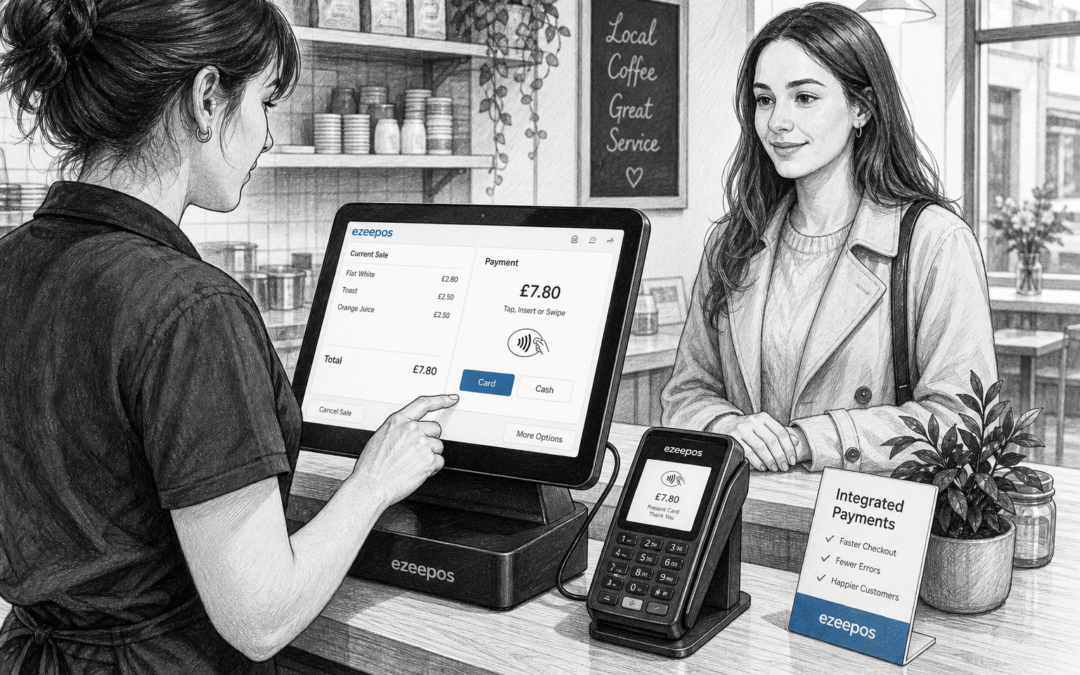
For many UK retailers, cafes, restaurants and takeaways, the checkout is where small delays and small mistakes quickly become visible. A missed amount, a manual card entry or a mismatch between the till and payment terminal can slow service down and create extra work at the end of the day. That is why more businesses are looking at integrated card payments as part of a smarter EPOS setup.
If you are reviewing your payment process, it is worth looking at how your till, card terminal and reporting all work together. On eZeePOS, integrated payments are part of the kind of practical setup many businesses want when they are trying to reduce friction at the counter and keep transactions accurate. In some cases, businesses may also want to discuss payment integration options such as Teya or Dojo Payments with YCR Distribution, depending on their requirements.
Why manual payment entry causes problems
When a staff member has to key in the card amount manually, there is more room for error. A mistyped figure, an extra zero or a card terminal that is not matched properly with the till can all affect the customer experience. In a quiet shop this might be manageable, but during a lunchtime rush or a weekend service it can quickly become a real issue.
Manual entry can also slow staff down. Instead of ringing through a sale, taking payment and moving to the next customer, they have to stop and double-check the amount. Over the course of a day, that extra handling adds up. It can mean longer queues, more pressure on staff and more time spent correcting small mistakes later.
What integrated card payments do differently
Integrated card payments link the amount on the EPOS system to the payment terminal, so the figure does not need to be entered again by hand. That simple change can make checkout handling feel far smoother. The till sends the payment amount to the card machine, the customer pays, and the transaction is recorded more cleanly in the system.
For businesses using eZeePOS, this can be particularly useful because it supports a more joined-up way of working at the till. Staff do not need to move between different screens or rely on memory. The checkout process becomes more consistent, which is helpful for training, daily operation and record keeping.
A better fit for busy retail counters
In retail, especially in independent shops, every transaction needs to move quickly without losing accuracy. Whether you run a convenience store, gift shop, fashion boutique or hardware store, integrated payments can help reduce pressure at the point of sale. Staff can focus on serving the customer, scanning items and completing the sale rather than re-entering values on a separate device.
This is especially useful where there are frequent small transactions, multiple staff members or periods of heavy footfall. A cleaner payment flow can help the counter feel more controlled, even when the shop is busy.
A better fit for hospitality service
In cafes, restaurants, bars and takeaways, payment handling has to keep pace with service. Staff may be splitting orders, making adjustments or dealing with table and counter payments in quick succession. If card payments are not connected to the till, it is easier for something to be missed or entered incorrectly.
Integrated card payments help create a more natural handover between taking the order and taking the money. That can make service feel calmer for staff and less confusing for customers, particularly during busy periods where speed and accuracy both matter.
How it can help reduce checkout errors
There are several practical ways this type of setup can improve accuracy:
- Less manual typing means fewer chances to enter the wrong amount.
- Clearer transaction records help match till activity with card payments.
- Faster payment flow reduces pressure during busy periods.
- Cleaner end-of-day checks make it easier to spot discrepancies.
- Better staff confidence comes from using one connected process instead of several separate steps.
These benefits are not about making payments complicated. They are about removing unnecessary steps. For most small and independent businesses, that is often where the biggest improvements are found.
Why payment visibility matters at the end of the day
One of the most valuable parts of an integrated payment setup is the clarity it can bring later on. When sales and payments are linked more closely, it becomes easier to review what has happened during the day. Managers can compare the till record to the card transactions with less manual checking, which may save time at closing and reduce the chance of unresolved differences.
This is especially useful if you have more than one person using the till, or if your business has different trading patterns across the week. Good visibility at the end of the day supports better decisions and helps keep routine admin under control.
Choosing the right payment setup for your business
Not every business needs exactly the same payment arrangement. A small countertop shop may want a simple, fast checkout process. A restaurant may want something that supports table service and different payment scenarios. A takeaway may want speed above all else. The best setup is the one that fits the way you already trade.
That is why it helps to look at the full EPOS picture rather than the card machine on its own. The software, the hardware and the payment process should work together as one practical system. If you are considering payment integration options, the team behind eZeePOS and YCR Distribution can help you think through what makes sense for your business.
Keeping service fast without making the till harder to use
Integrated payments should make life easier for staff, not more complicated. The aim is to reduce unnecessary steps, support a smoother checkout and limit avoidable mistakes. For many UK businesses, that can mean better customer flow, fewer payment issues and a more predictable end to the trading day.
If you are exploring a modern EPOS setup for your retail or hospitality business, it is worth seeing how eZeePOS could fit into your payment process. Visit www.ezeepos.co.uk to learn more about practical EPOS options for UK businesses.
Contact YCR Distribution at sales@ezeepos.co.uk or call 01924 438238.
For a closer look at eZeePOS and how it may support integrated payment discussions for your business, visit www.ezeepos.co.uk.
Recent Comments