

Types of payment solutions for UK hospitality venues

Types of payment solutions refer to the various methods and platforms businesses use to accept and process financial transactions from customers. For hospitality operators in the UK, the choice spans cash, cards, digital wallets, QR code payments, Buy Now Pay Later, and the backend gateways and POS systems that tie them together. Apple Pay, Google Pay, and PayPal now sit alongside chip-and-PIN as standard guest expectations. Getting this mix right in 2026 directly affects table turn times, reconciliation accuracy, and whether a guest returns.
1. Types of payment solutions: the full picture for hospitality
Payment solutions in hospitality fall into two categories: payment methods (what the guest uses to pay) and payment platforms (the systems that process and settle those payments). Understanding both layers is the starting point for any informed decision. Most venues focus only on the guest-facing side and underestimate how much the backend affects speed, reporting, and cash flow.
The most common payment methods used across UK hospitality today include:
- Cash: Still used by a significant minority of guests, particularly in pubs and casual venues. Requires float management, manual reconciliation, and carries theft risk.
- Debit and credit cards: The dominant method in UK hospitality. Chip-and-PIN interfaces can be configured to avoid manual entry, improving both speed and security.
- Digital wallets: Apple Pay and Google Pay use NFC contactless technology. No app is required for the guest, and transaction speeds are faster than chip-and-PIN.
- QR code payments: Guests scan a unique QR code from their phone, browse the menu, and pay via card or digital wallet without waiting for staff.
- Buy Now Pay Later (BNPL): Providers such as Klarna allow guests to split payments. Relevant for hotel bookings, event deposits, and higher-value dining experiences.
- Bank transfers and direct debits: Suited to corporate accounts, large group bookings, and supplier payments rather than point-of-sale transactions.
- Prepaid and gift cards: Common in hotel groups and branded restaurant chains for loyalty and gifting programmes.
2. Payment gateways and processors: the backend that makes it work
A payment gateway authorises transactions by securely transmitting card data between the guest, the merchant, and the acquiring bank. A payment processor handles the actual movement of funds and settlement into the merchant’s account. These two functions are often bundled by a single provider but are technically distinct roles.
For hospitality operators, the critical factor is how well these backend systems connect to your point-of-sale platform. Integrated payment processing means that a transaction completed at the table or counter flows directly into your POS, updating stock levels, applying the correct VAT rate, and recording service charges without manual intervention. Venues that run payment terminals separately from their POS create double-entry risk and slow down end-of-day reconciliation.
Modern payment platforms use tokenisation and Strong Customer Authentication (SCA) to meet UK regulatory requirements. Integrated payments flow end-to-end into the POS for operational accuracy, including correct VAT and service charge handling. This matters most during peak service when errors are hardest to catch.
Pro Tip: When evaluating payment processing solutions, ask providers specifically how their system handles service charge allocation and VAT splits. A gateway that cannot pass these fields to your POS will create reconciliation headaches every single night.
3. Comparing digital payment options: speed, cost, and guest experience
Not every payment method performs equally across the criteria that matter most to a hospitality manager. The table below compares the principal options by transaction speed, merchant cost, dispute support, and recurring payment capability.
| Payment method | Transaction speed | Merchant cost | Disputes supported | Recurring payments |
|---|---|---|---|---|
| Cash | Immediate | None (handling cost) | No | No |
| Debit/credit card | Immediate | Interchange + fee | Yes | Yes |
| Digital wallet (Apple Pay, Google Pay) | Immediate | Similar to card | No | No |
| QR code payment | Near-immediate | Low to moderate | Varies | No |
| Bank transfer / SEPA | 1 or more days | Low | No | Yes |
| BNPL (Klarna etc.) | Immediate for merchant | Higher merchant fee | Provider-managed | No |
| Autopay / direct debit | Immediate confirmation | Low | No | Yes |
Debit and credit cards offer immediate confirmation, chargeback protection, and recurring billing support. This combination makes them the most functionally complete option for hospitality. Digital wallets match card speed but lack native dispute and recurring billing support, which is worth noting for venues that take deposits or run membership schemes.
Bank transfers are well-suited to high-value corporate bookings but the 1-plus day settlement window makes them unsuitable for standard table service. BNPL carries a higher merchant fee than cards but can meaningfully increase average spend for hotels and event-led venues.
“Payment flexibility offering multiple options improves customer satisfaction and conversion in hospitality by catering to varied guest preferences.” Shopify
The practical implication is clear: no single payment method covers every guest segment or transaction type. A deliberate mix, configured correctly in your POS, is the only way to serve all guests without operational compromise.
4. Contactless and mobile payment systems: the speed advantage
Contactless payment solutions have become the default expectation in UK hospitality, not a premium feature. NFC-based payments via Apple Pay and Google Pay complete in under two seconds at the terminal, compared to five to eight seconds for chip-and-PIN. At a busy bar or quick-service counter, that difference compounds across hundreds of transactions per shift.
QR code ordering takes the speed benefit further. Guests scan, order, and pay from their own device with no app required. This model reduces guest wait times and frees front-of-house staff to focus on service quality rather than order-taking. The operational flow benefit is particularly pronounced in fast-casual venues and food halls where staff-to-cover ratios are tight.
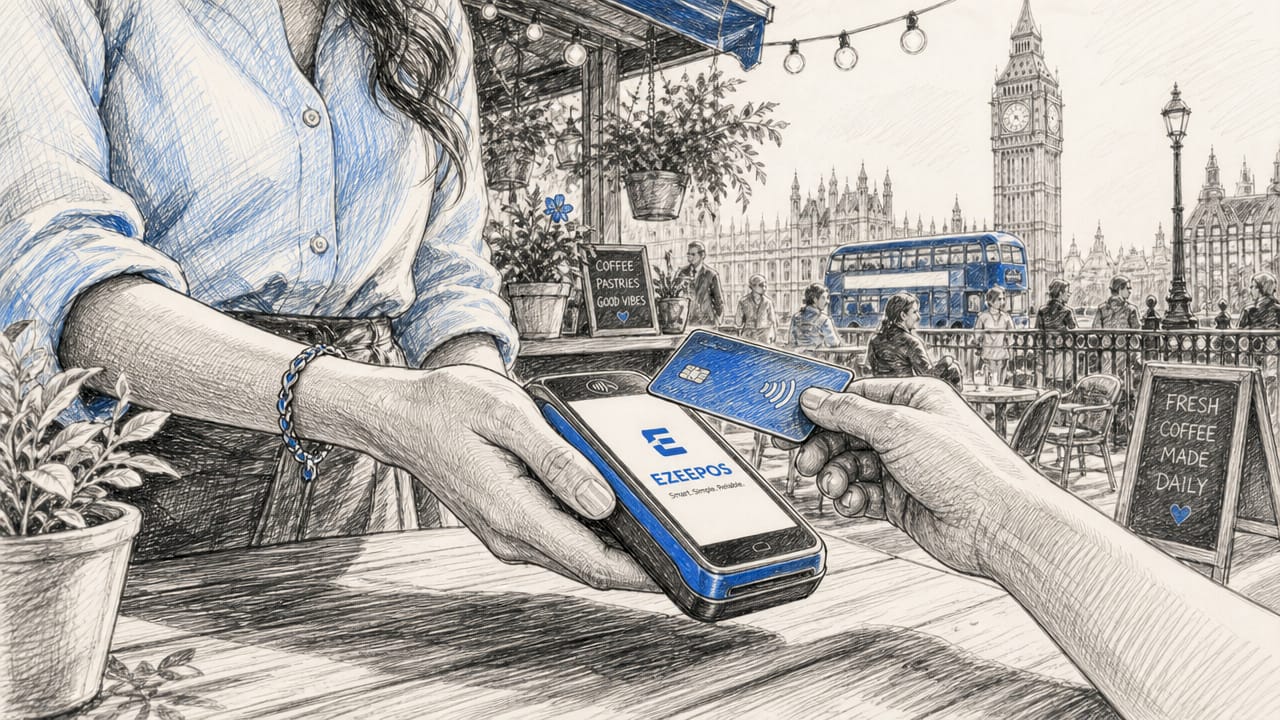
Contactless payment examples in UK hospitality now include handheld POS terminals at the table, self-service kiosks, and mobile POS units for outdoor or event catering. Each of these formats relies on the same NFC and tokenisation infrastructure, meaning a single integrated platform can support all of them without separate contracts or reconciliation streams.
5. Selecting the right payment mix for your venue type
The best payment solutions for a fine-dining restaurant differ from those for a festival bar or a city-centre hotel. Each venue type has a distinct guest profile, average transaction value, and service rhythm that should shape the payment configuration.
Fast-casual and quick-service venues benefit most from contactless and QR code payments. Speed is the primary metric. Card terminals should be positioned at every service point, and self-service kiosks with integrated payment should be considered for peak periods. BNPL is largely irrelevant at this price point.
Fine dining and hotel restaurants have higher average transaction values and guests who expect flexibility. Cards, digital wallets, and BNPL for deposits all belong in the mix. Recurring billing support via autopay is worth activating for membership dining programmes or tasting-menu deposits.
Hotels and event venues face the most complex payment requirements. Corporate accounts require bank transfer capability. Group bookings benefit from deposit management via BNPL or direct debit. Front-desk and restaurant payments need to reconcile against a single guest folio, which demands tight POS and property management system integration.
One operational challenge that affects all venue types is settlement timing. Daily close timing misalignment between your POS and payment processor can make transactions appear delayed. This is a configuration issue, not a payment failure, but it causes unnecessary concern during end-of-day reporting if not set up correctly from the start.
A second resilience consideration: offline credit card settlement allows folio settlement to continue even when connectivity is lost, with processing completing once the connection is restored. For outdoor events or venues with patchy connectivity, this capability is non-negotiable.
Pro Tip: Configure your payment platform to export settlement reports that match your POS close time exactly. Mismatched reporting windows are the single most common cause of apparent discrepancies in hospitality end-of-day accounts.
Key takeaways
The most effective payment strategy for hospitality venues combines multiple guest-facing methods with a single integrated backend platform that handles settlement, VAT, and reporting without manual intervention.
| Point | Details |
|---|---|
| Layer your payment methods | Offer cards, digital wallets, and QR code options to cover all guest preferences. |
| Backend integration is non-negotiable | Payment gateways must connect directly to your POS to avoid reconciliation errors. |
| Match methods to venue type | Fast-casual venues need speed; hotels need flexibility, recurring billing, and folio integration. |
| Offline resilience matters | Configure offline settlement to maintain service continuity during connectivity loss. |
| Settlement timing is a configuration issue | Align POS close times with processor deposit windows to prevent apparent discrepancies. |
The payment detail most hospitality managers overlook
After working closely with hospitality operators across the UK, the pattern I see most consistently is this: venues invest in the guest-facing payment experience and neglect the backend entirely. A tap-to-pay terminal at the table looks impressive. A reconciliation process that takes two hours every morning because the POS and payment processor do not talk to each other is invisible to guests but exhausting for the team.
The shift I have observed accelerating in 2026 is not the arrival of new payment methods. It is the growing recognition that integrated POS and payment platforms are an operational necessity, not a luxury upgrade. Venues that treat payment processing as a standalone function separate from their POS are creating friction in their own back office that compounds daily.
My honest view on BNPL in hospitality is that it is underused at the upper end of the market and irrelevant at the lower end. A hotel taking a £400 deposit for a private dining event should absolutely offer Klarna or a similar service. A café selling flat whites should not bother. The mistake is applying a blanket policy in either direction.
The future of payment solutions in hospitality is not about adding more methods. It is about reducing the number of systems those methods touch before they appear in your accounts. Every additional integration point is a potential failure. The operators who will manage payment complexity best are those who consolidate onto fewer, better-connected platforms rather than accumulating tools.
— John
How Ezeepos supports integrated payments for UK hospitality
Ezeepos is built specifically for UK hospitality venues that need payment processing and POS to work as a single system, not two separate tools bolted together.
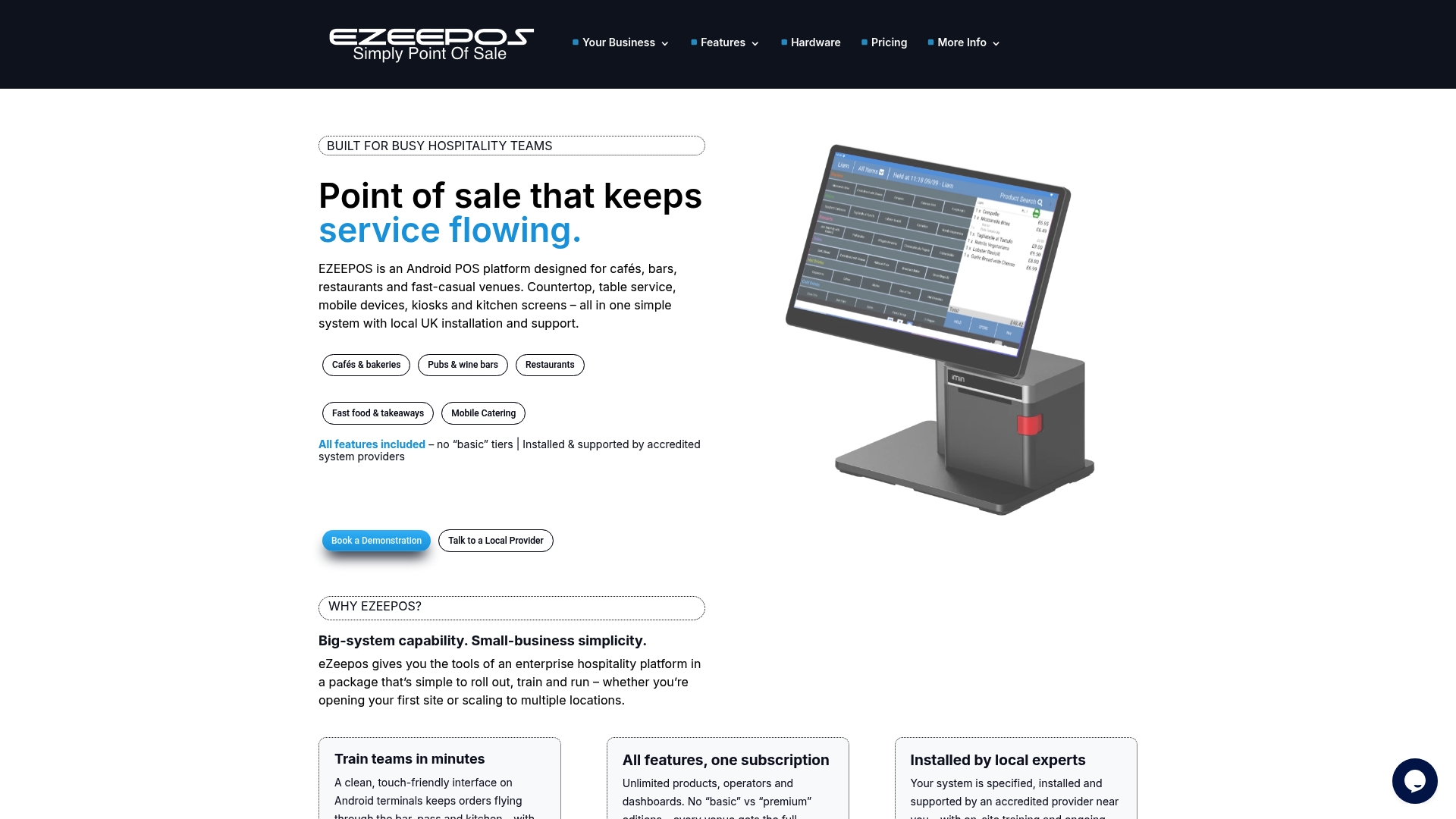
The Ezeepos platform connects card terminals, digital wallet acceptance, and QR code ordering directly into a unified POS that handles VAT, service charges, and end-of-day reporting without manual reconciliation. Whether you run a café, a bar, a fast-casual chain, or a multi-site restaurant group, the system is configured to your service style and supported by local UK installation teams. Explore the full Ezeepos POS platform to see how integrated payment solutions can reduce back-office workload and improve the guest experience across every service point.
FAQ
What are the main types of payment solutions for hospitality?
Payment solutions for hospitality include cash, debit and credit cards, digital wallets such as Apple Pay and Google Pay, QR code payments, BNPL services, bank transfers, and direct debits. Each method suits different transaction values, service speeds, and guest profiles.
Why does POS integration matter for payment processing?
An integrated POS connects payment terminals directly to your sales system, removing manual data entry and ensuring VAT, service charges, and stock levels update automatically with each transaction. Venues without this integration face daily reconciliation errors.
What is the fastest payment method for busy hospitality venues?
NFC contactless payments via Apple Pay and Google Pay are the fastest at the point of sale, completing in under two seconds. QR code ordering goes further by removing the terminal interaction entirely, allowing guests to order and pay from their own device.
How does offline payment settlement work in hospitality?
Offline settlement records transactions locally when connectivity is lost and processes them once the connection is restored. This allows hospitality venues to continue taking card payments during outages without interrupting service.
When should a hospitality venue offer BNPL payment options?
BNPL is most relevant for higher-value transactions such as hotel deposits, event bookings, and private dining. The merchant fee is higher than standard card rates, so it is best reserved for transactions where the flexibility meaningfully increases conversion or average spend.
Recent Comments