

Why real-time inventory sync matters for hospitality venues

Real-time inventory synchronisation is the process of instantly updating stock levels across every connected channel the moment a transaction occurs. For hospitality venue operators, this means your POS, kitchen, and supplier systems all reflect the same stock position within seconds, not hours. Global inventory distortion costs retailers $1.77 trillion annually, with up to 40% of potential sales lost to inaccuracies. That scale of loss is not a retail problem alone. Bars, restaurants, and cafés face the same exposure every service. The question of why real-time inventory sync belongs at the centre of your operations is answered by one fact: inaccurate stock data costs you sales, reputation, and staff time simultaneously.
Why real-time inventory sync improves operational efficiency
The most direct benefit of real-time inventory management is the elimination of order errors caused by stale stock data. When your POS reflects live stock levels, front-of-house staff stop selling dishes or drinks that the kitchen cannot fulfil. That single change removes a category of customer complaint that no amount of service recovery fully fixes.

The operational gains extend well beyond avoiding awkward conversations with guests. Retailers offering live stock visibility report 12% higher sell-through rates, 15% higher average order value, and 22% faster replenishment cycles. For a busy restaurant or bar, faster replenishment means fewer emergency supplier calls and less over-ordering to compensate for uncertainty.
Manual stock reconciliation is one of the most time-consuming tasks in venue management. Staff who spend shift time counting stock and correcting spreadsheets are not serving guests. Real-time stock tracking removes the need for constant manual checks by keeping your system of record accurate throughout the day.
- Fewer order errors: Live stock data prevents front-of-house from selling items the kitchen cannot deliver.
- Faster replenishment: Automated reorder triggers fire the moment stock hits a threshold, not after a weekly count.
- Reduced write-offs: Accurate data lets you identify slow-moving stock before it expires, protecting margin.
- Staff time reclaimed: Less manual counting means more time on service and guest experience.
Pro Tip: Set automated low-stock alerts at two separate thresholds: one to prompt a reorder and one to flag an item as unavailable on your POS. This two-stage approach prevents both stockouts and premature menu restrictions.
84% of shoppers prefer retailers with accurate, live stock data. In hospitality, that preference translates directly into repeat visits and positive reviews.
What technology powers real-time inventory synchronisation?
Understanding the mechanics behind inventory sync helps you ask better questions when evaluating systems. The industry term for the underlying approach is event-driven architecture. Rather than checking stock levels on a schedule, an event-driven system pushes an update the instant a stock change occurs.
Here is how the core components work together:
- Change data capture (CDC): The system monitors your database for any stock movement and captures it the moment it happens, whether that is a sale, a return, or a manual adjustment.
- Webhooks: These are automated messages sent from one system to another immediately after an event. When a pint is sold at your bar POS, a webhook fires to update the central stock record.
- Message brokers: Tools like Apache Kafka act as a relay, queuing updates so that no stock change is lost even if one system is temporarily slow to respond.
- Inventory locking: At the moment a customer initiates checkout, the system reserves stock instantaneously to prevent two orders claiming the same item simultaneously.
Event-driven architecture reduces sync latency to under five seconds, using webhooks and message brokers to push updates immediately. Five seconds is fast enough to prevent overselling in almost every real-world hospitality scenario.
The alternative is batch processing, where stock levels are updated on a fixed schedule, perhaps every 15 or 60 minutes. Batch inventory sync creates a window in which overselling can occur. During a busy Friday evening service, 60 minutes of stale stock data is long enough to sell the same bottle of wine three times over.
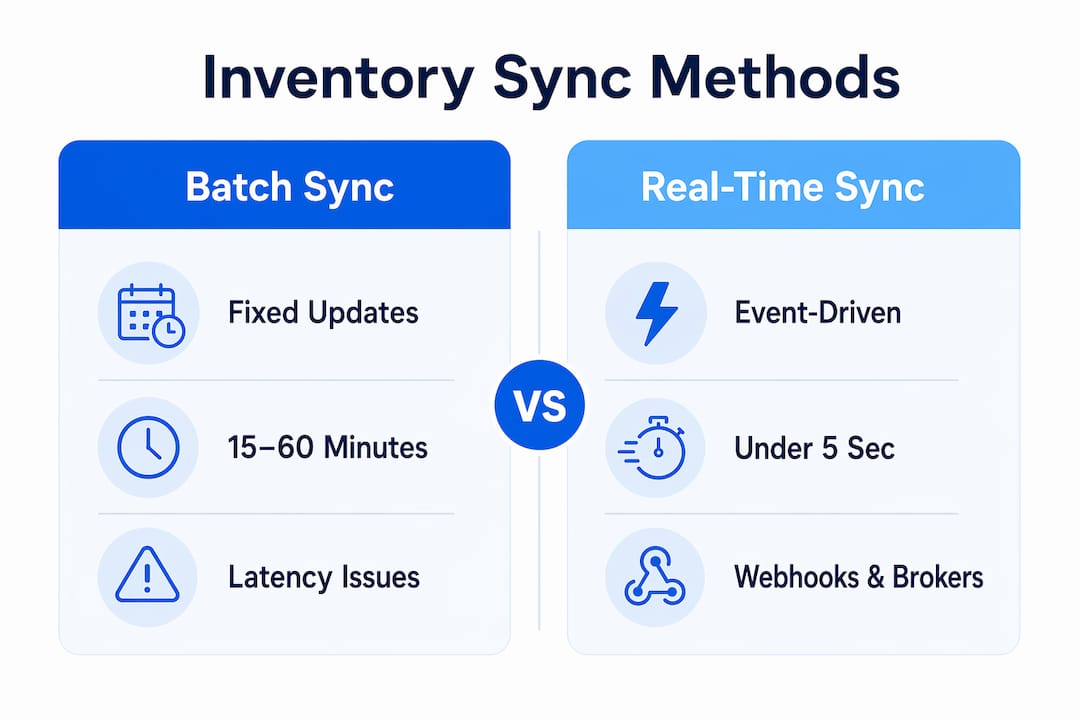
| Feature | Batch sync | Real-time event-driven sync |
|---|---|---|
| Update frequency | Fixed intervals (15–60 minutes) | Instant, on every stock change |
| Overselling risk | High during peak periods | Minimal with inventory locking |
| Scalability | Degrades with volume | Designed for high-volume environments |
| Manual reconciliation | Frequent | Rare, used only as a fallback |
Pro Tip: When assessing a POS or inventory system, ask the supplier directly whether it uses event-driven architecture or batch updates. If they cannot answer clearly, treat that as a warning sign.
What safeguards make real-time inventory sync reliable?
Even the best event-driven systems benefit from practical safeguards. Technology is not infallible, and hospitality environments are high-volume, high-pressure places where edge cases occur regularly.
- Safety buffers: Hold back 5–10% of your stock as unallocated reserve. This buffer absorbs minor sync delays or data spikes without triggering an oversell. For a venue running 200 covers a night, a 10% buffer on key items is a low-cost insurance policy.
- Inventory locking at checkout: The moment a transaction begins, the system locks the relevant stock. This prevents race conditions where two orders claim the same item within milliseconds of each other. Without locking, even a sub-five-second sync window carries risk during peak service.
- Reconciliation polls as a fallback: Schedule a lightweight stock reconciliation check every few hours. This is not a return to batch processing. It is a safety net that catches any discrepancy the event-driven system missed due to a network interruption or API timeout.
- Ghost stock prevention: Many systems still rely on batch updates, which cause ghost stock accumulation as synchronisation fails at scale. Ghost stock is inventory your system believes exists but physically does not. It is one of the most damaging forms of data inaccuracy because it leads to confident overselling. Event-driven architecture eliminates the conditions that create it.
- API error retries: Any integration between your POS, ERP, and supplier systems should include automatic retry logic. If a webhook fails to deliver, the system should attempt redelivery rather than silently dropping the update.
23% of multi-channel sellers cite inventory complaints as a key operational challenge. The safeguards above address the root causes of those complaints directly.
How can hospitality venues implement inventory sync effectively?
Adopting real-time synchronisation is a significant operational change. The venues that do it well treat it as a process project, not just a technology purchase.
Start by auditing your current setup. Map every point where stock data is created or consumed: your POS terminals, kitchen order screens, back-office system, and any supplier portals. Identify where data currently lags or where staff manually bridge gaps between systems. That map tells you where the highest-value integrations are.
When choosing a system, prioritise API-first platforms with documented event-driven design. An inventory management guide for hospitality venues can help you frame the right questions before you speak to suppliers. Avoid platforms that describe their sync capability in vague terms like “near real-time” without specifying latency figures.
Staff training is where many implementations stall. Your team needs to trust the live data on their screens. If they have spent years double-checking stock manually because the system was unreliable, they will not change behaviour overnight. Run structured handover sessions that show staff exactly how the new system updates and what to do when they spot an anomaly.
- Audit first: Document every system that touches stock data before selecting a solution.
- Demand specifics: Ask suppliers for latency figures and architecture details, not marketing descriptions.
- Train for trust: Staff who trust live data stop working around the system, which is where accuracy breaks down.
- Connect POS and ERP: The role of POS in inventory control is central. A unified POS that feeds directly into your back-office system removes the manual data transfer step entirely.
- Plan for scale: Choose a system that handles your busiest service, not your average one. Architecture that works at 50 covers will not necessarily hold at 300.
Real-time data flow allows finance teams to better manage working capital and identify slow-moving stock ahead of obsolescence. That benefit compounds over time as your purchasing decisions become more precise.
Key takeaways
Real-time inventory synchronisation is the single most effective way to eliminate stock discrepancies, prevent overselling, and reclaim staff time across a hospitality venue.
| Point | Details |
|---|---|
| Event-driven architecture is the standard | Systems using webhooks and message brokers update stock in under five seconds, preventing overselling. |
| Safety buffers protect against edge cases | Hold back 5–10% of stock as unallocated reserve to absorb sync delays during peak service. |
| Batch sync creates ghost stock | Batch updates fail at scale, producing inaccurate stock records that lead to confident overselling. |
| Staff trust determines success | Training staff to rely on live data is as important as the technology itself. |
| POS and ERP integration is the foundation | A unified POS connected to your back-office system removes manual data transfer and its associated errors. |
The uncomfortable truth about inventory sync I have seen too often
Most venue operators I speak with frame inventory sync as a technology problem. They ask which system to buy, which integration to prioritise, which API to connect. That framing misses the bigger issue.
The real cost of poor inventory synchronisation is not the stock you lose. It is the 66% of consumers who lose brand trust after a single overselling incident. In hospitality, that means a guest who ordered a dish that was not available, or a function that ran short on a key item. Those guests do not complain loudly. They simply do not return.
I have also seen venues invest in capable real-time systems and then undermine them by keeping manual workarounds in place. Staff who do not trust the system create parallel processes. Those parallel processes introduce the very inaccuracies the technology was meant to eliminate. The implementation is only as good as the culture that surrounds it.
Operators often mistake sync failures for technical bugs when the root cause is architecture decay in batch systems that cannot scale. If your current system struggles during Saturday night service, the answer is not a patch. It is a structural change to event-driven design.
The future of inventory management in hospitality points toward AI-driven predictive replenishment, where systems anticipate demand based on booking data, weather, and historical patterns. But that future is only accessible to venues that have accurate, real-time stock data as a foundation. You cannot build predictive intelligence on top of unreliable data.
Start with the architecture. Get the data right. The advanced capabilities follow naturally.
— John
How Ezeepos supports real-time inventory management for UK venues
Ezeepos is built specifically for UK hospitality venues, from independent cafés to multi-site restaurant groups. The platform connects your POS terminals, kitchen screens, and back-office system into a single unified environment, so stock data moves with every transaction rather than sitting in a spreadsheet waiting for a manual update.
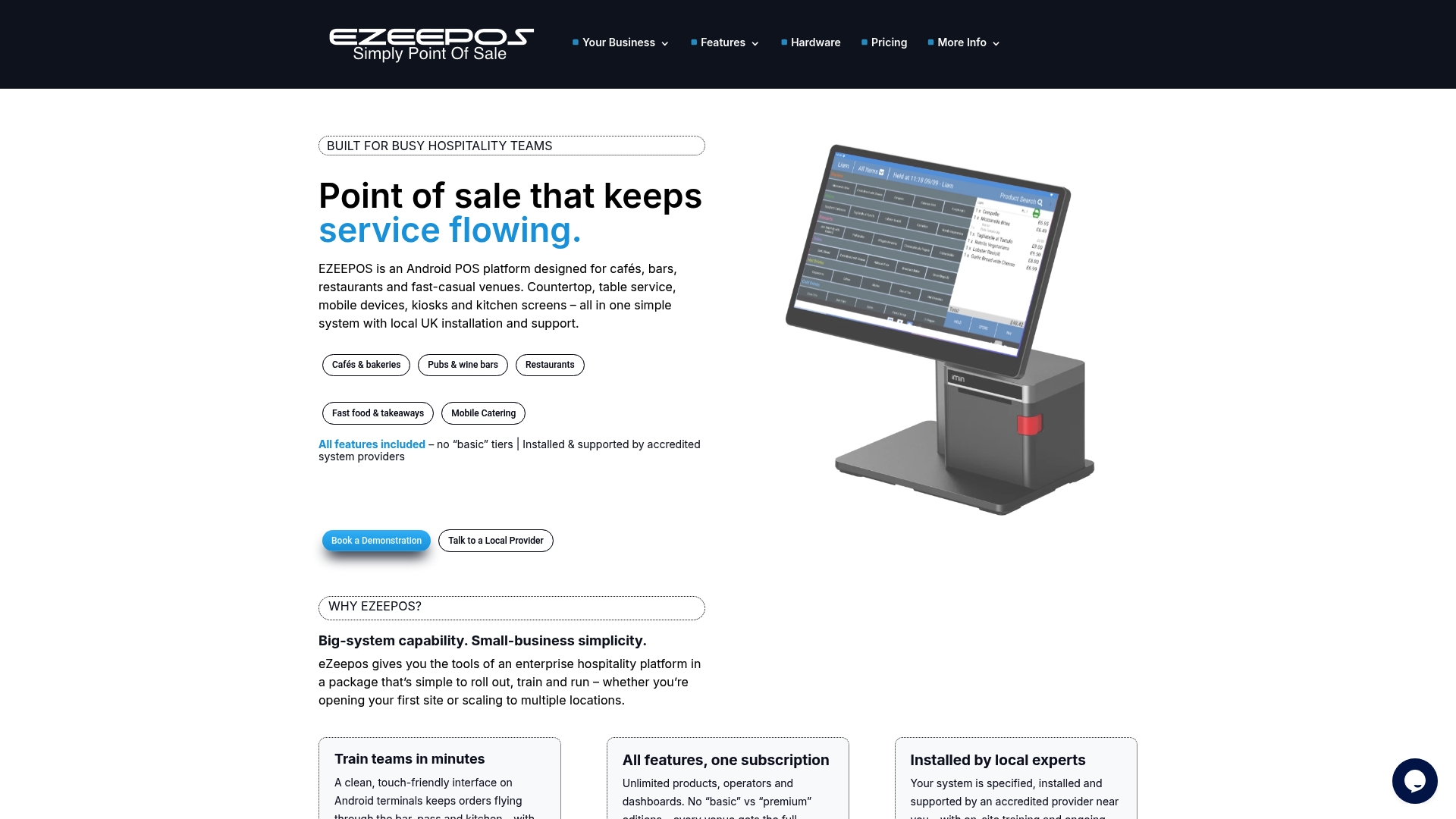
If you are ready to move away from batch updates and manual reconciliation, Ezeepos point of sale software gives you the foundation to do it with local UK installation and ongoing support from accredited providers. For venues exploring how a unified system changes day-to-day operations, the benefits of a unified POS platform are worth understanding before you commit to any solution.
FAQ
What is real-time inventory sync in hospitality?
Real-time inventory synchronisation is the instant updating of stock levels across all connected systems the moment a sale or stock movement occurs. It replaces periodic batch updates with continuous data flow between your POS, kitchen, and back-office systems.
How does inventory sync prevent overselling?
Inventory locking reserves stock the moment a transaction begins, preventing two orders from claiming the same item simultaneously. Combined with event-driven updates that propagate in under five seconds, this reduces overselling risk to near zero during normal service.
Why is batch inventory sync a problem for busy venues?
Batch sync updates stock on a fixed schedule, creating windows where your system shows stock that has already been sold. During peak service, this leads to ghost stock and overselling. Architecture decay in batch systems means the problem worsens as your venue scales.
What is a safety buffer in inventory management?
A safety buffer is a percentage of stock held back as unallocated reserve, typically 5–10% of total stock. It absorbs minor sync delays or data spikes without triggering an oversell, acting as a practical safeguard in high-volume environments.
How long does it take to implement real-time inventory sync?
Implementation timelines vary by venue size and existing system complexity, but most venues complete the core integration within four to eight weeks. The critical factor is not the technology setup but the staff training and workflow adjustment that follows.
Recent Comments