
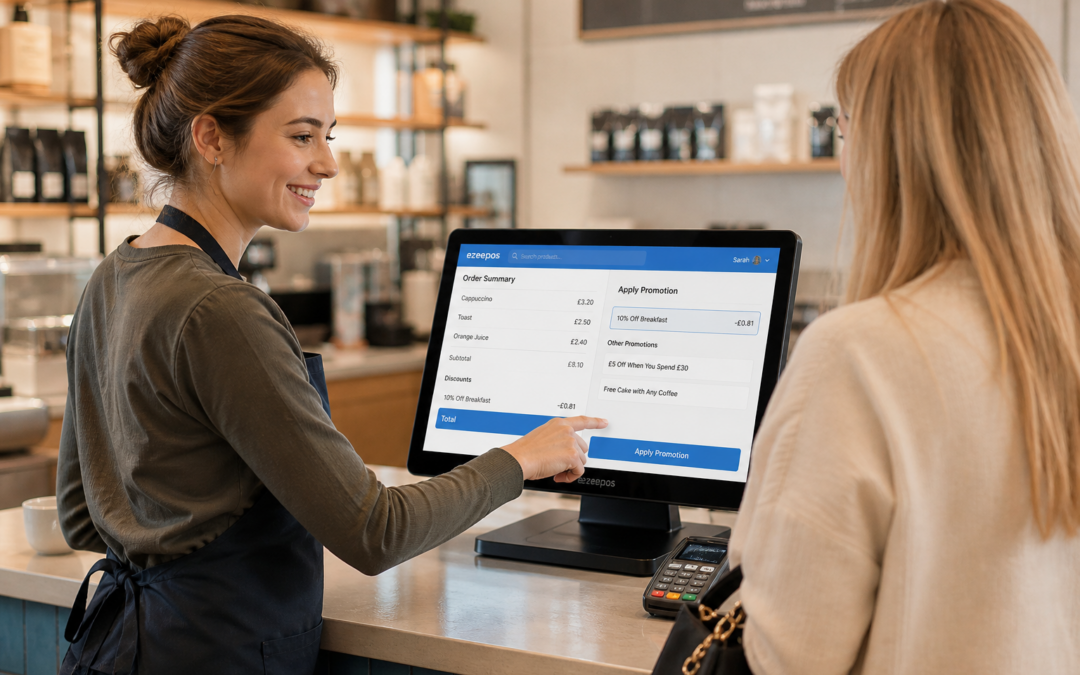
Why promotions need to be easy to run
Promotions and discounts can be very effective for UK retailers, cafés, takeaways and other hospitality businesses, but only if they are simple enough for staff to use correctly at the till. A complicated offer can slow down service, cause confusion for customers and lead to awkward conversations at busy times.
That is where a well-structured EPOS system can help. With eZeePOS, businesses can manage offers in a more organised way, so the right discount is applied consistently and staff do not have to rely on memory or manual calculations. If you are looking at ways to run offers more smoothly, you can explore more about the system at www.ezeepos.co.uk.
What a good promotion setup should do
A useful promotion setup should make life easier for both staff and customers. It should support common offers without turning the checkout into a guessing game. In practical terms, that means the till system should help with:
- clear discount application at the point of sale
- simple offer rules that staff can understand quickly
- reduced risk of manual pricing mistakes
- better consistency across shifts and locations
- a smoother customer experience during busy periods
For independent businesses, this matters because promotions are often run alongside normal trading, not as a separate marketing exercise. Staff need to stay focused on the queue, the customer and the till – not spend time working out whether an offer applies.
Retail and hospitality use promotions differently
In retail, promotions might include multibuy offers, price reductions on selected items or seasonal discounts to help clear slower lines. In hospitality, offers often focus on meal deals, lunch promotions, set menus, happy hour pricing or discounts for specific days and times.
Although the business types differ, the challenge is the same: the offer must be easy to apply and easy to explain. A customer should not need to ask twice for the total to make sense. Likewise, staff should not need to calculate each discount manually while the queue builds behind them.
Examples of practical uses
- A café running a coffee-and-pastry offer at breakfast time
- A takeaway offering a lunchtime deal with a fixed discounted price
- A shop promoting a seasonal range with a percentage reduction
- A pub using time-based offers during quieter trading periods
How EPOS can reduce confusion at the till
One of the biggest benefits of using EPOS for promotions is clarity. A good system can help staff follow the same steps every time, which reduces the chance of discounts being applied incorrectly. That can save time, improve accuracy and help protect margins.
Manual discounting can seem straightforward when trade is quiet, but it becomes much harder when several customers are waiting. A touchscreen till gives staff a cleaner way to access the offer they need, check the basket and keep service moving.
This also helps managers. When discounts are recorded properly within the EPOS, it becomes easier to review what was applied, when it was used and whether the promotion is actually delivering the result you wanted.
Making offers clearer for customers
Customers like promotions when they are easy to understand. They want to know what they are receiving, how the offer works and whether the price on the screen matches what they expected. Clear EPOS workflows support that experience by reducing uncertainty at the checkout.
That is especially useful in busy settings where service needs to stay friendly and relaxed. A customer who can see the discount being applied correctly is more likely to trust the total and move through the transaction without delay.
Promotions should support service, not slow it down
Not every offer needs to be complex. In fact, the best promotions are often the simplest. A good EPOS setup allows businesses to choose offers that are commercially useful without creating extra training problems for staff.
This matters for businesses with part-time teams, seasonal staff or multiple shifts. If the offer process is too complicated, people may avoid using it or apply it inconsistently. A practical EPOS approach keeps the process quick, visible and repeatable.
Planning offers more carefully
Promotions work best when they are part of a wider trading plan. Rather than offering discounts randomly, businesses can use them to support quieter periods, introduce new products or encourage repeat visits. EPOS reporting can then help owners review whether the offers are worth repeating.
For example, a restaurant may run a weekday lunch promotion to attract trade outside the evening rush. A retail shop may use a short-term discount to move seasonal stock. In both cases, the goal is not simply to lower price, but to create a more effective trading pattern.
Questions worth asking before launching an offer
- Will staff be able to apply this quickly at the till?
- Can customers understand the offer without extra explanation?
- Will the promotion help trading at the times we need it most?
- Can we review the results clearly afterwards?
Where eZeePOS fits in
eZeePOS is designed to give UK retail and hospitality businesses a practical, easy-to-use EPOS option that supports day-to-day trading. If discounts and promotions are part of your sales approach, the aim is to make those offers simple for staff to apply and straightforward for customers to follow.
For businesses that want a more efficient checkout process, better control over offers and a clearer till workflow, it is worth considering how your EPOS handles promotions before the next campaign begins. You can find out more at www.ezeepos.co.uk.
Contact YCR Distribution at sales@ezeepos.co.uk or call 01924 438238.
If you are planning new offers for your shop, café, restaurant or takeaway, a well-set-up EPOS system can make the whole process easier to manage from the first transaction to the final report.
Recent Comments