
Importance of integrated payment solutions for hospitality
Integrated payment solutions are unified systems that connect every payment touchpoint in a hospitality venue, from point of sale and booking engines to property management and accounting, into a single operational layer. For venue owners and managers, the importance of integrated payment solutions goes well beyond convenience. These systems automate reconciliation, cut manual errors, and give finance teams real-time visibility across all revenue streams. Platforms like Stripe, Apaleo Pay, and Trintech have each demonstrated measurable gains in operational efficiency for hospitality businesses that replace fragmented payment workflows with a connected infrastructure.
Why integrated payment solutions reduce operational complexity
Hospitality venues run on multiple, overlapping systems. A busy hotel or restaurant typically processes payments through a POS terminal, an online booking engine, a property management system (PMS), and sometimes a pay-by-link channel. Without integration, each of these generates its own data stream. Finance teams then spend hours manually matching transactions across systems, a process that creates delays and leaves room for costly discrepancies.
Unified payment infrastructure consolidates transactions from all these channels, automatically updating accounting, inventory, and reporting in real time. Stripe describes this as replacing overlapping systems with one platform that enforces consistent risk controls and enables faster feature rollout. The practical effect for a venue manager is that end-of-day reconciliation shrinks from a multi-hour task to a review of exceptions.

| Task | Without integration | With integration |
|---|---|---|
| End-of-day reconciliation | Manual matching across 3+ systems | Automated matching with exception flags |
| Accounting updates | Manual data entry per transaction | Real-time ledger sync |
| Reporting | Pulled from separate platforms | Single dashboard view |
| Error investigation | Traced manually across systems | Audit trail with reason codes |
Trintech automates the matching of transactions across PMS, POS, booking engines, and payment providers, reducing manual work and accelerating financial close. That matters most at month end, when hospitality venues face the highest volume of reconciliation activity.
Pro Tip: Connect your POS directly to your accounting software, such as Xero, to eliminate manual ledger entries entirely. Ezeepos supports this type of accounting integration out of the box.
How payment integration reduces errors and saves time
The real business value of integrated payments is reducing what Helcim calls the “manual entry tax.” Manual payment data entry carries a 3% error risk per transaction and costs businesses between 10 and 40 hours of administrative labour every month. For a venue processing hundreds of transactions daily, that error rate compounds quickly into reconciliation headaches and financial inaccuracies.
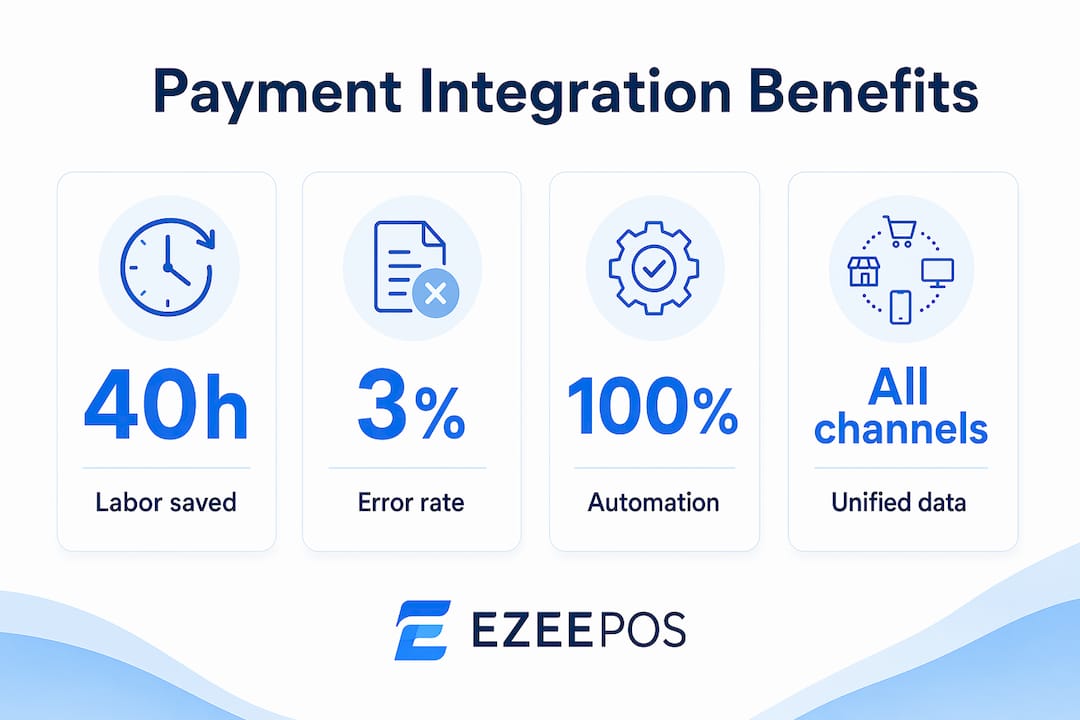
Integrated systems remove manual re-entry by syncing transaction data automatically across every connected platform. A payment taken at the bar posts directly to the guest folio, the inventory system, and the accounting ledger without a staff member touching a keyboard. That accuracy is not just an efficiency gain. It is a financial control.
Security is the other major gain. Payment tokenisation replaces sensitive card data with a token the moment a transaction is initiated, keeping cardholder information out of the venue’s internal systems entirely. Checkout.com notes that implementing tokenisation as far upstream as possible minimises PCI DSS scope and reduces exposure. For a hospitality venue handling card-on-file charges, no-show fees, and incidental holds, that protection is not optional.
Key efficiency and security gains from payment integration:
- Automatic transaction posting to POS, PMS, and accounting with no manual re-entry
- Real-time error detection rather than end-of-day discrepancy hunting
- Tokenised card storage that reduces PCI DSS compliance burden
- Consolidated reporting across all payment channels in one view
- Faster financial close through automated reconciliation matching
Pro Tip: Audit your current error rate before switching systems. Count reconciliation discrepancies over one month. That number becomes your baseline for measuring the improvement after integration.
How hospitality payment systems handle the full guest lifecycle
Hospitality payment workflows are more complex than retail. A guest books online, checks in, runs a tab at the bar, orders room service, and checks out three days later. Each of those events generates a payment instruction that must link back to the original reservation. Non-integrated systems break that chain at every handoff.
Apaleo Pay addresses this by supporting online bookings, POS charges posted to guest folios, pay-by-link, and merchant-initiated charges, all recorded within a single payment layer tied to the reservation. The insight from Apaleo’s architecture is that hospitality payment integration must fully map to the booking and guest lifecycle. Reconciling charges after the fact, rather than recording them in real time, creates the gaps that cause disputes and revenue leakage.
| Payment scenario | Non-integrated outcome | Integrated outcome |
|---|---|---|
| Bar charge during stay | Manually added to folio at checkout | Auto-posted to folio in real time |
| No-show fee | Requires manual card-on-file retrieval | Merchant-initiated charge via stored token |
| Incidental hold | Tracked in separate PMS field | Linked to reservation and released automatically |
| Pay-by-link for deposit | Recorded separately, matched later | Recorded against booking immediately |
The hotel check-in workflow illustrates how tightly payment and operational processes are linked. When a guest’s card is tokenised at check-in, every subsequent charge during the stay can be processed without asking for the card again. That removes friction for the guest and removes risk for the venue.
What are the common pitfalls in implementing integrated payment systems?
Implementation failures in hospitality payment integration almost always come down to two causes: incomplete data mapping and insufficient staff training. A system that does not pass all transactional states, including voids, discounts, comps, and overrides, to the central ledger will produce reconciliation gaps that are difficult to trace.
Prostay emphasises that every transactional state must carry a reason code so that audit trails remain clear and variances can be reconciled. Without reason codes, a voided transaction looks identical to a missing one. That ambiguity costs finance teams hours of investigation per week.
- Map every payment state before go-live, including voids, refunds, comps, and no-shows, to confirm each posts correctly to the ledger.
- Test reconciliation end-to-end across all channels before switching off legacy systems.
- Train front-of-house and back-office staff separately. Their interaction with the payment system differs significantly.
- Set up automated exception alerts so that unmatched transactions surface immediately rather than accumulating overnight.
- Schedule a monthly integration health check to confirm all system connections are active and data is flowing correctly.
Operational success depends not only on the technology architecture but also on disciplined training and ongoing reconciliation rigour. A well-configured system managed by an undertrained team will still produce errors. The technology removes the manual burden. The team removes the exceptions.
Pro Tip: Run a parallel reconciliation for the first two weeks after go-live. Compare your integrated system output against your old manual process. Discrepancies in that window reveal configuration gaps before they become financial problems.
Integrated vs non-integrated payment solutions: what do venue managers actually gain?
Non-integrated payment setups share a predictable set of problems. Duplicate data entry across POS and PMS creates version conflicts. Delayed reporting means managers make decisions on yesterday’s numbers. Missing transaction links between booking and payment channels produce revenue leakage that is hard to quantify until month end.
Replacing overlapping systems with a unified payment platform delivers consistent risk controls and faster rollout of new payment channels. The gains are measurable across four areas:
- Cost: Fewer staff hours spent on reconciliation and error correction
- Speed: Real-time transaction posting replaces batch updates
- Accuracy: Automated matching reduces the 3% per-transaction error risk associated with manual entry
- Guest experience: Faster checkout, card-on-file charges, and pay-by-link options reduce friction at every touchpoint
The contrast is sharpest at scale. A venue processing 500 transactions a day with a 3% manual error rate faces 15 potential discrepancies every single day. An integrated system catches those in real time. A non-integrated one surfaces them at month end, when tracing the cause is far harder. For UK hospitality venues operating on tight margins, that difference is material.
Key takeaways
Integrated payment solutions deliver their greatest value by eliminating the manual entry tax and connecting every payment event to a single, auditable record across the guest lifecycle.
| Point | Details |
|---|---|
| Operational complexity | Integration consolidates POS, PMS, and booking data, removing manual reconciliation across separate systems. |
| Error and labour costs | Manual entry carries a 3% error risk per transaction and up to 40 hours of admin labour monthly. |
| Guest lifecycle mapping | Hospitality integration must link every charge, from booking to checkout, to the original reservation in real time. |
| Implementation discipline | All transactional states, including voids and comps, must carry reason codes to maintain clean audit trails. |
| Security gains | Tokenisation removes card data from internal systems, reducing PCI DSS scope and exposure for venue operators. |
The uncomfortable truth about payment integration in hospitality
Having worked with hospitality venues across the UK, the pattern I see most often is this: venues invest in integrated payment technology and then undermine it with manual workarounds within six months. A member of staff finds it faster to key a charge directly into the PMS rather than post it through the POS. A manager bypasses the reconciliation report because it flags too many exceptions. The technology works. The discipline does not.
The venues that get the most from integrated payment systems treat reconciliation as a daily operational discipline, not a monthly accounting task. They review exceptions every morning the same way they review covers and revenue. When an unmatched transaction appears, they investigate it that day, not three weeks later when the audit trail has gone cold.
The other thing I would push back on is the idea that integration is primarily a finance department concern. The front-of-house team interacts with the payment system on every transaction. If they do not understand why posting a bar charge to a folio matters, they will find a shortcut. Training is not a one-time event at go-live. It is an ongoing conversation about why the process exists.
For venue managers considering a switch, my honest advice is to start with reconciliation. Map your current process in detail before you touch the technology. Understand where your gaps are. Then select a system that closes those specific gaps rather than one that promises to do everything. Ezeepos, for example, is built specifically for hospitality venues and connects payment processing directly to the POS without requiring a separate middleware layer. That specificity matters more than feature breadth.
— John
How Ezeepos supports integrated payments for UK hospitality venues
Ezeepos is a hospitality-specific POS platform built for UK venues including restaurants, bars, cafés, and fast-casual operations. It connects payment processing, order management, inventory, and back-office reporting into a single Android-based system, removing the need for separate tools that create data silos.
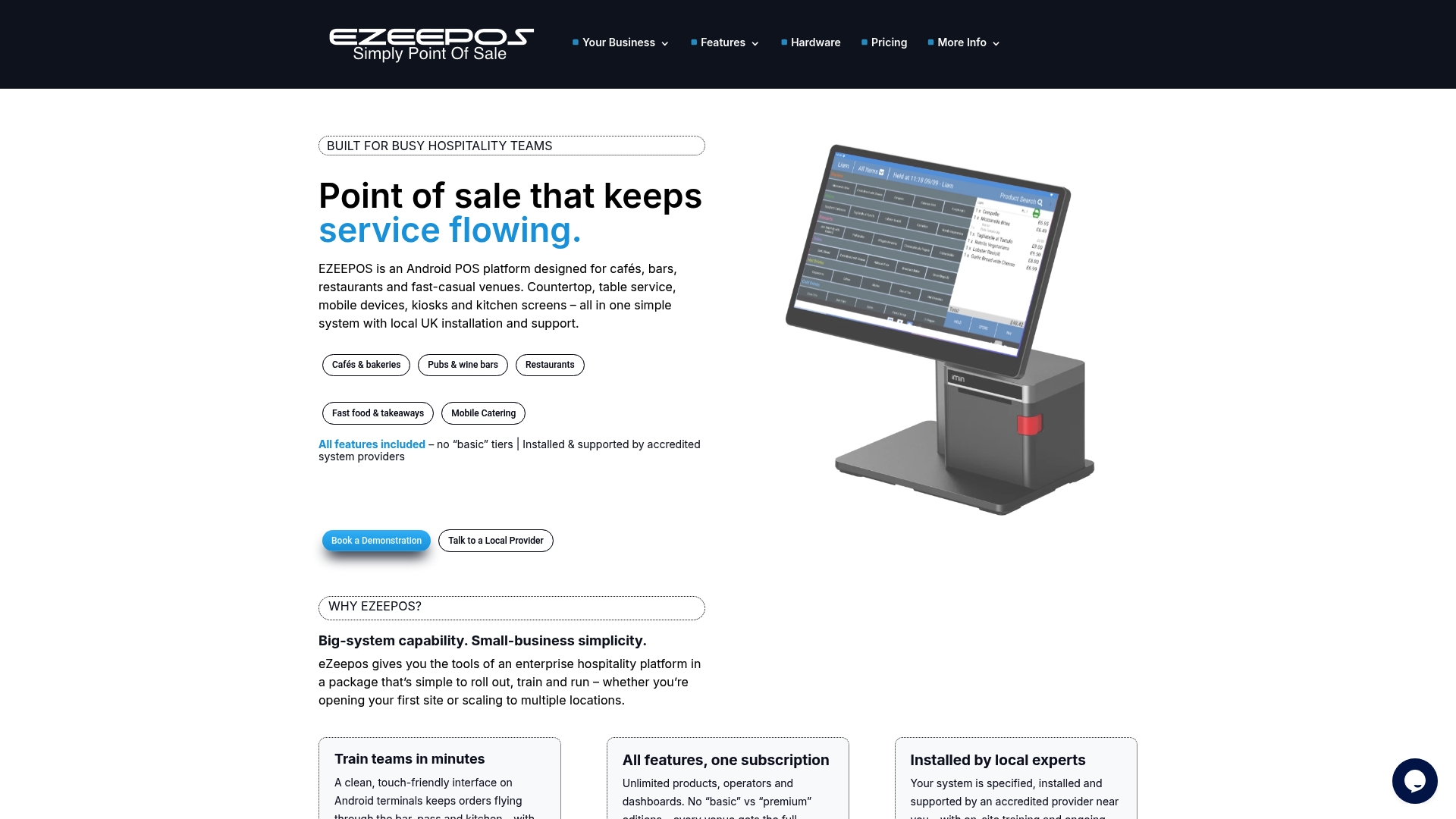
The platform integrates directly with payment providers and accounting software, so every transaction posts automatically to the correct ledger without manual re-entry. Cloud-based back-office reporting gives managers real-time visibility across all revenue channels. For venues ready to move away from fragmented systems, Ezeepos POS solutions offer a practical starting point built around the specific workflows of UK hospitality.
FAQ
What are integrated payment solutions in hospitality?
Integrated payment solutions connect a venue’s POS, booking engine, PMS, and accounting systems into a single payment layer. Every transaction posts automatically across all platforms without manual re-entry.
Why do integrated payment solutions matter for venue managers?
Manual payment entry carries a 3% error risk per transaction and up to 40 hours of administrative labour monthly. Integration removes that burden by automating transaction posting and reconciliation.
How does payment tokenisation protect hospitality venues?
Tokenisation replaces card data with a secure token at the point of capture, keeping sensitive information out of internal systems. This reduces PCI DSS scope and protects venues from cardholder data exposure.
What is the biggest implementation risk for integrated payment systems?
Incomplete data mapping is the most common failure point. If voids, comps, and discounts do not carry reason codes through to the central ledger, audit trails break and reconciliation gaps accumulate.
How does Apaleo Pay handle hospitality-specific payment workflows?
Apaleo Pay links online bookings, POS charges, pay-by-link, and merchant-initiated charges to a single reservation record. This ensures every payment event in the guest lifecycle is captured and reconciled in real time.
Recent Comments