
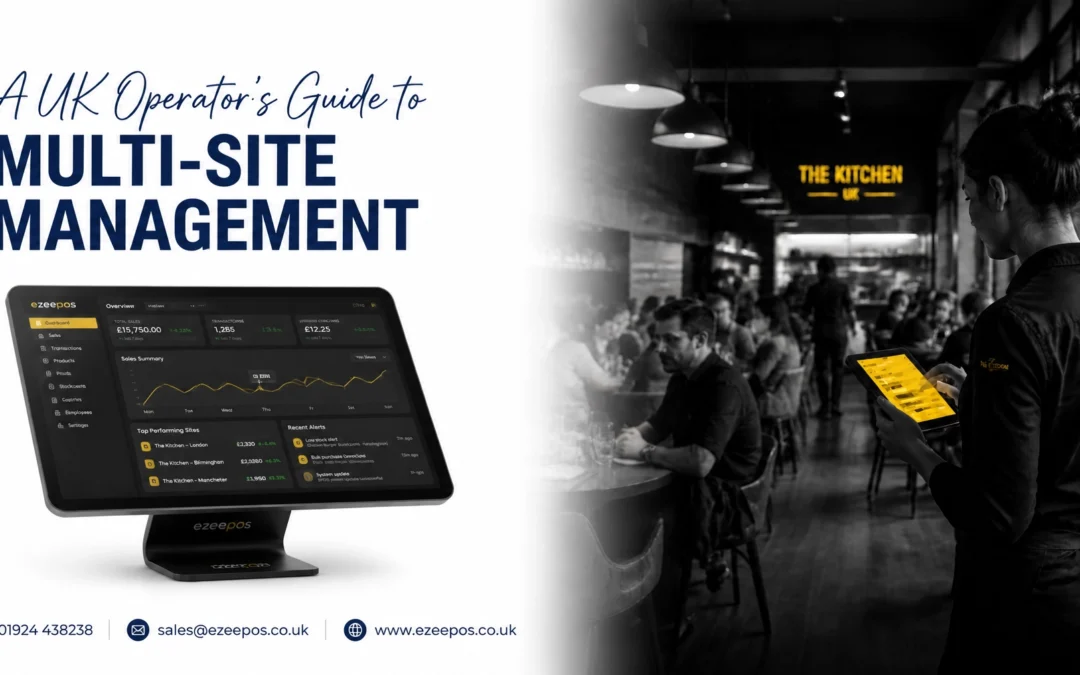
Expanding from a single successful venue to a second, third, or tenth location is the ultimate goal for many UK hospitality entrepreneurs. However, the transition from "owner-operator" to "multi-site manager" is where most businesses face their steepest learning curve. What worked for one site: personal oversight, informal communication, and manual stock takes: simply does not scale.
In 2026, the UK hospitality landscape is defined by tighter margins, persistent labour shortages, and an increasing need for data-driven precision. To grow without compromising your brand or your sanity, you must move away from reactive management and embrace centralised, scalable systems.
Table of Contents
- The "Blind Spot" Problem: Why Centralised Data is Non-Negotiable
- Standardising Operations: Preserving Consistency Across the Estate
- Labour Management at Scale: Onboarding and Scheduling
- Inventory and Margin Protection: Fighting the 2026 Cost Squeeze
- Choosing the Right Tech Stack for Growth
- Multi-Site Management Checklist
1. The "Blind Spot" Problem: Why Centralised Data is Non-Negotiable
The moment you open a second location, you lose the ability to be everywhere at once. Without a unified view of your operations, you are essentially flying blind. Many operators make the mistake of running disconnected systems, leading to "performance gaps" where one site thrives while another bleeds margin unnoticed.
Prioritise real-time visibility. You need to know your live sales, labour costs, and stock levels across every site from a single login. If you have to wait until Monday morning to see how your Saturday night performed at Site B, you are already too late to fix any issues.
Pro tip: Use a cloud-based EPOS system that pushes data instantly to a back-office dashboard. This allows you to spot trends: like a sudden drop in average spend at one location: and investigate immediately.

2. Standardising Operations: Preserving Consistency
Consistency is the bedrock of a multi-site brand. A customer visiting your Leeds cafe expects the same flat white and the same level of service they received in your Manchester branch.
To achieve this, you must implement Standard Operating Procedures (SOPs) that are digitised and easily accessible.
- Menu Management: Use your EPOS to push menu updates, pricing changes, and allergen information to all sites simultaneously.
- Quality Control: Conduct regular "internal audits" using a standardised checklist to ensure every site meets your brand's physical and operational standards.
Pro tip: Leverage Android-based POS stations that allow for intuitive, visual menu layouts. This reduces the cognitive load on staff and ensures they are selecting the correct items every time.
3. Labour Management at Scale: Onboarding and Scheduling
In the current UK market, attracting and retaining talent is arguably the greatest challenge for multi-site operators. Fragmented rotas often lead to overstaffing in quiet periods and understaffing during peaks, directly impacting your bottom line and staff morale.
Ensure your scheduling is demand-driven. By integrating your rota software with your sales data, you can forecast staffing needs based on historical performance at each specific location.
Furthermore, training must be streamlined. When you are managing 50+ employees across four sites, you cannot personally train every new hire.
- Implement a structured training process that uses your technology as a teaching tool.
- Use "training modes" on your EPOS to allow new starters to practice without affecting live sales.

4. Inventory and Margin Protection: Fighting the 2026 Cost Squeeze
With food inflation and supplier volatility remaining high in 2026, inventory management is no longer just about counting boxes: it’s about margin protection.
In a multi-site setup, you must control:
- Waste Tracking: Identify which sites are wasting the most prep and why.
- Internal Transfers: Easily move stock between locations to prevent over-ordering at one site while another runs out.
- Supplier Management: Centralise your purchasing to leverage bulk-buying power and maintain consistent ingredient quality.
Conduct weekly stock takes across all sites. Discrepancies between "theoretical stock" (what the EPOS says you should have) and "actual stock" (what is on the shelf) are often the first sign of theft, portioning issues, or excessive waste.

Pro tip: Focus on your "Top 10" high-value items. Controlling waste on steaks or expensive spirits will have a far greater impact on your margin than worrying about the cost of napkins.
5. Choosing the Right Tech Stack for Growth
Many operators find their growth stunted by "legacy debt": outdated tills that don't talk to their inventory software or online ordering platforms.
When expanding, your tech stack must be:
- Scalable: Adding a new site should be as simple as ordering new hardware and "cloning" your existing setup in the cloud.
- Integrated: Your EPOS, online ordering app, and loyalty programs should all feed into one central database.
- Supported Locally: As you grow, you cannot afford downtime. Ensure your provider offers UK-based support and local installation partners who can be on-site quickly if hardware fails.
Multi-Site Management Checklist
Use this checklist to evaluate if your current operation is ready for expansion:
| Area | Requirement | Status |
|---|---|---|
| Data | Can you see live sales for all sites on one mobile dashboard? | [ ] |
| Menu | Can you change a price across the entire estate in under 60 seconds? | [ ] |
| Labour | Is your rota software integrated with your EPOS sales data? | [ ] |
| Stock | Do you have a system for recording internal stock transfers between sites? | [ ] |
| Support | If a till goes down at 8 PM on a Saturday, do you have a local contact? | [ ] |
Conclusion
Running multiple restaurant locations is a transition from being a "hospitality pro" to being a "systems architect." Success lies in your ability to centralise control while empowering your site managers with the right tools. By prioritising cloud-based technology, standardising your SOPs, and keeping a hawk-like eye on your multi-site data, you can scale your brand without losing the quality that made your first location a success.
Ready to scale? Discover how eZeepos multi-site solutions provide the enterprise-level control you need with the simplicity your team will love.
Recent Comments