

Advantages of tablet POS for hospitality venues

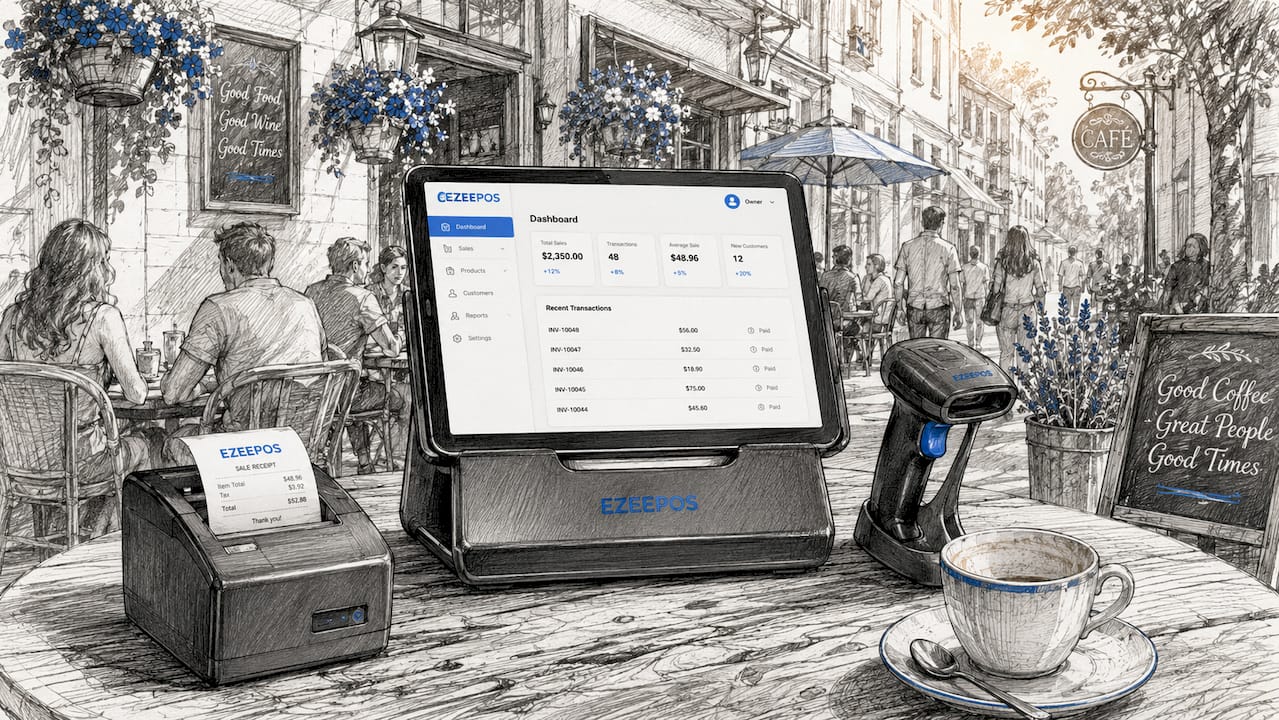
Tablet POS, the industry term for tablet-based point-of-sale systems, is the most cost-effective and flexible solution available to hospitality venue owners today. These systems pair consumer-grade tablets with cloud-based POS software to handle orders, payments, inventory, and reporting from a single device. The advantages of tablet POS are most visible in venues where speed, staff mobility, and tight margins all matter at once: restaurants, bars, cafés, and mobile catering operations. Compared to traditional fixed terminals, tablet POS cuts upfront hardware costs, reduces training time, and gives managers real-time visibility across every part of the operation.
1. Lower upfront hardware cost
Tablet POS hardware costs a fraction of traditional dedicated terminals. A capable Android tablet suitable for commercial POS use costs significantly less than a full all-in-one terminal. That price difference means you can buy multiple tablets for the cost of a single legacy unit, giving you built-in redundancy from day one.
For small venues especially, this changes the maths of opening or upgrading entirely. A café launching its first proper POS setup no longer needs to commit thousands to hardware before serving a single customer. The savings can go directly into stock, staffing, or fit-out instead.
2. Faster staff onboarding and training
Familiarity with tablet interfaces means most staff need minimal training before they are productive at the till. Staff who already use tablets or smartphones in daily life adapt to POS use within hours rather than days. That matters enormously in hospitality, where high turnover and seasonal hiring are facts of life.
Traditional POS terminals often use proprietary interfaces that require dedicated training sessions. Tablet POS systems, particularly those built on Android, present menus and workflows that feel immediately familiar. The result is less time off the floor and fewer errors during the first weeks of a new hire’s tenure.
Pro Tip: Run a 30-minute walk-through on a quiet afternoon before a new hire’s first busy shift. Tablet POS systems are forgiving enough that one real-world practice session is usually sufficient.
3. Mobility and tableside ordering
Tablets offer portability that fixed terminals simply cannot match. Staff can take orders and process payments at the table, at the bar, in a beer garden, or at an outdoor event without returning to a fixed counter. That mobility directly reduces the time between a customer’s decision and the order reaching the kitchen.
For restaurants with large floor plans or multiple service areas, this is a genuine operational advantage. A server covering a busy terrace no longer needs to walk back to a central terminal for every transaction. Payments happen where the customer is, which shortens queues and improves the overall experience.
4. Real-time inventory tracking
Tablet POS systems enable real-time inventory tracking with automatic stock deduction at the point of sale. Every item sold is removed from stock immediately, without manual intervention. This reduces the risk of unexpected stockouts during a busy service.
Industry analysts identify real-time inventory tracking as the critical advantage of tablet POS systems for smarter stock management. For a bar running a Friday night service, knowing that a particular spirit is down to its last few measures before the rush peaks is the difference between a smooth shift and an awkward conversation with a customer. Ezeepos integrates this capability directly into its cloud-based back office, giving managers visibility from any device.
Pro Tip: Set low-stock alerts for your top ten selling items. Tablet POS systems with cloud back offices can send notifications before you run out, not after.
5. Reduced checkout times and better floor space use
Retailers and hospitality venues using tablet POS report reduced checkout times, improved floor space usage, and better access to product information for staff. A tablet mounted on a slim stand takes up a fraction of the counter space that a traditional terminal occupies. That freed space matters in tight bar areas or compact café counters.
Shorter queues have a direct effect on revenue. Customers who would otherwise leave during a long wait are served faster and are more likely to order again. The combination of speed and space efficiency makes tablet POS particularly well suited to quick-service and counter-service environments.
6. Cloud-based access and reporting
Cloud-based tablet POS systems give managers access to sales data, staff performance reports, and inventory levels from any device with an internet connection. You do not need to be on-site to know how a lunchtime service went or which menu items are underperforming. That visibility is especially useful for owners managing multiple venues or operating from a distance.
Ezeepos delivers this through its cloud back office, which connects all terminals and tablets into a single reporting view. Managers can check live sales figures, adjust pricing, and monitor stock without touching the till. For a venue group running three or four sites, that centralised oversight removes a significant administrative burden.
7. Android vs iPad: which platform suits hospitality better?
Android tablets generally offer greater cost advantages and accessory compatibility than iPads for hospitality POS purposes. Android devices support a wider range of receipt printers, cash drawers, and card readers without proprietary connectors or additional adapters. That flexibility allows venues to build a hardware configuration that fits their specific layout and workflow.
iPads remain a strong choice where brand presentation is a priority, such as in high-end restaurants or hotel lobbies. However, for the majority of UK hospitality venues focused on reliability and value, Android delivers more practical flexibility. Ezeepos is built on Android, which is a deliberate choice that reflects where the operational advantages actually sit.
8. Key technical specs that determine performance
The right hardware specs prevent the lag and crashes that make a busy service miserable. Minimum 4GB RAM, with 6GB preferred, along with dual-band Wi-Fi and a dedicated processor, are the recommended specifications for any tablet used in a commercial POS environment. These specs support all-day operation without slowdown.
The key technical features to prioritise when selecting a tablet for hospitality POS are:
- RAM: 4GB minimum, 6GB or above for high-volume venues
- Processor: A dedicated, multi-core chip prevents slowdown during peak periods
- Wi-Fi: Dual-band support (2.4GHz and 5GHz) for reliable connectivity across a venue
- NFC: Contactless payment compatibility is non-negotiable for UK customers in 2026
- Screen size: 8–10 inch displays balance portability with readability for staff
Skimping on RAM is the most common mistake venues make when choosing tablet hardware. A device that handles light use perfectly will stall during a Saturday night rush if it cannot hold the POS application, payment processing, and kitchen communication in memory simultaneously.
9. Hybrid hardware strategy: tablets and terminals together
SWIFTPOS experts recommend viewing tablets not as replacements for all-in-one terminals but as complements to them in high-volume venue lanes. The most effective deployment combines durable fixed terminals at primary checkouts with tablets for mobile and secondary tasks. This hybrid POS approach balances cost, durability, and professional presentation.
Practical use cases for tablets within a hybrid setup include:
- Tableside ordering in restaurants and pubs with table service
- Pop-up and outdoor events where fixed infrastructure is unavailable
- Manager dashboards for live oversight without occupying a till
- Secondary counters during peak periods to reduce queue build-up
- Self-service kiosk mode for quick-service environments
The hybrid model also protects against hardware failure. If a tablet goes down during service, a fixed terminal continues operating. That redundancy is worth more than any individual cost saving.
Pro Tip: Deploy tablets first in your lowest-risk service area, such as a garden bar or secondary counter. This gives your team time to build confidence before tablets become central to your main operation.
10. Scalability without tiered pricing penalties
Traditional POS vendors often charge more as you add terminals, either through per-device licences or tiered feature access. Tablet POS systems built on cloud platforms, such as Ezeepos, give every device access to the full feature set regardless of how many tablets you run. Adding a terminal for a new service area does not require a software upgrade or a renegotiated contract.
For growing venues, this matters. A restaurant that starts with two tablets and expands to five should not face a pricing cliff at device number three. The types of tablet POS stations available for hospitality venues now cover everything from countertop mounts to handheld units, all running the same software instance.
Key takeaways
Tablet POS systems deliver the strongest combination of cost savings, operational flexibility, and real-time data access available to UK hospitality venues in 2026.
| Point | Details |
|---|---|
| Lower hardware cost | Tablets cost a fraction of traditional terminals, enabling redundancy and faster scaling. |
| Faster staff training | Familiar touchscreen interfaces reduce onboarding time to hours rather than days. |
| Real-time stock control | Automatic stock deduction at point of sale prevents stockouts during busy service. |
| Hybrid deployment wins | Combining tablets with fixed terminals balances mobility, durability, and professionalism. |
| Cloud access anywhere | Managers can view sales, stock, and staff data from any device, on or off site. |
Why I think most venues underestimate the hybrid approach
The conversation around tablet POS tends to focus on cost savings, and the savings are real. But the venues I see getting the most from tablet POS are not the ones that replaced everything overnight. They are the ones that introduced tablets into one specific part of their operation, learned what worked, and then expanded deliberately.
The temptation is to go all-in immediately because the hardware is cheap. The risk is that you end up with a floor full of underpowered devices running a POS system that was not configured for your specific workflow. A tablet that works brilliantly for tableside ordering in a 40-cover restaurant will struggle as the sole terminal in a 200-cover venue during a Saturday dinner service.
The hybrid model is not a compromise. It is the correct answer for most UK hospitality venues. Fixed terminals handle the high-volume, high-pressure moments. Tablets handle everything else: the garden, the events, the manager’s oversight, the secondary counter. That division of labour is where the real efficiency gains sit.
My advice to any venue owner considering tablet POS in 2026 is this: start with the Android POS efficiency gains that are achievable in your lowest-risk service area. Prove the model there. Then scale with confidence.
— John
Ezeepos tablet POS solutions for UK hospitality venues
Ezeepos offers a cloud-based, Android-native POS platform built specifically for UK hospitality venues, from independent cafés to multi-site restaurant groups.
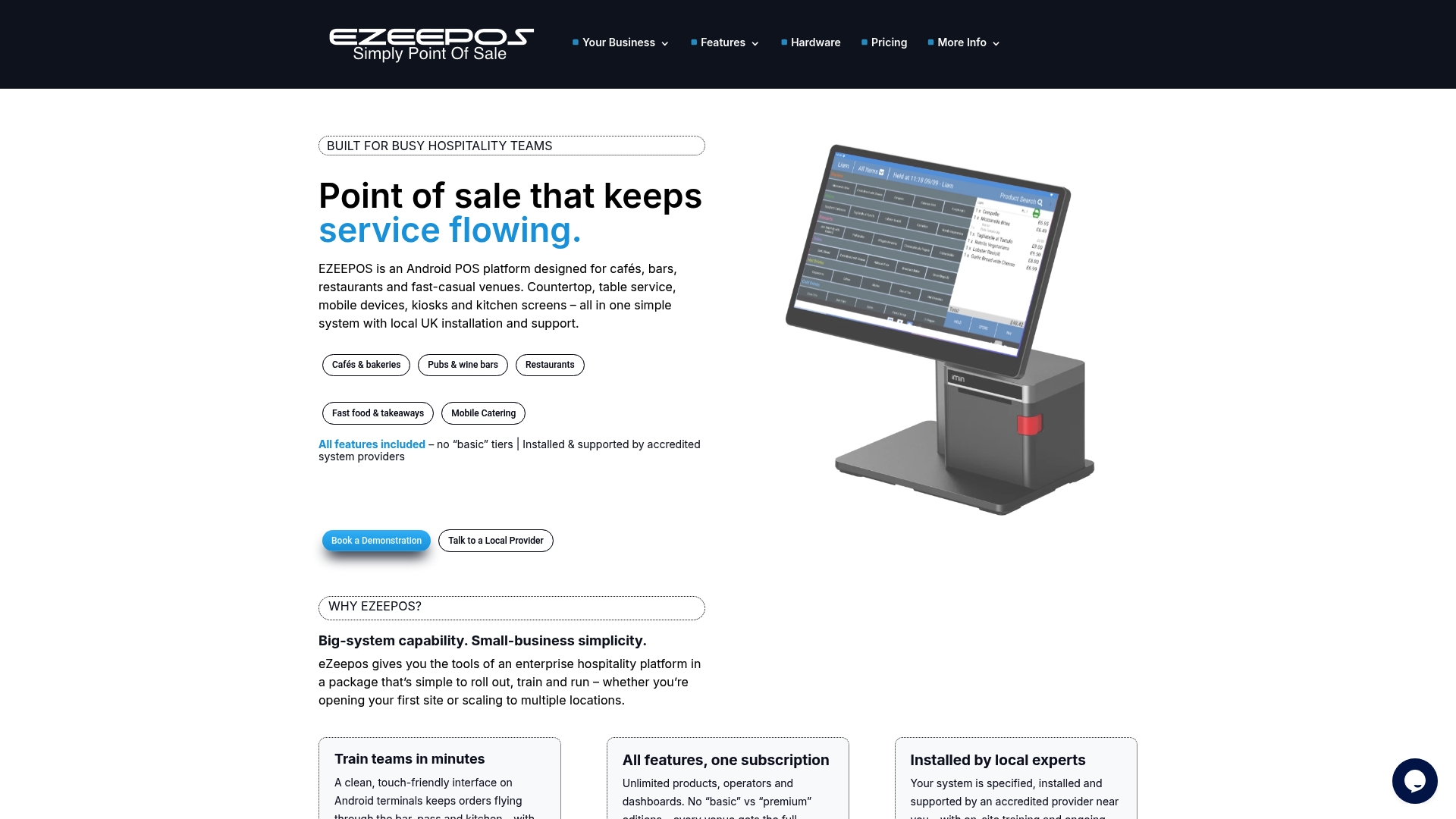
The platform supports tablets, countertop terminals, kiosks, and kitchen screens within a single unified system. Every device runs the full feature set, with no tiered pricing and no hidden upgrade costs. Local UK installation and ongoing support from accredited providers mean you are never left troubleshooting alone during a busy service. If you are ready to see how tablet POS fits your venue, explore Ezeepos or read more about the benefits of a unified POS platform for hospitality operations.
FAQ
What are the main advantages of tablet POS for hospitality?
Tablet POS systems offer lower hardware costs, faster staff training, tableside mobility, and real-time inventory tracking. These benefits make them particularly well suited to restaurants, bars, cafés, and mobile catering operations.
Is Android or iPad better for hospitality POS?
Android tablets offer greater cost advantages and accessory compatibility for most hospitality settings. iPads suit venues where premium presentation is the priority, but Android delivers more practical flexibility for day-to-day operations.
What RAM does a hospitality POS tablet need?
A minimum of 4GB RAM is required, with 6GB or above recommended for high-volume venues. Insufficient RAM is the most common cause of slowdown during peak service periods.
Can tablet POS replace traditional terminals entirely?
For most venues, a hybrid approach works best. Tablets handle mobile tasks, tableside ordering, and secondary counters, while fixed terminals manage high-volume primary checkouts reliably.
How does tablet POS help with stock management?
Tablet POS systems with cloud back offices deduct stock automatically at the point of sale. This gives managers real-time visibility of stock levels and reduces the risk of running out of key items during service.
Recent Comments