
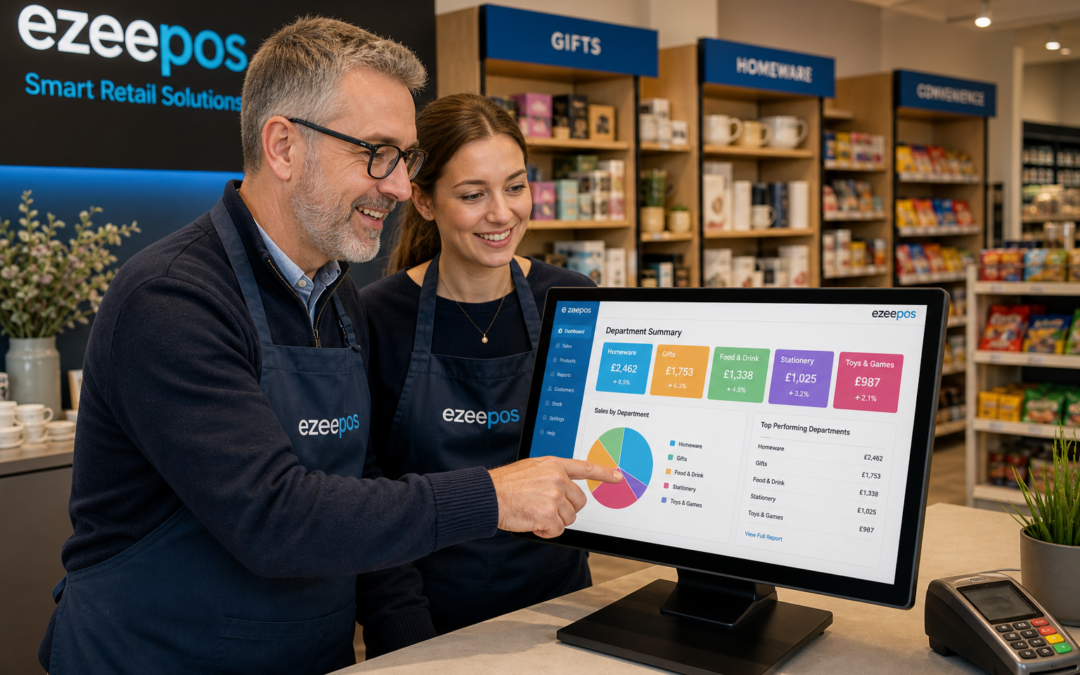
For shops with more than one department, a simple daily sales total only tells part of the story. A garden centre, farm shop, hardware store or larger convenience store may have separate areas for gifts, food, clothing, homeware or seasonal lines, and each one can perform very differently from week to week.
That is where a well-set-up EPOS system can make a real difference. With eZeePOS, multi-department retailers can turn routine till data into clearer, more useful reporting. Instead of guessing which areas are working well, owners and managers can see where trade is strongest, where stock is moving more slowly and where small changes could improve the day-to-day running of the business.
Why multi-department reporting matters
Multi-department businesses rarely fit neatly into one sales category. A shop might sell popular everyday items at the front counter, higher-value seasonal products at the rear of the store and a separate range of impulse lines near the checkout. If all of that information is blended together, it becomes difficult to see what is actually helping the business.
Good reporting breaks that picture down into clearer parts. That can help business owners answer practical questions such as:
- Which department is bringing in the most revenue?
- Which area has the strongest margin?
- Which product groups are busiest at certain times of day or week?
- Which departments need more attention from staff?
For independent retailers, that sort of detail is often more useful than broad assumptions. It helps decisions feel based on what is really happening in the shop, not just what feels busy.
From sales totals to department-level insight
A basic till can tell you how much money was taken. A better retail EPOS can show where that money came from. That distinction matters when your business relies on several departments with different customer habits, price points and trading patterns.
Spotting stronger and weaker lines
Department-level reporting can show whether one area is consistently performing better than another. For example, a farm shop might find that deli items sell well throughout the week, while giftware performs best at weekends. A hardware store may see regular demand for essential tools, but slower movement in specialist ranges.
That kind of information can support more confident decisions on display layout, staff focus and in-store promotions. It also helps businesses avoid overinvesting in areas that do not bring the same return.
Tracking seasonal changes more clearly
Many multi-department retailers experience big shifts across the year. Garden centres may see gardening supplies peak in spring, while gift lines and indoor ranges grow later in the year. Farm shops often notice weekend patterns and holiday trading changes. By using EPOS reporting to compare departments over time, businesses can see those changes earlier and plan ahead.
This is one reason reporting is often more valuable than a simple end-of-day total. It shows how each part of the business behaves, not just the final figure.
Making staffing and display decisions easier
One of the most practical benefits of better reporting is that it helps owners manage the shop floor more effectively. If one department clearly needs more attention during busy periods, staff can be scheduled accordingly. If another section is underperforming, it may need a better layout, clearer product grouping or more visible signage.
In a busy multi-department store, even small changes can improve the customer experience. A better product placement strategy or a more visible top-selling range can make the shop easier to navigate and help staff spend more time serving customers rather than searching for answers.
With clear EPOS reporting, those decisions are based on real trading patterns rather than guesswork.
Useful reporting for different retail settings
Every multi-department retailer works differently, but the principle is the same: business owners need a clearer view of what is happening across the whole store. A few examples include:
- Garden centres: comparing plants, homeware, gifts and café lines to see which departments support footfall best.
- Farm shops: separating fresh produce, deli items, gift ranges and convenience items for a clearer view of trade.
- Hardware stores: understanding which product categories move quickly and which need more attention.
- Gift shops with mixed ranges: seeing which product types drive purchase frequency and basket value.
- Concessions or shared retail spaces: comparing areas properly so each section can be managed on its own performance.
For each of these, the main value is clarity. A multi-department EPOS setup helps owners see the business in a more structured way, which can make day-to-day decisions easier and more consistent.
Using reports without creating extra admin
Some business owners worry that more detailed reporting will mean more work. In practice, a well-designed retail EPOS should do the opposite. It should bring together sales data in a format that is easy to review, so you can spend less time manually checking figures and more time acting on them.
That might mean quickly reviewing a department summary at the end of the day, comparing week-on-week performance or checking which product areas are driving the most trade. The reporting should support the business, not slow it down.
For many independent shops, that convenience is one of the biggest advantages of moving away from a basic till or spreadsheet-led approach.
Why this matters for growing independent retailers
As a shop grows, details matter more. A business with just one till line may be able to rely on instinct for a while, but once multiple departments are involved, the picture becomes more complex. At that point, clear reporting becomes a practical management tool rather than a nice extra.
eZeePOS is designed to help UK retail and hospitality businesses work in a more organised way, and multi-department reporting is a good example of that. It gives owners a clearer view of trading across different parts of the business, helping them make smarter decisions about products, staffing and shop layout.
If you would like to see how eZeePOS could support your business, visit www.ezeepos.co.uk for more information.
Contact YCR Distribution at sales@ezeepos.co.uk or call 01924 438238.
Ready to improve how you track performance across your store? Explore eZeePOS at www.ezeepos.co.uk to see how clearer reporting can help your team make better day-to-day decisions.
Recent Comments