
Table of Contents
- Introduction
- The Hidden Costs of Paper Dockets in a Modern Pub
- How a Kitchen Display System (KDS) Eliminates Bottlenecks
- Paper Dockets vs. Kitchen Display System: A Direct Comparison
- Bulletproof Allergen Management and Special Instructions
- Data-Driven Kitchen Management: Stop Guessing, Start Measuring
- My Take: Why Paper Belongs in the Past
- Frequently Asked Questions
Walk into any busy British pub on a Friday evening, and you can practically hear the margin erosion. In the kitchen, thermal ticket printers chatter endlessly, spitting out long streams of paper dockets that chefs spear onto metal rails. Front-of-house staff squeeze past each other carrying handfuls of slips, shouting modifications across the pass. Halfway through the rush, a printer jams, a ticket blows onto the floor behind the fryer, and an order of Sunday roasts or gourmet burgers is completely forgotten. This is not just a stressful service; it is a financial leak that silently destroys your prime cost targets.
For decades, paper dockets were accepted as an unavoidable hazard of pub operations. Today, with rising ingredient costs, stringent allergen legislation, and tighter-than-ever labour budgets, relying on thermal paper is a massive operational liability. Upgrading to an integrated Kitchen Display System (KDS) is no longer a luxury reserved for multi-site restaurant chains: it is an absolute prerequisite for any independent pub aiming to protect its bottom line and deliver consistent, high-speed food service.
The Hidden Costs of Paper Dockets in a Modern Pub
Most operators calculate their kitchen costs based on food delivery invoices and hourly wage sheets. They rarely audit the true cost of paper-based errors. When an order is misread because of messy handwriting, lost in the shuffle of a crowded rail, or delayed because a server forgot to run a docket back to the kitchen, the consequences compound rapidly.

Consider the direct fallout of paper dependency:
- The "Three-Ticket Handwriting" Problem: Servers scribbling modifications onto paper pads or punching incomplete notes into outdated tills create endless ambiguity for chefs working the line.
- Unnecessary Food Waste: When dishes are miscommunicated or forgotten, they either go cold on the pass or get remade entirely from scratch, burning through your GP margins.
- Consumable Overhead: Thermal paper rolls, ink ribbons, and printer maintenance costs add up significantly over twelve months of continuous trading.
Pro Tip: Conduct a "Docket Audit" during your next busy Saturday shift. Collect every discarded paper docket, note how many resulted in remakes, delayed courses, or verbal clarification shouts, and multiply that by your average food cost. The annual total will shock you.
How a Kitchen Display System (KDS) Eliminates BOH Bottlenecks
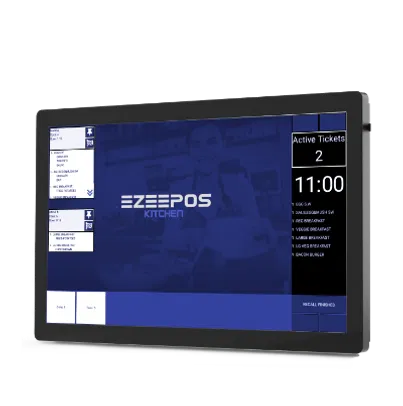
A modern Kitchen Display System integrates directly with your point-of-sale platform, such as an advanced eZeepos hospitality EPOS system, to replace paper rails with rugged, high-definition touchscreen monitors. The moment an order is entered at the bar or sent via a handheld ordering device, it appears instantly on the kitchen screen with zero lag, zero paper waste, and zero ambiguity.
Automated Order Routing and Station Load Balancing
In a traditional pub kitchen, every item prints on one master docket, forcing line cooks to mentally filter out what belongs to the grill, the fryer, or the salad station. A KDS utilizes intelligent station routing.
When a table orders a mix of starters, mains, and sides, the system automatically dispatches each item to its specific display screen:
- The fryer station receives precise drop times for chips and scampi.
- The grill station receives exact cooking preferences (medium-rare, well-done) for steaks and burgers.
- The dessert station holds pastry orders until mains are marked as cleared.
This eliminates cross-contamination of tasks and ensures that every element of a table’s order finishes simultaneously, preventing dishes from sitting under heat lamps while waiting for lagging stations.
Paper Dockets vs. Kitchen Display System: A Direct Comparison
| Operational Aspect | Paper Dockets | Kitchen Display System (KDS) |
|---|---|---|
| Order Visibility | Static snapshot; prone to being lost, stained, or blown off the rail | Dynamic, real-time digital queue with colour-coded timers |
| Allergen Alerts | Hand-written notes that are easily missed during a rush | High-contrast visual warnings and mandatory acknowledgement prompts |
| Station Routing | Manual sorting required by kitchen staff; high error rate | Automatic item routing to dedicated grill, fryer, and prep screens |
| Pacing & Timing | Relies entirely on chef memory and guesswork | Built-in ageing indicators and course-sequencing logic |
| FOH / BOH Communication | Requires verbal shouting or physical trips to the pass | Two-way status updates visible instantly across terminals |
| Consumable Costs | Ongoing monthly expenditure on thermal paper rolls and printer upkeep | Zero paper consumables; long-term hardware durability |

Bulletproof Allergen Management and Special Instructions
Under UK hospitality regulations, dietary requirements and allergen handling are non-negotiable. With paper dockets, a gluten-free request or dairy allergy is often jotted down in hurried shorthand, leaving plenty of room for dangerous misinterpretation during peak service hours.
A KDS transforms allergen safety into an infallible digital protocol. Critical dietary notes are highlighted in distinct, high-visibility colours on the screen. Furthermore, many advanced kitchen display systems can be configured to require a physical or tap-to-confirm acknowledgement from the chef before an order can be bumped or processed. This creates an unshakeable audit trail that protects your customers and shields your business from liability.
Data-Driven Kitchen Management: Stop Guessing, Start Measuring
You cannot improve what you do not measure. Paper dockets provide zero analytical feedback; once they hit the bin, their operational data is gone forever.
A KDS logs every second of kitchen performance automatically. Managers can pull comprehensive reports showing:
- Average Ticket Times (TT): Track exactly how long dishes take from order entry to completion across different day-parts.
- Station Bottlenecks: Identify whether your burger section or dessert station is holding up table turns.
- Staff Performance Trends: Assess workflow efficiency during peak versus quiet trading hours to optimize your staff scheduling.
My Take: Why Paper Belongs in the Past
Having consulted for dozens of independent pubs and hospitality groups across the UK, I have seen firsthand how resistance to technology holds venues back. Owners often worry about the initial hardware investment or staff retraining friction.
My recommendation is unequivocal: rip off the band-aid and ditch the paper. Within forty-eight hours of switching to a KDS, kitchen morale improves dramatically because the noise and confusion of physical dockets disappear. Service speeds increase by 20 to 35 percent, table turns become predictable, and your front-of-house teams spend less time chasing chefs and more time engaging with customers. In today's hyper-competitive pub market, that operational edge is priceless.
Frequently Asked Questions
Will my older kitchen staff struggle to learn a KDS touchscreen?
Not at all. Modern KDS interfaces are designed specifically for high-pressure hospitality environments with large touch targets, intuitive colour coding, and straightforward "bump bar" or touch-screen interactions. Most kitchen teams pick up the workflow within a single shift.
What happens to the KDS if our internet connection drops?
Robust EPOS and KDS setups operate on local network routing. Even if your external broadband connection fails, your front-of-house terminals and kitchen displays continue communicating seamlessly over your local router, ensuring service is never interrupted.
How difficult is it to integrate a KDS with our existing EPOS?
When you partner with an experienced UK provider like eZeepos, the KDS module is natively integrated into your core EPOS software. Setup involves connecting the touchscreen hardware to your local network, syncing your menu categories, and running a quick test workflow with your team.
Ready to Modernise Your Pub Kitchen?
Transform your kitchen operations, eliminate paper waste, and speed up table turns with an enterprise-grade EPOS and KDS solution tailored for independent UK venues.
- Phone: 01924 438238
- Email: sales@ezeepos.co.uk
- Website: www.ezeepos.co.uk
Recent Comments