
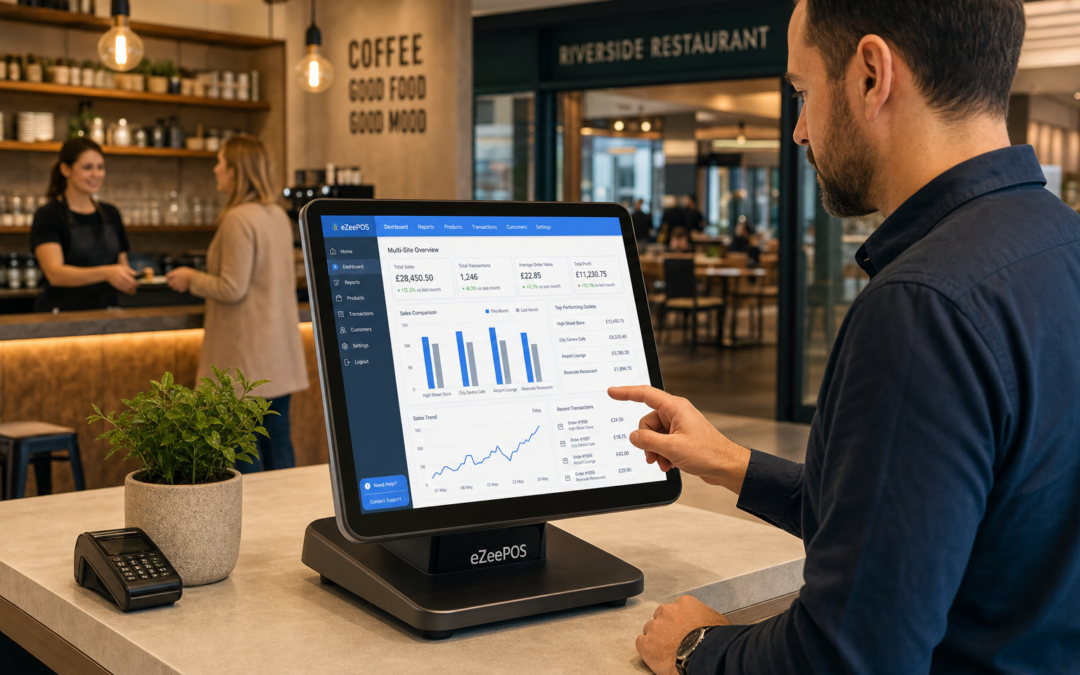
As a business grows, day-to-day reporting becomes more important, not less. What once worked for a single shop, cafe or takeaway can quickly become too limited when there are two, three or more sites to manage. That is where eZeePOS can help businesses keep a clearer view of sales and performance across different locations.
Multi-site reporting gives owners a practical way to compare trading patterns, understand where revenue is being made and spot issues before they become bigger problems. For UK retailers and hospitality businesses, it can take a lot of the guesswork out of running more than one branch.
What multi-site reporting actually helps you see
At its simplest, multi-site reporting brings sales information from different locations into one place. Instead of checking each branch separately, managers can review a broader picture and compare performance without relying on spreadsheets or manual collation.
That can be especially useful when each site has slightly different trading patterns. A cafe in one town may be busiest on weekday mornings, while another is stronger at weekends. A shop in a city centre may sell more lunch items, while a branch in a local parade may do better on everyday essentials. Multi-site reporting helps those differences become visible.
Useful information to compare across sites
- Daily and weekly sales totals
- Peak trading times by branch
- Best-selling products or menu items
- Average transaction values
- Staff or location performance trends
- Changes in trade over busy or quiet periods
For businesses with more than one site, this kind of information is not just useful for finance. It can also help with staffing, stock planning, promotions and customer service.
Why a single view matters for growing businesses
When you are focused on day-to-day trading, it is easy to look at each location in isolation. But growth decisions are usually made on the combined picture. A multi-site EPOS setup helps bring that picture together so owners can make clearer, quicker decisions.
For example, if one branch is consistently outperforming the others, you may want to look at staffing levels, opening hours, local demand or product mix. If another location is underperforming, it becomes easier to identify whether the issue is low footfall, different customer behaviour or something operational.
That does not mean every site should be run in the same way. In fact, one of the main benefits of multi-site reporting is that it shows where a location needs its own approach. A business can keep a consistent overall structure while still making practical decisions for individual branches.
How multi-site reporting supports retail
In retail, multi-site reporting can be particularly helpful for businesses with similar shops in different areas. That might include gift shops, fashion retailers, convenience stores or mixed-product businesses with more than one counter or branch.
A business owner can see which locations sell particular categories better, which days are busiest and whether promotional activity is working in the same way across all stores. It is a simple way to understand whether a product range is performing consistently or whether one location needs a different selection.
Examples of retail decisions it can support
- Adjusting opening hours for different branches
- Planning staffing around real trade patterns
- Reviewing which locations respond best to promotions
- Comparing basket size between branches
- Spotting seasonal differences from one store to another
For independent retailers, that is often the difference between making decisions based on instinct and making decisions based on evidence.
How multi-site reporting supports hospitality
In hospitality, the value is just as strong. Cafes, restaurants, bars and takeaways often have very different trading rhythms depending on location, local customers and opening times. A site near offices may peak during lunch, while another may be stronger in the evening or at weekends.
Multi-site reporting can help owners compare covers, order values and sales patterns across branches. That makes it easier to understand which site needs extra support, where certain menus perform best and how service is changing over time.
It can also help with quieter operational questions. For instance, if one branch has a lower average spend, is it because of the menu, the customer mix, or how items are being sold at the till? Having the numbers in one place makes those conversations far more practical.
Why this matters for day-to-day management
One of the biggest benefits of multi-site reporting is that it makes management feel less reactive. Instead of waiting until the end of the month to see what happened, owners can review trends more regularly and respond sooner.
That can help with:
- Budget planning
- Staff rota decisions
- Branch-by-branch performance reviews
- Identifying seasonal changes earlier
- Reducing time spent gathering figures manually
It also gives managers a better way to talk to teams. When performance data is clear, conversations can stay focused on what is happening in the business rather than on assumptions.
Keeping reporting simple as you expand
Not every growing business wants a complicated system. In many cases, the best reporting setup is one that is easy to read and simple to use. The aim is not to drown owners in data, but to give them the right figures at the right time.
That is why businesses often look for a modern EPOS system that can support multiple sites without making reporting harder to handle. A practical setup should help owners see the full picture quickly, while still allowing them to drill down into individual locations when needed.
If you are comparing options for retail or hospitality, it is worth thinking about how reporting will work not just now, but when the business grows again. A system that can grow with you may save time and stress later on.
Why UK businesses choose better reporting before they need it
Many businesses only realise the value of multi-site reporting after they have already struggled with manual processes. By that stage, it can mean wasted time, delayed decisions and less confidence in the numbers.
Planning for better reporting earlier gives owners a cleaner way to manage expansion. It also helps keep standards more consistent across branches, which is important when customers expect a similar experience wherever they visit.
If your business is starting to operate from more than one location, or you are preparing to open another site, it is worth reviewing how your reporting will work from day one. eZeePOS offers a practical UK EPOS option for businesses that want clearer visibility across retail and hospitality locations.
To explore how a modern EPOS setup could support your business, visit www.ezeepos.co.uk.
Contact YCR Distribution at sales@ezeepos.co.uk or call 01924 438238.
Recent Comments