

What is unified inventory? a guide for venues

Unified inventory is a centralised, real-time database that merges stock records from every channel and location into a single source of truth for your venue. In hospitality, that means your café counter, online ordering platform, and back-of-house storage all reflect the same stock figures at the same moment. For venue managers running busy services across multiple touchpoints, this single view is the difference between confident operational decisions and costly guesswork. Understanding what is unified inventory, and how it applies to your venue, is the first step toward tighter margins and fewer service failures.
What is unified inventory and how does it work?
Unified inventory management is built on a central data model that assigns standardised SKUs and consistent stock attributes to every item across your venue. Whether a bottle of house wine is sold at the bar, through a table ordering app, or via a click-and-collect service, the system recognises it as the same product and deducts from the same stock count.
The core mechanism is real-time transaction processing. Stock updates synchronise across platforms in under 5 seconds, which is fast enough to prevent double-selling during a busy Friday evening service. That speed matters most when you are running simultaneous sales channels and cannot afford to promise a customer something you no longer have.
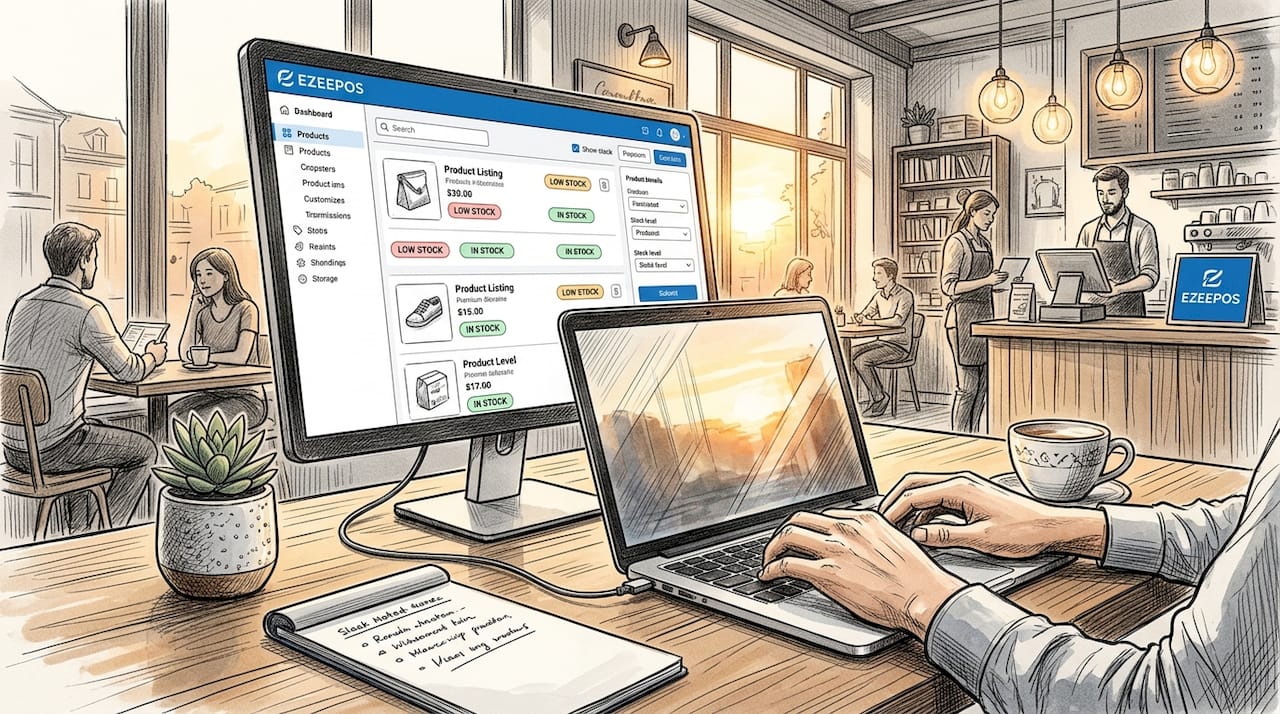
Integration is delivered through APIs that connect your point of sale, warehouse records, and any online sales platforms into one shared data layer. Physical controls sit alongside the digital layer. Barcodes and RFID tags combined with consistent bin labelling reduce human error and keep your physical stock aligned with what the system shows.
Key components of a unified inventory system include:
- Central data model: Standardised SKUs and product attributes shared across all sales channels and locations
- Real-time sync: Transaction data processed and reflected across all platforms within seconds
- API integrations: Connections between your POS, online ordering, and supplier systems
- Physical controls: Barcodes, RFID, and bin labelling to reconcile digital records with physical stock
- Conflict resolution: Automated logic that handles simultaneous sales to prevent overcommitments
Pro Tip: Before you connect any system, audit your existing SKU list. Duplicate or inconsistent product codes are the single most common reason a new unified system produces inaccurate results from day one.
What are the key benefits of unified inventory management?
The most direct benefit is the elimination of invisible inventory. Invisible inventory refers to stock that exists in your records but is unavailable, misplaced, or already committed elsewhere. Centralising inventory reduces reconciliation labour and improves stock allocation, cutting both stockouts and excess safety stock across your venue.
Here is how those benefits play out in practice for a hospitality venue:
- Fewer overselling errors. When a customer orders the last portion of a dish online at the same moment a table orders it in person, the system resolves the conflict instantly rather than leaving your team to apologise.
- Reduced manual reconciliation. Staff no longer need to cross-check spreadsheets between your bar, kitchen, and online platform at the end of each shift.
- Lower carrying costs. Retailers report improved cash flow and lower inventory carrying costs when redundant safety stock across multiple locations is removed. For a restaurant group with three sites, that freed capital is material.
- Faster fulfilment. Your team knows exactly what is available and where, so orders move from receipt to delivery without unnecessary delays or stock checks.
- Omnichannel confidence. Synchronised inventory enables flexible fulfilment from stores and warehouses, supporting click-and-collect and delivery models that are now standard expectations for UK hospitality venues.
Centralising your inventory also shifts responsibility clearly. A dedicated team focused on receiving and replenishing stock frees your front-of-house staff to concentrate on service quality rather than stock queries. That separation of duties is a structural advantage most venue managers underestimate.
Unified inventory vs. decentralised inventory: what is the difference?
The practical gap between unified and decentralised inventory management is wider than most venue managers expect. The table below captures the key contrasts.
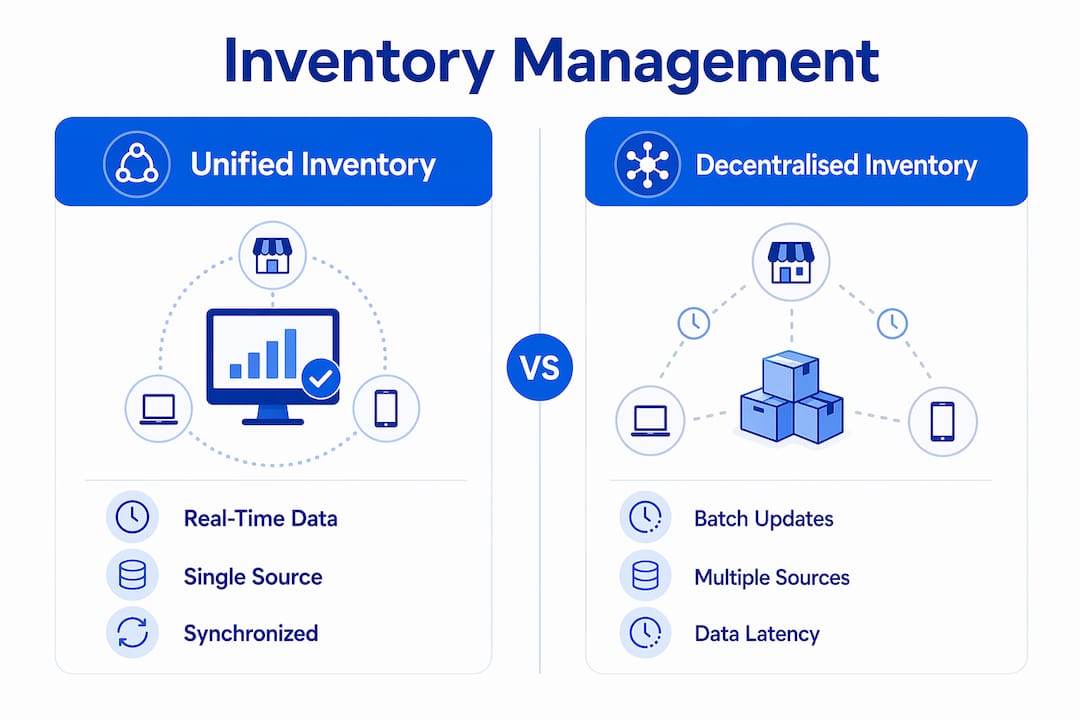
| Factor | Unified Inventory | Decentralised Inventory |
|---|---|---|
| Data source | Single, shared real-time record | Multiple siloed records per location |
| Update speed | Under 5 seconds across all channels | Batch updates, often hours apart |
| Overselling risk | Minimal, resolved automatically | High, especially during peak service |
| Staff coordination | Low overhead, shared visibility | High overhead, frequent manual checks |
| Forecasting accuracy | Strong, based on clean unified data | Weak, distorted by inconsistent records |
| Multichannel visibility | Full, instant | Partial, delayed |
Decentralised systems create latency. A batch update that runs every few hours means your online menu may show stock that sold out at lunchtime. That gap between digital record and physical reality is where customer complaints and wasted prep time originate.
A single source of truth reduces coordination overhead and aligns purchasing, warehousing, and sales around shared performance metrics. For a hotel with a restaurant, a bar, and a room service operation, that alignment means all three departments pull from the same stock data rather than maintaining separate counts that drift apart over a busy weekend.
Pro Tip: If your venue currently reconciles stock manually at the end of each day, calculate the staff hours spent on that task each week. That number is your baseline cost of decentralised inventory and your clearest argument for change.
How to implement a unified inventory system in your venue
Implementation succeeds or fails on data quality before technology. Rigorous SKU standardisation across channels is required before unification, because automating inconsistent data simply scales your existing errors.
Follow these steps to build a solid foundation:
- Cleanse your product data first. Audit every SKU, remove duplicates, and agree on a single naming convention before connecting any system.
- Establish a cycle count cadence. Regular physical cycle counts ensure your digital record reflects actual physical stock, correcting for theft, loss, or miscounts before they compound.
- Select systems with fast conflict resolution. Top platforms handle simultaneous multi-channel sales automatically, preventing overcommitments on popular or scarce items. Confirm this capability before committing to any software.
- Pilot in one high-impact area. Start with your busiest sales channel, whether that is your bar, your online ordering platform, or your kitchen. Prove the model before rolling it out across all locations.
- Build process discipline into your team. Technology alone does not maintain accuracy. Staff must follow receiving procedures, scan items correctly, and flag discrepancies in real time.
The most common mistake venue managers make is treating a unified inventory system as a one-off purchase. Long-term value requires continuous management and process discipline. The system is only as accurate as the data your team puts into it each day.
Applying unified inventory to daily hospitality operations
The advantages of unified inventory management become concrete when you map them to the workflows your team runs every day. For a café, the role of POS in inventory control is central: every sale at the counter automatically deducts from the same stock count that your morning prep team and your online ordering platform share.
Practical applications across hospitality venues include:
- Automatic stock deductions at point of sale. When a barista sells the last almond croissant, the system updates immediately. Your online menu removes it within seconds rather than after a manual check.
- Click-and-collect and delivery integration. A restaurant accepting online pre-orders for Sunday lunch can commit stock to those orders in real time, preventing the kitchen from overselling covers.
- Waste reduction through accurate forecasting. Clean, unified data gives your purchasing team a reliable picture of consumption patterns, so you order closer to actual demand rather than building in excessive safety stock.
- Labour allocation improvements. When staff are not chasing stock discrepancies or manually reconciling counts, those hours redirect to service. For a busy bar on a Saturday night, that reallocation is measurable.
- Unified dashboards for performance monitoring. Managers at multi-site venues can view stock levels, sales velocity, and fulfilment performance across all locations from a single screen, supporting faster decisions on transfers and reorders.
For hotel operations, centralised inventory and real-time databases directly improve responsiveness across restaurant, bar, and room service departments. The benefits of inventory management extend beyond stock accuracy to cover staff efficiency, supplier relationships, and guest satisfaction.
Key takeaways
A unified inventory system is the single most effective operational change a hospitality venue can make to eliminate stock discrepancies, reduce wasted labour, and protect profit margins across all sales channels.
| Point | Details |
|---|---|
| Definition is precise | Unified inventory is a real-time, centralised database merging all stock records into one source of truth. |
| Speed prevents overselling | Stock updates synchronise in under 5 seconds, stopping double-selling across simultaneous channels. |
| Data quality comes first | Clean, standardised SKUs and regular cycle counts are required before any system delivers accurate results. |
| Benefits are operational and financial | Venues gain lower carrying costs, less reconciliation labour, and stronger omnichannel fulfilment capability. |
| It requires ongoing discipline | Unified inventory is a continuous capability, not a one-off installation. Process discipline sustains accuracy. |
Why most venues get unified inventory wrong
I have worked with enough hospitality operators to know that the conversation about unified inventory almost always starts in the wrong place. Managers ask which software to buy. The real question is whether their product data is clean enough to unify.
The misconception that buying software solves inventory problems is widespread. The true benefit lies in adherence to data standards and ongoing integrations that keep records accurate. I have seen venues invest in capable systems and still run manual reconciliations every morning because nobody standardised the SKU list before go-live.
The other thing most articles will not tell you is that unified inventory changes your team’s behaviour as much as it changes your technology stack. When staff know that every scan and every sale updates a shared record, accountability shifts. Shrinkage becomes visible. Receiving errors surface quickly rather than hiding in a spreadsheet for weeks.
My honest view is that the venues getting the most value from unified inventory in 2026 are not necessarily the ones with the most sophisticated software. They are the ones where a manager made data discipline a non-negotiable part of the daily opening and closing routine. The technology is the easy part. The culture is where the work is.
— John
How Ezeepos supports unified inventory for UK venues
Ezeepos builds its POS platform specifically for UK hospitality venues, with inventory management integrated directly into the point of sale rather than bolted on as an afterthought. Every sale updates your stock count in real time, whether it comes from a counter terminal, a tablet, or a self-service kiosk.
For cafés and restaurants looking to connect their front-of-house sales with accurate back-of-house stock records, Ezeepos provides the integration layer that makes unified inventory practical rather than theoretical. The platform runs on Android hardware, carries no tiered pricing restrictions, and is installed and supported by accredited UK providers. If you are ready to move beyond spreadsheets and manual counts, explore the Ezeepos café POS solution and see how it fits your venue’s operation.
FAQ
What is unified inventory in simple terms?
Unified inventory is a single, real-time stock record that combines data from all your sales channels and locations into one accurate database. It prevents discrepancies such as overselling by updating every platform the moment a sale occurs.
How does unified inventory differ from standard stock management?
Standard stock management often relies on separate records per location or channel, updated in batches. Unified inventory synchronises all records instantly, eliminating the gaps where overselling and reconciliation errors occur.
What are the main benefits of unified inventory for hospitality venues?
The primary advantages of unified inventory include fewer overselling errors, reduced reconciliation labour, lower inventory carrying costs, and the ability to support omnichannel fulfilment such as click-and-collect and delivery orders.
How long does it take to implement a unified inventory system?
Implementation timelines vary by venue size and data quality, but most venues benefit from piloting in one area first. Clean product data and standardised SKUs before go-live are the factors that most directly determine how quickly the system delivers accurate results.
Does a unified inventory system require specialist staff to manage?
No specialist staff are required, but the system does need consistent process discipline from your existing team. Staff must follow correct receiving and scanning procedures daily to maintain the accuracy that makes unified inventory valuable.
Recent Comments