
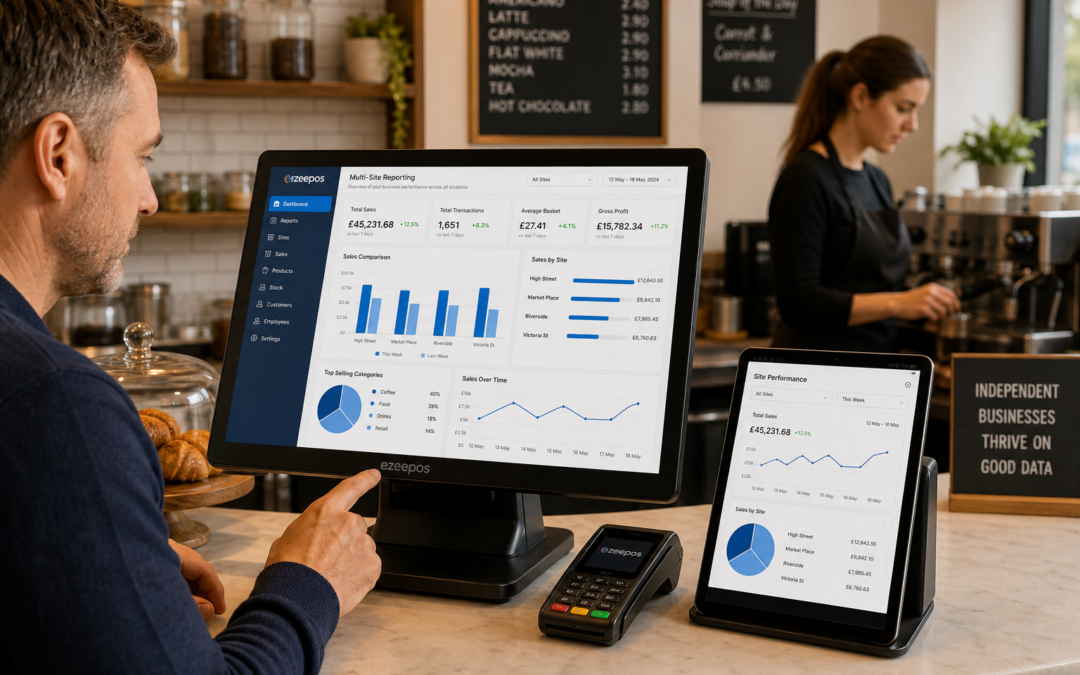
For independent businesses with more than one location, it can quickly become harder to get a clear picture of performance by relying on spreadsheets, emailed reports or end-of-day totals alone. Multi-site reporting brings sales data together in one place, making it easier to compare branches, understand performance and keep day-to-day decisions grounded in facts.
At eZeePOS, we work with UK retail and hospitality businesses that want a practical, easy-to-use EPOS setup rather than a complicated system that creates more admin. If you are managing a small group of shops, cafés, restaurants or takeaway sites, multi-site reporting can save time and help you stay closer to what is happening across the business.
Why multi-site reporting matters
When businesses open a second or third location, the challenge is rarely just about taking payments or recording sales. The bigger issue is visibility. Without a central view, owners may not notice that one branch is outperforming another, that certain trading hours vary by site, or that a simple operational change could improve results.
Multi-site reporting helps bring those details together in a practical way. Instead of checking each location separately, you can review performance across the whole business and see how each branch contributes. That can be especially useful for independent owners who are still closely involved in the day-to-day running of the business.
What you can learn from location-by-location reporting
A good reporting setup should do more than list turnover. It should help you understand how each site is trading and where attention may be needed.
Compare sales patterns across branches
Some locations may trade more strongly at lunchtime, while others perform better in the evenings or on weekends. Looking at each site side by side can help you spot trends that are easy to miss in overall business totals. That can be useful when planning staffing, opening hours or promotions.
See where menu or product mixes differ
In hospitality, one branch may sell more hot drinks while another sees stronger food sales. In retail, product ranges may perform differently depending on the local customer base. Multi-site reporting helps owners understand these differences and respond accordingly.
Track performance without relying on guesswork
It is not always obvious which site is strongest or which one may need extra support. Reporting gives you a clearer starting point for follow-up conversations with managers and supervisors, so decisions are based on data rather than assumptions.
How it supports day-to-day management
Multi-site reporting is not only useful for end-of-month reviews. It can also support daily and weekly management decisions across the business.
Better oversight for owners and managers
If you are responsible for several locations, it is valuable to know how each branch is performing without needing to visit every site in person. A central reporting view can make it easier to stay informed and focus your time where it is most needed.
More consistent decision-making
When each branch works from the same EPOS system, reporting becomes easier to compare. That can help with decisions around pricing, promotions, staffing and trading hours, because everyone is looking at the same information.
Faster response to changes in trade
If one site starts performing differently, it is easier to notice sooner. That means you can investigate whether the change is seasonal, operational or customer-led before it becomes a bigger issue.
Multi-site reporting for retail businesses
For independent retailers, multi-site reporting can be especially useful when stores have slightly different customer bases or layouts. A busy convenience store in one area may trade very differently from a gift shop or fashion branch elsewhere.
With a central reporting view, retailers can compare turnover, identify branch-level trends and understand which products or departments are contributing most to sales. That can help when planning stock ranges, seasonal displays and staffing levels, although the main value is often in general business visibility rather than deep stock analysis alone.
It can also help owners keep branch managers aligned. When every store is working towards the same goals, shared reporting makes it easier to discuss performance in a clear and constructive way.
Multi-site reporting for cafés, restaurants and takeaways
In hospitality, small differences between sites can have a big effect. One restaurant may have stronger weekday lunches, while another depends more on evening trade or weekend bookings. A takeaway may see its busiest periods at different times depending on local demand.
Multi-site reporting helps hospitality businesses understand these patterns more clearly. It can support planning around staffing, table capacity, opening hours and service focus. For example, if one branch consistently performs best during a specific trading window, that may influence how you schedule labour and prepare for busy periods.
For multi-site hospitality groups, having a single EPOS platform also helps reduce the need to piece together reports from different systems, which can save time at the end of each day or week.
Making reporting easier to use
Reporting only becomes useful if it is practical to access and understand. That is why many growing businesses prefer a system that presents information in a straightforward way.
- Clear branch-by-branch sales views
- Consistent reporting across locations
- Simple comparisons for busy periods, days and trading patterns
- Less time spent pulling data together manually
- Better visibility for business owners and managers
When reporting is built into the EPOS system, it becomes part of everyday business management rather than an extra task that gets left until the end of the month.
Why it suits growing independent businesses
Many independent businesses reach a point where a basic till or disconnected setup no longer gives enough visibility. Once more than one branch is involved, the need for clear reporting becomes much more important.
That is where a practical system such as eZeePOS can help. It is designed to support UK retailers and hospitality businesses that want better day-to-day control without unnecessary complexity. If you are planning to expand, or already manage several sites, multi-site reporting can be a useful part of a wider EPOS setup.
It is not about making reporting more complicated. It is about making it easier to see what is happening across the business so you can act with more confidence.
Choosing the right approach for your business
Not every multi-site operation needs the same level of reporting detail. A small group of cafés may want straightforward branch comparisons, while a multi-location retailer may need a broader view across different departments or locations. The key is to choose a system that suits how you work now, while leaving room to grow.
If your current setup makes it difficult to compare branches, check performance or keep all locations aligned, it may be time to look at a more joined-up EPOS solution. That can make life easier for managers, staff and owners alike.
For more information about EPOS options for UK retail and hospitality businesses, visit www.ezeepos.co.uk. Contact YCR Distribution at sales@ezeepos.co.uk or call 01924 438238.
Recent Comments